US-EU Trade Standoff Deepens Over Greenland and Tariff Threats
A Trade Deal Becomes Collateral in a Geopolitical Confrontation
The European Union has suspended a major trade agreement with the United States, marking a sharp escalation in transatlantic tensions. The decision, announced on January 21, 2026, reflects growing European alarm over President Donald Trump’s renewed push to acquire Greenland and his accompanying threats of punitive tariffs against multiple European countries.
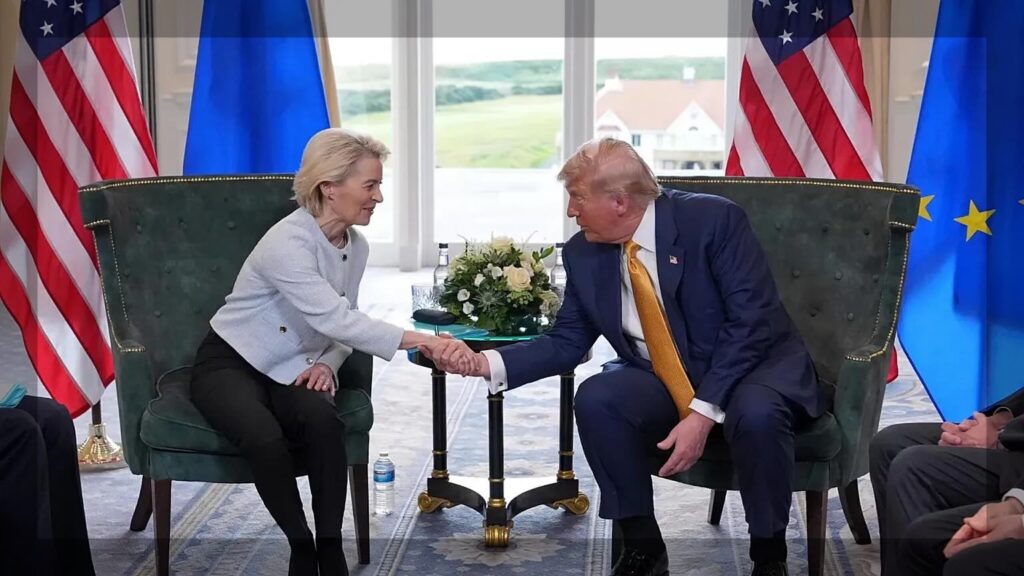
The suspension halts the ratification of the so-called “Turnberry Agreement,” concluded in July 2025 at Trump’s Turnberry resort in Scotland. What was initially framed as a stabilising truce in a strained trade relationship has now become entangled in a broader geopolitical dispute that extends far beyond tariffs and market access.
The Turn-berry Agreement and Its Fragile Promise
A Deal Designed to Pause Trade Hostilities
The Turnberry Agreement aimed to ease long-standing trade frictions by eliminating tariffs on a wide range of US industrial goods and select agricultural products, including lobsters. In return, the United States would impose a capped 15 percent tariff on most European exports.
At the time, the deal was viewed as a pragmatic compromise. It offered relief to manufacturers, exporters, and agricultural producers on both sides of the Atlantic amid slowing global growth and mounting uncertainty. Nevertheless, European lawmakers remained uneasy, viewing the arrangement as asymmetrical and disproportionately favourable to Washington.
These reservations came to a head when the European Parliament’s International Trade Committee voted to indefinitely postpone ratification.
Sovereignty, Tariffs, and the Breaking Point
Europe Pushes Back Against Economic Coercion
Bernd Lange, chair of the International Trade Committee, framed the suspension in stark terms. He accused the United States of undermining stable trade relations by threatening the territorial integrity of an EU member state and wielding tariffs as a coercive instrument.
According to Lange, work on the agreement will remain frozen until Washington abandons confrontation and returns to cooperation. This position reflects a broader European view that Trump’s tactics amount to economic blackmail, placing alliance norms and international trust at risk.
Greenland at the Centre of the Storm
Strategic Minerals and Arctic Power Politics
The immediate trigger for the trade freeze lies in President Trump’s renewed fixation on Greenland. Speaking at the World Economic Forum in Davos, Trump described US acquisition of the island as a “small ask,” citing decades of American security support to Denmark and NATO.
Greenland’s strategic value is undeniable. It possesses vast reserves of rare-earth minerals essential for advanced technology and defence systems. Its Arctic location is becoming increasingly important as melting ice opens new shipping routes and intensifies competition with Russia and China.
To pressure Europe, Trump threatened tariffs of 10 percent on goods from Denmark, Sweden, Norway, France, Germany, the Netherlands, Finland, and the United Kingdom starting February 1. He warned these could rise to 25 percent by June if European governments block the acquisition.
Although Trump has ruled out military force, the rhetoric has unsettled allies, reviving memories of his 2019 proposal to buy Greenland, which Denmark dismissed at the time as absurd.
Europe’s Collective Response
Countermeasures and Strategic Signalling
The European Union has responded with unusual unity. Beyond suspending the trade agreement, officials are considering activation of the bloc’s anti-coercion instrument. This mechanism allows retaliatory measures, including tariffs on up to €93 billion worth of US exports and restrictions on American services.
French President Emmanuel Macron has proposed NATO exercises in Greenland as a visible signal of European resolve. Meanwhile, Commission President Ursula von der Leyen has warned that such threats strike at the heart of Europe’s security and prosperity.
An emergency EU summit in Brussels is expected to assess economic retaliation, security coordination, and diplomatic escalation.
Economic Ramifications of the US-EU Trade Standoff
Growth, Trade, and GDP at Risk
The suspension of the trade pact, combined with threatened tariffs, raises the spectre of a broader trade war. Economic modelling based on previous US tariff episodes suggests EU exports to the United States could fall between 3.9 and 8.7 percent. Germany, Europe’s largest exporter, could see declines ranging from nearly 10 percent to over 21 percent.
EU GDP could contract by 0.1 to 0.5 percent, while the US economy might shrink by 0.2 to 0.7 percent if retaliation intensifies. Global trade volumes could fall by nearly 5 percent relative to GDP, reducing worldwide output by around 0.3 percent. Similar dynamics played out during Trump’s first-term tariff actions, which cut US GDP by roughly 0.5 percent even before retaliation was factored in.
Should the EU fully deploy its anti-coercion instrument, the consequences would deepen. Reciprocal measures could mirror the destructive pattern seen in US-China trade disputes, where welfare losses compounded as supply chains fragmented.
Inflation, Markets, and Financial Stress
Costs Passed to Consumers and Investors
Tariffs act as an indirect tax, pushing up prices and squeezing household budgets. In the United States, broad tariffs could impose costs approaching $400 billion, equivalent to about 1.3 percent of GDP. Inflation could rise by 0.1 to 0.2 percentage points, eroding purchasing power.
In Europe, retaliatory measures may limit US access to financial infrastructure, increasing funding costs for American firms and banks. Financial markets have already shown signs of strain, with equity volatility, bond market fluctuations, and pressure on the US dollar as political risk premiums rise.
A prolonged confrontation could amplify instability. Europe’s roughly $8 trillion in US asset holdings gives it leverage that, if deployed, could significantly unsettle American financial markets.
Who Bears the Economic Burden
Uneven Pain Across Societies
The costs of escalation would not be evenly shared. Consumers in the United States would face higher prices for cars, electronics, food, and everyday goods, effectively absorbing a massive tax increase. European consumers would feel the impact through higher prices on American imports and reduced choice.
Businesses on both sides would confront disrupted supply chains, higher input costs, and lost market access. European automotive, chemical, and agricultural exporters are particularly exposed, while US firms in technology, energy, and agriculture risk retaliation affecting up to $100 billion in exports.
Employment would suffer as production slows. Global employment could decline by around 0.58 percent, with manufacturing workers bearing the brunt. Trade-exposed economies such as Germany, Norway, and the United Kingdom face disproportionate GDP losses, while Denmark and Greenland confront added political and sovereignty uncertainty.
Strategic and Alliance Consequences
Trust Erodes as Trade Meets Security
Beyond economics, the standoff strains the foundations of the transatlantic alliance. NATO cohesion could weaken as economic coercion spills into security cooperation. The dispute complicates joint responses to Arctic competition with Russia and China, precisely when coordination is most needed.
Over the long term, the confrontation may accelerate Europe’s pursuit of strategic autonomy, reducing reliance on US partnerships and reshaping global trade architecture.
An Arctic Chill Spreading Across the Atlantic
Denmark has firmly rejected any sale of Greenland, while the territory’s government has issued crisis guidelines to residents amid rising uncertainty. As markets react and diplomacy hardens, the dispute underscores how quickly trade, sovereignty, and security can collide.
Whether Trump’s deal-making strategy yields concessions or further fractures the post-war transatlantic order remains uncertain. For now, the chill emanating from the Arctic has reached far beyond Greenland, freezing trust at the very core of US-EU relations.