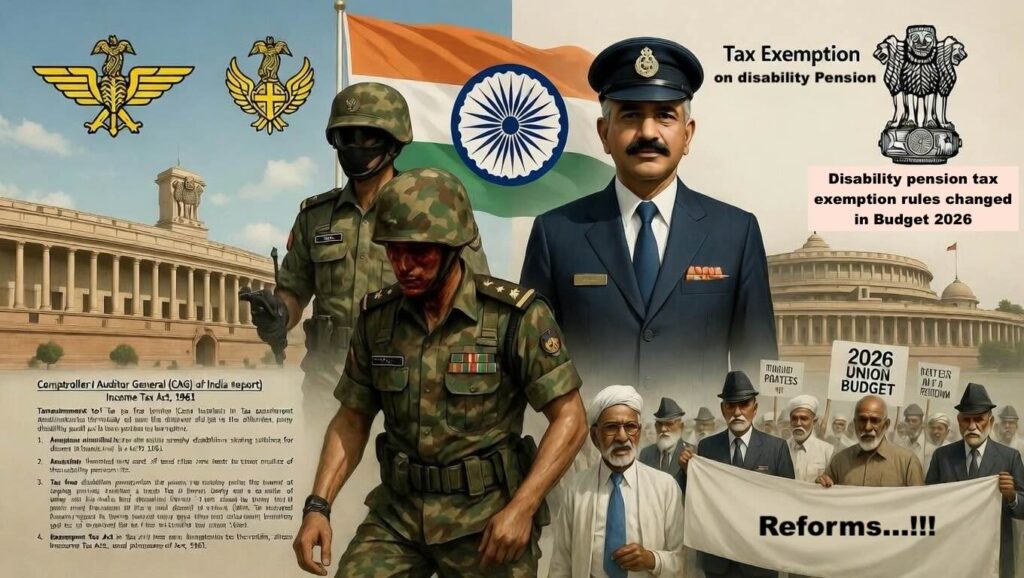
Disability Pension Tax Exemption and the 2026 Budget: Justice or Discrimination?
The recent amendment to the disability pension tax exemption under the Union Budget 2026–27 has triggered a debate among India’s armed forces veterans. For decades, this exemption symbolised national gratitude towards injured soldiers. However, the new provision restricts this benefit only to those invalided out of service. As a result, personnel who retire normally, despite service-related disabilities, now face taxation. This policy shift raises serious questions about equity, morale, and institutional ethics.
Historical Basis of Disability Pension Tax Exemption
Since the Income-tax Act of 1922, India has recognised disability pensions as deserving special protection. This recognition continued under the 1961 Act and subsequent notifications. For nearly a century, armed forces personnel receiving disability pensions enjoyed full tax exemption.
This exemption applied irrespective of retirement mode. Whether a soldier was invalided out early or retired after full service, the entire pension remained tax-free. Therefore, both the service element and the disability element were treated as a unified benefit.
Over time, this arrangement became part of the psychological contract between the state and its soldiers. It reassured personnel that injuries sustained in national service would never become a financial burden.
Structure of Disability Pension in Armed Forces
A disability pension comprises two distinct components.
Service Element: The service element represents the normal pension based on rank, pay, and years of service. For most government employees, this portion is taxable.
Disability Element: The disability element provides additional compensation for injuries or illnesses attributable to military duty. This component reflects recognition of physical and mental sacrifices.
Earlier, when these two elements were combined, the entire amount enjoyed tax exemption. Consequently, recipients paid no income tax on their pension.
Emerging Patterns and Policy Concerns
During the last two decades, oversight agencies and defence authorities observed worrying trends.
Rising Claim Ratios
A 2023 CAG report observed that roughly 36–40% of retiring officers and 15–18% of PBOR personnel were being granted disability pensions. These figures appeared unusually high when compared with earlier periods.
Such patterns suggested that not all claims originated from battlefield injuries or severe operational hazards.
Expansion of Lifestyle Disease Claims
Many applications involved diabetes, hypertension, cardiac ailments, and back disorders. Claimants often cited service stress as aggravating factors.
While military life is undoubtedly demanding, critics argued that these conditions increasingly mirrored civilian health patterns. As a result, the distinction between genuine service injuries and general ailments became blurred.
End-of-Career Medical Downgrading
Another concern involved late-stage medical downgrades. Some senior officers reportedly sought disability certification shortly before retirement.
This practice enabled them to convert high service-based pensions into fully tax-free packages. In several cases, claims emerged 15 to 20 years after initial service exposure.
The Supreme Court, in multiple observations, described such delayed claims as potential abuse of policy.
The 2026 Budget Amendment: What Has Changed
The Union Budget 2026–27 introduced a decisive shift in pension taxation.
Under the amended law, full disability pension tax exemption applies only to personnel invalided out due to service-related disabilities. This rule takes effect from April 1, 2026.
For those retiring on superannuation:
- The service element becomes taxable.
- The disability element may receive limited relief.
- The blanket exemption no longer applies.
In essence, only soldiers whose careers ended prematurely due to injury will enjoy full tax benefits.
Government’s Rationale Behind the Reform
The government has advanced three primary justifications.
Curbing Systemic Misuse
Authorities argue that the earlier regime incentivised strategic behaviour. Some personnel continued service despite moderate disabilities in order to maximise tax-free pensions.
The new rule seeks to realign benefits with original intent.
Fiscal Discipline
Disability pensions already carry higher financial outflows. When combined with tax exemptions, the burden increases substantially.
By narrowing eligibility, policymakers aim to ensure targeted welfare without unsustainable expenditure.
Responding to Institutional Feedback
CAG audits, judicial observations, and defence leadership inputs consistently flagged loopholes. Therefore, embedding the restriction in legislation provides legal clarity and administrative consistency.
Veterans’ Perspective and Moral Dilemmas
Despite official reasoning, veterans have voiced strong objections.
Many argue that the policy penalises resilience. Soldiers who continued serving despite injuries now face taxation, while those discharged early receive full exemption.
This creates an ethical paradox. Perseverance and dedication appear financially discouraged.
Furthermore, combat and counter-insurgency environments often compel personnel to suppress injuries. Continuing service is frequently driven by unit loyalty and professional commitment.
Under the new regime, such sacrifices receive limited recognition.
Impact on Military Morale and Recruitment
Military institutions depend heavily on morale and trust.
If personnel perceive welfare systems as unpredictable, long-term confidence erodes. Young officers may become risk-averse, fearing future financial insecurity.
In addition, the amendment may influence medical reporting behaviour. Personnel might prefer early invalidation rather than continued service.
Such unintended consequences could affect operational efficiency.
Legal and Policy Implications Ahead
The 2019 CBDT circular faced strong resistance and legal challenges. A similar trajectory remains possible for the 2026 amendment.
Veterans’ associations may pursue judicial review on grounds of equality and legitimate expectation. Courts will need to balance fiscal prudence against constitutional fairness.
Simultaneously, policymakers may consider graded exemptions based on disability severity and service length.
Such calibrated approaches could preserve both integrity and equity.
Rebalancing Integrity and Gratitude
The disability pension tax exemption was never designed as a financial loophole. It symbolised national respect for wounded soldiers.
However, unchecked expansion diluted its moral foundation. Reform was therefore inevitable.
Yet, sustainable reform must distinguish between misuse and merit. Blanket restrictions risk undermining genuine dedication.
A balanced framework should reward both sacrifice and perseverance. Only then can India honour its armed forces without compromising administrative integrity.