Bondi Beach Shooting: What Investigators Know Three Days On
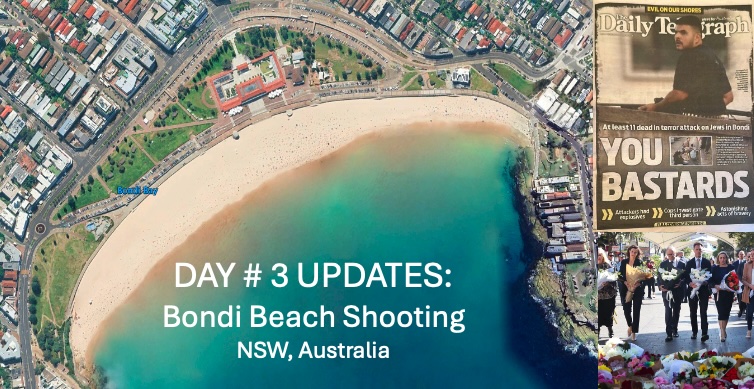
Sydney continued to mourn on Tuesday as investigators intensified their probe into the Bondi Beach shooting, three days after the attack left 15 people dead and pushed Australia into its gravest national security reckoning in nearly three decades. The mass shooting, which occurred during a Hanukkah gathering near the Bondi Pavilion on December 14, has been officially classified as a terrorist attack, with authorities pointing to ideological extremism as the driving force.
The attack has shaken Australia’s sense of public safety and reopened debate on gun licensing, intelligence monitoring, and radicalisation pathways within the country.
What Happened at Bondi Beach
Police confirmed that a father and son opened fire on a crowd assembled for a Jewish religious event at one of Sydney’s most iconic public spaces. Fifteen civilians were killed, including women, children and elderly attendees, while more than two dozen others were injured. Officers responding to the scene shot dead 50-year-old Sajid Akram, while his 24-year-old son, Naveed Akram, was critically wounded and remains under police guard in hospital.
Authorities recovered extremist material from the attackers’ vehicle and nearby locations, strengthening the assessment that the shooting was premeditated and ideologically motivated, rather than an impulsive act of violence.
Background of the Gunmen Comes into Focus
Investigators in India have confirmed that Sajid Akram was originally from Hyderabad, India, and migrated to Australia in 1998. He continued to hold an Indian passport and had limited interaction with relatives in India over the past two decades. Indian police officials, speaking after coordination with Australian authorities, said Akram had no known criminal record or history of radical activity in India and maintained minimal family contact.
The younger attacker, Naveed Akram, was born and raised in Australia. Security agencies disclosed that he had previously come to the attention of intelligence officials several years ago but was not assessed as posing an immediate threat at that time. This disclosure has prompted renewed scrutiny of how individuals previously reviewed by intelligence agencies can later carry out large-scale violence.
Overseas Travel and Radicalisation Questions
A critical focus of the Day-3 investigation is the attackers’ recent overseas travel, particularly a trip to the Philippines in November 2025. Australian police and intelligence agencies are examining whether the journey played a role in further radicalisation or tactical preparation. While investigators have not confirmed direct operational links to foreign terror groups, officials acknowledged that the region visited has a long history of extremist activity.
Authorities stressed that the investigation remains ongoing and cautioned against speculation, while confirming that international intelligence cooperation has intensified since the attack.
Gun Licence System Under National Scrutiny
The Bondi Beach shooting has ignited renewed debate over Australia’s gun control framework. Despite the country’s strict post-Port Arthur gun laws, it has emerged that Sajid Akram legally held multiple firearms, all obtained through licensed channels. This revelation has triggered public anger and political pressure to reassess firearm licensing standards, background checks, and post-approval monitoring.
Prime Minister Anthony Albanese said the government would examine whether existing laws adequately address evolving security threats, signalling that tighter gun ownership rules could be considered in the coming weeks.
Community Grief and National Response
Across Sydney, vigils and memorial services continued as families grieved the victims of the Bondi Beach shooting. Jewish community leaders described the attack as a devastating act of antisemitic violence, while political leaders called for unity and resilience in the face of extremism.
Security has been visibly increased around places of worship, public events and transport hubs nationwide, as authorities work to reassure a shaken public.
What Comes Next
Three days on, the Bondi Beach shooting remains under intensive investigation, with authorities working to establish the full chain of radicalisation, planning, funding money trails, logistics support and activities carried out by the shooters in Philippines and systemic failures that allowed the attack to occur. As Sydney mourns, Australia faces difficult questions about terror prevention, firearm oversight, and intelligence coordination in an increasingly complex threat environment.
Further updates are expected as investigators release more findings and the condition of the surviving attacker evolves.