Bondi Beach Hanukkah Massacre: Father-Son Terror Duo Unmasked, Guns Were Legal, Albanese Clashes with Netanyahu
By Tattvam News Staff
Sydney, Australia – December 15, 2025
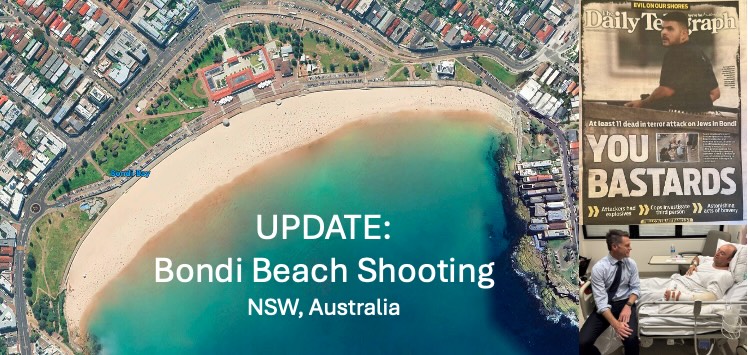
Australia is confronting one of its darkest security failures after investigators confirmed that the Bondi Beach Hanukkah terror attack was carried out by a radicalised father and son acting together. What began as a public Jewish celebration titled “Chanukah by the Sea” descended into mass murder within minutes. 16 people were killed, including a child and a Holocaust survivor, while at least 29 others were injured.
The attack, which unfolded on the evening of December 14 near the Bondi Pavilion, is now officially classified as a terrorist act targeting the Jewish community. Authorities insist there are no additional suspects. However, the political, security, and social repercussions are intensifying both domestically and internationally.
The Akram Father-Son Duo: Bondi Beach Hanukkah Terror Attack – A Case Study in Familial Radicalisation
Police have identified the attackers as Sajid Akram (50, killed) and his son Naveed Akram (24, injured) from Bonnyrigg, south-western Sydney. Sajid, a Pakistani-born permanent resident (PR), arrived in Australia in 1998 on a student visa. He later married an Italian-Australian citizen and worked for years as a bricklayer.
Despite outward normalcy, investigators now confirm that the household became a closed ideological echo chamber. Naveed Akram was already known to ASIO after a 2019 investigation into his links with an ISIS-influenced network operating in Sydney. At that time, he was assessed as “not an immediate threat”.
That assessment is now under intense scrutiny.
Forensic teams discovered ISIS flags, extremist propaganda, and encrypted communications inside the attackers’ vehicle. Security experts note that family-based radicalisation accelerates commitment, removes dissent, and bypasses early warning mechanisms. Comparisons are being drawn to past terror attacks where kinship reinforced ideological extremism.
Sajid Akram was shot dead by police at the scene. Naveed Akram remains in critical condition under armed guard and is expected to face terrorism charges upon recovery.
Legally Owned Guns, Illicit Intent: Australia’s Gun Law Paradox
One of the most disturbing elements of the Bondi Beach Hanukkah terror attack is that all firearms used were legally owned. Sajid Akram held a valid New South Wales firearms licence for over a decade. Police recovered six registered longarms, including semi-automatic rifles and a high-capacity shotgun.
Witnesses described sustained gunfire from an elevated footbridge overlooking the crowd. An improvised explosive device found in the attackers’ vehicle was safely defused, raising the casualty count that could have occurred.
Australia’s post-1996 gun laws are often cited globally as a model. However, this incident exposes a blind spot. Licensing frameworks focus heavily on criminal history but remain poorly integrated with counter-terror intelligence databases. Critics argue that ideological risk is still treated as a secondary factor.
Prime Minister Anthony Albanese has announced emergency consultations with state leaders to review licence renewals, weapon categories, and intelligence-sharing protocols.
Heroism Amid Horror: Muslim Bystander Stops the Gunman during Bondi Beach Hanukkah Terror Attack
In a moment that cut through communal fear, Ahmed al-Ahmed, a Syrian-born Muslim shopkeeper, intervened during the shooting. CCTV footage shows him tackling Sajid Akram from behind and wresting away his rifle.
Despite being shot, al-Ahmed restrained the attacker until police arrived. Doctors confirm that his actions likely prevented further mass casualties. NSW Premier Chris Minns described him as “a genuine Australian hero”.
The episode stands as a powerful counter-narrative to extremist ideology and collective blame. It has also become a focal point for calls to resist communal polarisation.
Albanese’s Security Narrative Triggers Political Backlash
Prime Minister Albanese condemned the attack as “pure antisemitic terror” and pledged enhanced protection for Jewish institutions nationwide. Flags were lowered, and federal funding for security upgrades was fast-tracked.
However, his emphasis on right-wing extremism as Australia’s primary domestic threat has drawn criticism. Opposition figures and Jewish groups argue that the Bondi attack was clearly Islamist-inspired and that rhetorical hedging undermines public trust.
Albanese rejected ideological labels, stating that “antisemitism has no single face”. Critics counter that analytical clarity is essential for prevention, not political convenience.
Netanyahu vs Albanese: A Diplomatic Rift Widens
The attack has also triggered a sharp diplomatic exchange. Israeli Prime Minister Benjamin Netanyahu renewed accusations that Australia’s recognition of Palestinian statehood emboldened antisemitic violence.
Israel’s Diaspora Affairs Ministry went further, openly blaming Canberra’s foreign policy for the climate in which the attack occurred. Albanese dismissed the claims, insisting there is no causal link and urging restraint during national mourning.
Jewish community leaders have called for de-escalation, warning that geopolitical blame games risk inflaming local tensions.
Unanswered Questions and a Nation on Edge
As vigils continue across Sydney, difficult questions remain unresolved. Why did ASIO’s early warning not escalate? How did a licensed gun owner with extremist exposure avoid scrutiny? Was this truly an isolated cell?
The Bondi Beach Hanukkah terror attack has become more than a crime scene. It is now a stress test for Australia’s intelligence architecture, gun control philosophy, and political honesty.
Tattvam News will continue to track developments closely. Our original breaking report can be read here:
👉 https://tattvamnews.com/bondi-beach-shooting-16-dead-in-hanukkah-terror-attack/