A Masterclass in Alliance Discipline, Campaign Intensity, and Forward Planning
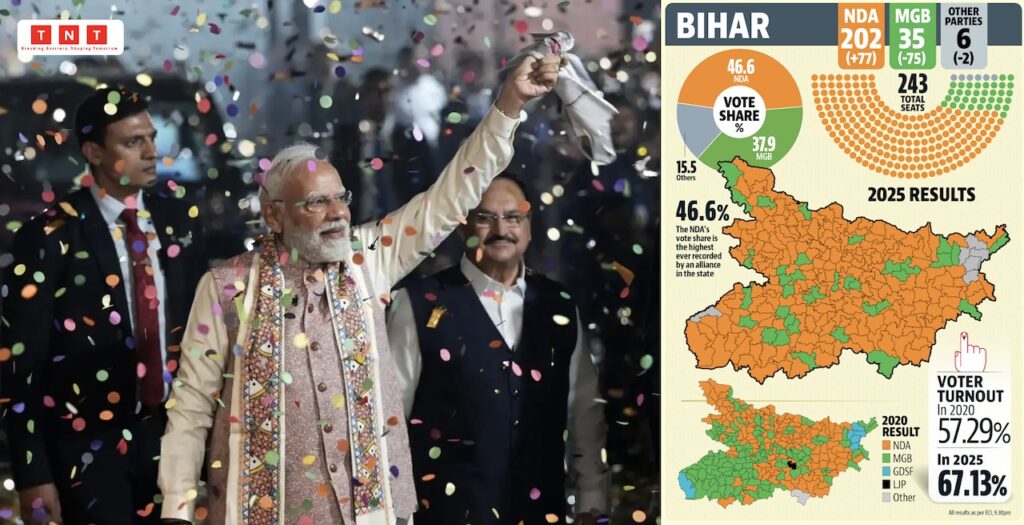
In the 2025 Bihar Assembly elections, the National Democratic Alliance (NDA) did more than just win — it executed a political strategy so disciplined and well-oiled that the mandate felt engineered rather than earned. By securing 202 of 243 seats, the NDA not only delivered a massive three-fourths majority but also set a new benchmark for coalition management under the BJP-JD(U) umbrella.
What made this victory especially potent was not just how many seats the NDA won, but how it built, maintained, and executed a united front. From year-round preparation to cross-party rallies and a meticulously balanced seat-sharing deal, the NDA’s strategy was comprehensive — and it left the Opposition scrambling.
Building the Coalition: Unity in Diversity
Bihar’s politics is a complicated tapestry of caste, region, and personalities. The NDA brought together five parties — BJP, JD(U), LJP (Ram Vilas), HAM (Secular), and RLM — and treated them not as junior partners but as equal members of a political family. Unlike past elections, this time the NDA consciously avoided ego wars.
HM Amit Shah personally coordinated with dozens of party leaders and potential dissenters, not just to negotiate seats but to allay deeper anxieties. The result: minimal vote leakage, very high vote-transfer efficiency, and partners fully committed to the alliance project. Analysts estimate 95% vote transfer (for alliance partner candidate), a level far ahead of what the Opposition managed.
Significantly, the NDA turned down a BJP only Chief Ministerial claim even after emerging as the single-largest party. Leaders repeatedly invoked “coalition dharma,” with Prime Minister Narendra Modi and Nitish Kumar projecting a picture of harmony and mutual respect — a contrast the Opposition simply could not match.
Parity-Based Seat Sharing: A Masterstroke
On 12 October 2025, after long negotiations, the NDA announced an equitable seat-sharing deal: BJP and JD(U) contested 101 seats each, while LJP (RV) got 29, HAM (S) 6, and RLM another 6. Rather than dominating the alliance, the BJP ceded strong constituencies to its partners — even prized seats — and gave them space to compete and win.
This parity sent a strong signal to the electorate: the NDA was not a coalition of convenience but a union of equals. Take LJP (RV), it rocketed from just 1 seat in 2020 to 19 in 2025, thanks to carefully negotiated seats. This balance not only addressed caste arithmetic — upper caste, EBCs, Mahadalits, Kurmis — but also maximised the alliance’s overall vote share and translated it into a landslide.
Campaign Grind: Relentless, United, Targeted
The NDA’s campaign was relentless and unified in a way that leveraged national firepower into local gains. While grassroots workers humbly went door to door, national leaders flooded the state to amplify the message.
Prime Minister Modi alone held 14 rallies and a major roadshow, promoting his “MY Formula” — Mahila & Yuva — which resonated deeply with women and youth, especially in areas that felt neglected by traditional caste politics. Meanwhile, Amit Shah ran more than 20+ events, focusing on themes of security, illegal migration, and industrial development.
Rajnath Singh’s anti-corruption pitch in 10+ rallies and Yogi Adityanath’s powerful 30-rally stint underscored both governance and cultural stability. Importantly, in a majority of these events, NDA partners shared the stage: Modi campaigned with Nitish, Paswan, and Manjhi, radiating an image of unity.
This unity wasn’t superficial — it delivered vote conversion. Booth-level surveys and internal NDA assessments suggest strong vote transfers from BJP’s star rallies to allied party candidates. The message was no longer just “vote BJP” but “vote NDA.”
Voter Conversion: Welfare Meets Stability
One of the most striking outcomes was the surge in women voter turnout, which climbed to 71.8% compared to men’s 63%. The NDA’s pitch of cash transfers, social schemes, and job promises — particularly for women and youth — struck a chord.
Their “1 Crore Jobs” promise and a vision for a “Viksit Bihar 2047” offered both ambition and security. Meanwhile, the Opposition’s reliance on caste nostalgia and negative rhetoric fell flat against a message grounded in inclusive growth and long-term development.
The NDA didn’t just campaign to win votes — it campaigned to transform constituencies. And it worked.
Round-the-Clock Election Work: No Complacency, Only Strategy
An often-overlooked factor was the year-round effort by the NDA. This wasn’t a campaign that kicked off a few months before polling. From office-bearers to ground workers, the NDA built its election machine long before 2025.
Even after announcing victory, their message was clear. In his thanks giving post-win remarks, Prime Minister Modi said, “Ganga flows from Patna to Calcutta,” a metaphor signalling that the alliance was already preparing for the 2026 West Bengal elections. In his view, Bihar’s mandate was not a destination but a launchpad.
That kind of forward-looking discipline is rare — and it shows that for the NDA, elections are not one-off battles. They are a continuous mission.
Lessons from the Opposition: Why It Couldn’t Keep Up
In contrast, the MGB repeatedly faltered on multiple fronts. It delayed seat-sharing decisions, which triggered internal fights and friendly contests. Its leadership was divided, and its messaging lacked coherence. While the NDA spoke of development and unity, the Opposition reverted to old strategies — caste fragmentation, blame games, and negative slogans.
Rahul Gandhi’s much-publicised “vote chori” tour performed poorly in converting real votes. AIMIM’s rise in Seemanchal splintered minority votes. And Prashant Kishor’s launch of a separate third front with “Jan Suraaj” drained anti-NDA sentiment without building an alternative growth narrative. In the end, chaos and contradiction cost the Opposition its chance.
Eyes on 2026: The Bengāl Battleground
If Bihar 2025 was a showcase of NDA’s strength, West Bengal is emerging as its next frontier. The BJP-led alliance appears to be treating Bengal not as a distant goal, but as the next logical step — a vision Modi hinted at through his Ganga metaphor.
Assembly elections in West Bengal are expected in March–April 2026. In the run-up, the BJP is already moving with purpose. According to reports, ticket-sharing strategies, internal unity efforts (“party first”), and grassroots mobilisation have begun in earnest. Meanwhile, the Election Commission has laid the groundwork for a clean and robust election exercise, launching Special Intensive Revision (SIR) processes and digital platforms like EMMS 2.0 to streamline polling personnel deployment.
The NDA’s Bihar victory, then, is not just a triumph—it is the momentum for a bigger gamble. For years, West Bengal has resisted the BJP. In 2026, the NDA clearly intends to rewrite that story.
What the Bihar Strategy Means for the NDA’s Future
The Bihar 2025 NDA Victory Strategy is more than a one-off election win. It’s proof that disciplined coalition politics, strategic seat-sharing, relentless campaigning, and forward-thinking leadership can deliver even in the most fragmented political landscapes.
If the NDA maintains this rigor — working round the clock, projecting unity, and converting votes with both policy and symbolism — its electoral reach could expand far beyond Bihar. The BJP and its partners are not just consolidating power state by state; they are laying the foundation for a national electoral juggernaut.
And for the Opposition, the message is clear: stop reacting, start building.