By Samir Gupta | Tattvam News Analysis
Beyond the Noise: Inside the Washington Post–LIC–Adani Controversy
When foreign headlines clash with domestic institutions, who holds the truth?
The Washington Post LIC Adani Controversy has reopened an uneasy global debate — the fine line between allegation and adjudicated proof.
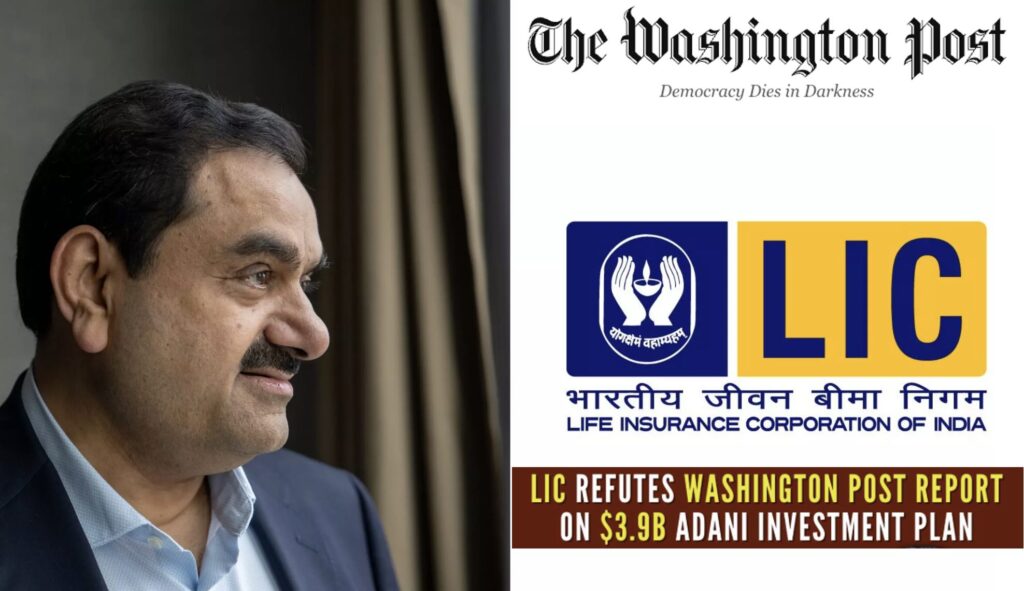
The Washington Post recently reported that the Life Insurance Corporation of India (LIC) was allegedly guided by the Indian government to channel $3.9 billion (about ₹33,000 crore) into the Adani Group, despite ongoing financial scrutiny of the conglomerate abroad. The story painted the move as part of a coordinated state effort to bolster Adani’s liquidity and valuations.
At first glance, it reads like classic investigative journalism. But the evidence remains contested. The report relies on unnamed sources and documents that have not been independently verified. Meanwhile, LIC and the Adani Group have both rejected the report as “false and baseless”, asserting that every investment decision was made transparently and in accordance with board-approved protocols.
As the noise builds, one thing is clear: India’s institutions are again standing trial in the court of global perception.
Institutions, Not Impressions
LIC is not a private fund operating in the shadows. It is India’s largest state-backed insurer, governed by the Insurance Regulatory and Development Authority of India (IRDAI), audited by the Comptroller and Auditor General (CAG), and subject to SEBI oversight in its equity and bond market investments.
In its formal statement, LIC denied any external involvement, clarifying that “no roadmap or plan was ever prepared” to steer funds towards the Adani Group. It added that investment decisions are taken independently, based on financial viability and due diligence, not on political direction.
To project suspicion without a regulatory audit — to equate institutional investment with covert political favour — risks eroding public trust built over decades. If discrepancies exist, they must be identified and corrected through domestic regulators, not through insinuations in foreign publications.
In matters of economic governance, India’s credibility must rest on its institutions, not imported narratives.
The Global Playbook: Economic Subversion Through Perception
This controversy fits into a familiar global pattern.
From the Hindenburg Research report of 2023 to recent Western media stories, emerging economies have become targets of what some analysts describe as “economic perception warfare.” The new battlefield is not physical but informational.
It begins with a headline, amplifies through algorithms, and ends with volatility in markets. The ripple effect of perception can move billions overnight.
After the Hindenburg episode, the Adani Group’s valuation temporarily dropped by over $100 billion, unsettling not only promoters but also institutional investors, including pension funds and small shareholders. The damage was not confined to one company — it shook confidence across India’s infrastructure and energy sectors.
The Washington Post LIC Adani Controversy thus reignites an old anxiety: can information be weaponised to undermine an economy’s image and investor sentiment?
Criticism and accountability are integral to democracy. But when selective framing masquerades as investigative truth, the distinction between scrutiny and sabotage begins to blur.
Transparency, Yes. Targeting, No.
A democracy of India’s scale must never fear transparency. Every public institution — LIC included — owes its stakeholders complete clarity. Periodic independent audits, disclosures, and communication with investors must remain non-negotiable.
But scrutiny must not morph into selective targeting. When journalism selectively extracts numbers, omits regulatory context, and constructs suspicion without substantive proof, it moves from inquiry to agenda.
It is important to remember that LIC’s total assets under management exceed ₹49 trillion, and its exposure to the Adani Group reportedly stands at less than 1% of that portfolio. To extrapolate systemic risk or collusion from such exposure — without acknowledging proportion — is misleading.
Healthy criticism drives reform; narrative warfare drives instability. The difference lies in intent.
The Real Test: India’s Regulatory Spine
This controversy is ultimately a test of India’s regulatory maturity and institutional confidence.
The right response is not to silence critics but to let facts precede fear. The IRDAI, SEBI, and the Ministry of Financeare equipped to verify compliance through audit trails and disclosure reviews.
India’s economic system is not flawless, but it is sovereign and evolving. Domestic accountability must be the first and final referee — not editorial verdicts from overseas.
As a democracy with over a billion stakeholders — policyholders, investors, and taxpayers — India must insist on data before debate and audit before outrage.
Economic sovereignty is not achieved by rejecting critique, but by defining who gets to adjudicate it.
Finally, Stand for Truth, Not Hysteria
The Washington Post LIC Adani Controversy has value only if it encourages transparency — not if it becomes a weapon for perception wars.
Foreign media has every right to investigate. But when allegations rely on anonymous claims without corroborated evidence, they risk turning journalism into activism. “Questioning power” must not become a euphemism for undermining sovereignty.
For India, the path forward is simple yet crucial:
-
Proof over perception.
-
Process over propaganda.
-
Rule of law over imported outrage.
Headlines cannot replace audits.
And truth cannot depend on who publishes first.