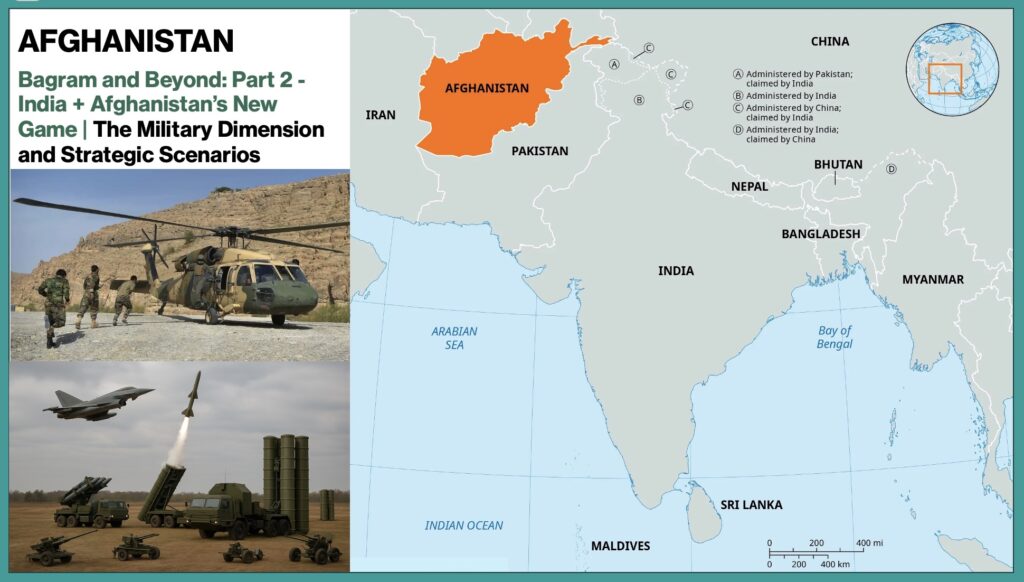
Bagram and Beyond: Part 2 – India + Afghanistan’s New Game
The Military Dimension and Strategic Scenarios
From Diplomacy to Deterrence: A New Phase in India–Afghanistan Relations
With the diplomatic thaw between New Delhi and Kabul now visible, the next logical question is whether India’s engagement will evolve beyond developmental diplomacy into calibrated defence cooperation. The shifting regional landscape — defined by Pakistan’s intensifying hostility, China’s western assertiveness, and the United States’ sanctions coercion — makes such a transition both plausible and strategically desirable.
Since the reopening of India’s embassy in Kabul, quiet discussions have centred on technical cooperation, legacy system maintenance, and counterterrorism intelligence sharing. These exchanges, though limited, lay the foundation for a broader strategic partnership. For India, Afghanistan’s stability is no longer a matter of altruism; it is a forward layer of deterrence against Pakistan’s militant networks and China–Pakistan strategic collusion.
The Defence Infrastructure Landscape in Afghanistan
Afghanistan today sits atop an arsenal of abandoned but salvageable military hardware. The U.S. withdrawal in 2021 left behind an estimated $7 billion worth of equipment, including aircraft, helicopters, armoured vehicles, and radar components. Much of this hardware is degraded but restorable. In parallel, Soviet-era systems — air defence guns, surface-to-air missiles, and artillery — remain scattered across Afghan depots.
Technically, these platforms are of limited operational value without maintenance, spare parts, and training — areas where India’s defence ecosystem has comparative advantage. Indian engineers have decades of experience in servicing both Western and Russian-origin systems and could, if formally invited, restore Afghanistan’s baseline air-defence capability in a short window.
A phased technical assistance programme could involve:
-
Repair and refurbishment of Russian-origin radar and air-defence assets.
-
Supply of non-offensive dual-use equipment (e.g., radar calibration systems, communication links).
-
Training of Afghan technical crews at Indian facilities under humanitarian cooperation or regional stability frameworks.
Such initiatives, publicly presented as “infrastructure and security stabilisation assistance,” would stop short of offensive weapon transfers but effectively rebuild Afghanistan’s deterrent posture.
Pakistan’s Structural Vulnerability: A Diminishing Strategic Depth
The principal consequence of an empowered Afghanistan would be the collapse of Pakistan’s long-standing “strategic depth” doctrine — the concept that Afghanistan could serve as a fallback zone for Pakistani forces in any conflict with India and as a buffer for cross-border militant operations.
That premise has evaporated. The Taliban’s defiance of Pakistani airstrikes, cross-border artillery exchanges, and their claims of downing Pakistani aircraft demonstrate a profound shift in the regional equation. Pakistan’s western frontier has transformed from a sanctuary into a potential security liability.
A strengthened Afghanistan, supported by Indian logistics, training, or defensive technology, would force Islamabad to divide its military resources across two active frontiers.
-
On the eastern front, India’s conventional superiority already keeps Pakistan in a deterrence-dominated posture.
-
On the western front, Afghan retaliation capability — even limited — erodes Pakistan’s comfort of unilateral escalation.
The result is a two-front strategic compression that Pakistan’s overstretched economy and fragmented command structure are ill-equipped to sustain.
India’s Strategic Options: Calibrated Defence Engagement
India must, however, walk a fine line between influence and overreach. Four graduated levels of engagement appear feasible:
-
Technical & Maintenance Assistance (Low-Visibility Phase):
Establishing service contracts for legacy air-defence and radar systems; providing spare parts through Iran’s Chabahar-Zahedan corridor; and training Afghan technicians under “civil aviation and border security” cover. -
Integrated Surveillance & Early-Warning Cooperation (Medium Phase):
Setting up joint radar data-sharing agreements focusing on border monitoring, drug trafficking, and cross-border infiltration. This could be presented as a counter-terrorism initiative. -
Supply of Defensive Systems (High Phase):
Possible transfer of Indian-made short-range air-defence systems such as Akash or QRSAM variants under bilateral security cooperation, subject to export-control modifications. Public framing would remain defensive. -
Regional Security Compact (Strategic Phase):
Creation of a multilateral “Regional Stability Forum” involving India, Iran, Russia, and Afghanistan for combined training, counter-terrorism intelligence, and joint patrol doctrines. Such a framework would institutionalise India’s continental security role without formal military basing.
Each phase scales India’s involvement proportionally to regional acceptance and global tolerance, avoiding abrupt provocation or sanctions exposure.
Sanctions, Optics, and Strategic Communication
Any direct defence cooperation with the Taliban government faces three major constraints — legal, reputational, and financial.
-
Legal: Western sanctions lists still designate numerous Taliban figures, restricting formal government-to-government transfers.
-
Reputational: Open military cooperation risks international backlash, particularly from Western partners invested in human-rights conditionality.
-
Financial: Payments and procurement would require non-dollar denominated systems, such as rupee-rial or barter frameworks via Chabahar, to circumvent banking prohibitions.
Therefore, India’s approach must rely on dual-use and deniable mechanisms — assistance framed as “border surveillance and anti-terrorism capacity building,” financed through multilateral stabilisation funds rather than direct military credit lines.
Diplomatically, India can emphasise that its support aims to contain transnational terror networks and stabilise the regional security environment, thereby positioning itself as a responsible stakeholder rather than a partisan actor.
The Deterrence Equation: Shifting Military Balance in South and Central Asia
If executed prudently, limited Indian military cooperation with Afghanistan would alter three layers of the regional deterrence matrix:
-
Tactical Deterrence (Pakistan–Afghanistan border):
Improved Afghan air-defence capability raises the cost of Pakistani cross-border strikes. Even a small number of operational batteries or radar-linked anti-aircraft systems can neutralise the element of surprise. -
Operational Deterrence (Two-Front Pressure on Pakistan):
Islamabad’s defence establishment, historically oriented eastward toward India, would face resource diffusion. Any flare-up in Kashmir would now carry the implicit risk of western retaliation, constraining strategic planners in Rawalpindi. -
Strategic Deterrence (Regional Power Geometry):
India’s quiet re-entry into Afghanistan’s security calculus, sanctioned or not, would consolidate its position as a continental stabiliser. It would also signal to Washington and Beijing alike that New Delhi possesses independent means to influence land-based geopolitics beyond maritime Indo-Pacific constructs.
China’s and Russia’s Calculated Tolerance
Beijing and Moscow would watch such developments with caution but not necessarily opposition.
-
China values stability on its western frontier more than ideological alignment. A stable Afghanistan capable of restraining jihadist movements spilling into Xinjiang serves Beijing’s interests, even if assisted by India.
-
Russia has pragmatic incentives: an India-Afghanistan security link would reduce U.S. prospects of re-entry while preserving Russian arms-maintenance contracts and intelligence coordination channels.
Hence, both powers are likely to tolerate, or quietly endorse, a limited Indian role so long as it does not introduce U.S. or NATO presence by proxy.
Iran’s Role as the Enabler
Iran remains the indispensable logistical bridge. Any Indian military-technical assistance to Afghanistan would have to transit via the Chabahar–Zahedan–Zaranj corridor.
Tehran’s cooperation serves multiple mutual interests:
-
It strengthens Iran’s position as a regional transit hub despite U.S. sanctions.
-
It integrates Afghanistan into the INSTC framework, boosting regional trade.
-
It binds India, Iran, and Afghanistan into a functional triangle of continental resilience.
Given Iran’s own adversarial relationship with Pakistan and the U.S., Tehran has strong incentives to facilitate discreet logistical support so long as it enhances regional autonomy.
Risks of Escalation and Asymmetric Retaliation
Any elevation of India–Afghanistan defence ties will inevitably trigger Pakistan’s asymmetric response spectrum:
-
Proxy Activation: Re-energising sleeper networks within Afghanistan to destabilise Kabul’s internal security.
-
Information Warfare: Narratives portraying India as violating international norms or supporting “anti-Pakistan elements.”
-
Covert Disruption: Targeted attacks on Indian infrastructure projects or personnel in Afghanistan.
To mitigate this, India must integrate counter-intelligence, diplomatic insulation, and economic redundancy.Diversifying project leadership through local Afghan contractors and regional partners (Iranian or Russian) can reduce exposure while maintaining operational continuity.
Strategic Forecast: 2025–2030
If India manages to balance engagement with restraint, several outcomes emerge by 2030:
-
A Functioning Afghan Air-Defence Grid:
Limited but credible systems deterring Pakistani air incursions. -
Two-Front Deterrence Normalisation:
Pakistan forced into sustained resource division, reducing aggressive posture toward India’s western and northern sectors. -
Regional Stability through Interdependence:
Economic corridors — Chabahar, INSTC, and prospective energy pipelines — shielded by collective interest in peace. -
Reduced U.S. Leverage:
Washington’s capacity to weaponise sanctions diminishes as India, Iran, and Central Asian states operationalise alternative trade and finance channels. -
India’s Continental Emergence:
New Delhi evolves from a maritime-focused power into a dual-domain actor — balancing Indo-Pacific cooperation with a stabilising footprint in Eurasia.
Policy Recommendations for India
-
Adopt a “Defensive Partnership” Doctrine:
Frame all military cooperation as defensive capacity building, focused on border management and counter-terrorism. -
Institutionalise Multilateral Oversight:
Use SCO and Moscow Format mechanisms to provide legitimacy and transparency to cooperation, reducing perceptions of unilateralism. -
Prioritise Sanction-Resilient Financing:
Employ local-currency settlements and barter systems through Chabahar; expand rupee-rial trade channels. -
Enhance Strategic Communication:
Clearly articulate that India’s goal is a stable, sovereign Afghanistan free of external manipulation, not confrontation with any state. -
Prepare for Asymmetric Pushback:
Develop rapid-response frameworks for cyber, narrative, and proxy attacks linked to Pakistan’s intelligence ecosystem.
Finally, The Emergence of a Continental Deterrent Order
The contours of a new deterrence architecture are emerging across the region. Afghanistan, once a theatre of foreign occupation, is gradually repositioning as a sovereign pivot between South and Central Asia. India, by offering selective technical support and diplomatic legitimacy, stands to anchor this transformation — converting instability into structured balance.
Pakistan’s traditional leverage — its geographic centrality — is eroding; Iran’s and India’s logistical corridors are rewriting the map. China and Russia, while wary, recognise the stabilising potential of an India-Afghanistan equation that keeps U.S. military ambitions at bay.
In essence, the shifting security order marks the arrival of a continental equilibrium built not on bases or alliances but on distributed deterrence and interlocking interests.
If New Delhi continues to act with restraint, precision, and persistence, the outcome will not be another proxy battlefield but a Eurasian balance of power in which India’s stabilising influence becomes both indispensable and undeniable.
Explore Related Articles
Bagram and Beyond: Part 3 – Trump’s “China Nuke Containment” Smoke Screen and the Rare Earth Reality | dated October 18, 2025 | 05:00 PM
Bagram and Beyond: Part 2 – India + Afghanistan’s New Game | dated October 18, 2025 | 04:00 PM
Bagram and Beyond: Part 1 – Regional Power Realignments | dated October 17, 2025 | 08:33 PM
India–Taliban Diplomatic Relations: A New Geopolitical Chapter in South Asia | dated October 10, 2025 | 01:44 PM
Early Moves on Bagram Air Base: US–Taliban Handover Reports and Strategic Analysis from April 2025 | dated September 19, 2025 | 02:27 PM
Trump Seeks to Reclaim Bagram Air Base from Taliban: Full Coverage and Reactions | dated September 19, 2025 | 12:37 PM
US Revokes Sanctions Exemption on Iran’s Chabahar Port, Impacting India’s Strategic Gateway | dated September 18, 2025 | 11:05 PM
Afghanistan, China, Pakistan Hold 6th FMs Meeting in Kabul on Regional Ties, India Watchful | dated August 21, 2025 | 09:04 PM