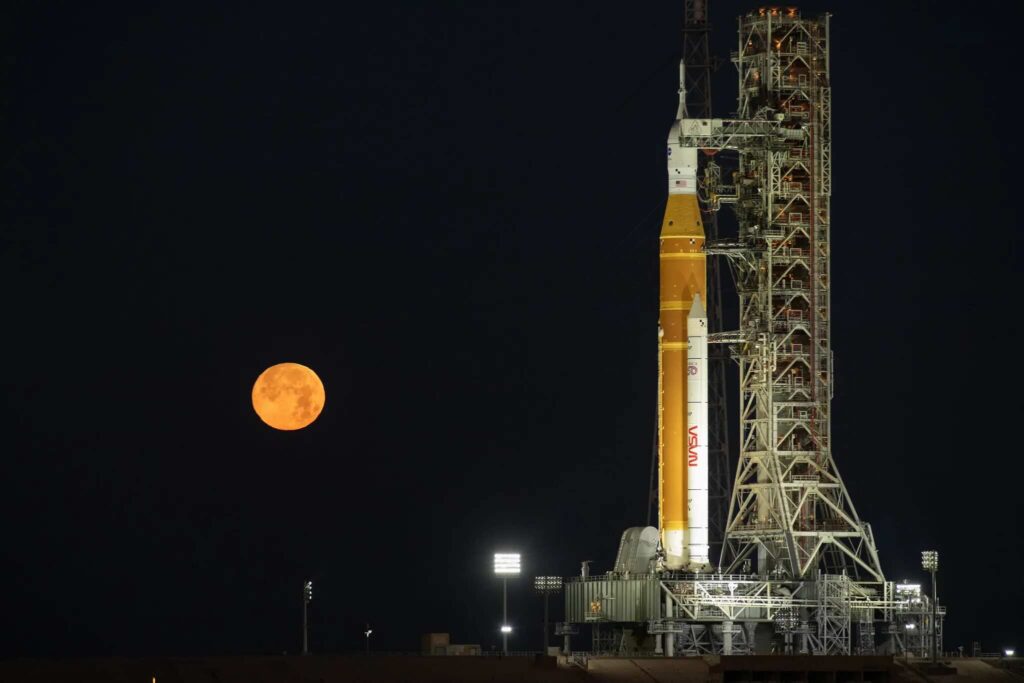
NASA Targets March 6 Launch for Artemis II Mission: Humans Return to Lunar Orbit After 53 Years
February 21, 2026 | The Artemis II mission launch scheduled for March 6, 2026, marks a historic milestone in global space exploration. The mission, led by National Aeronautics and Space Administration, will send astronauts beyond low Earth orbit for the first time since 1972.
Preparations are in their final stages at Kennedy Space Center in Florida, where engineers are completing system checks on the Space Launch System and Orion spacecraft.
If successful, Artemis II will become the first human mission to orbit the Moon since the Apollo era, reaffirming America’s leadership in deep-space exploration.
Artemis Programme and the Significance of Artemis II
Artemis II forms a critical part of NASA’s long-term lunar exploration strategy. The Artemis programme aims to establish a sustained human presence on the Moon and create pathways for future missions to Mars.
Unlike Artemis I, which was an uncrewed test flight in 2022, Artemis II will carry astronauts on a 10-day journey around the Moon. The mission will test life-support systems, propulsion technologies, and navigation capabilities in deep space.
NASA officials describe Artemis II as the operational bridge between experimental flights and future lunar landings.
What Is the Artemis II Mission?
Artemis II is designed as a crewed lunar flyby mission. The Orion spacecraft will travel nearly 240,000 miles from Earth, loop around the far side of the Moon, and return via a free-return trajectory.
Key Mission Parameters
Duration: Approximately 10 days
Re-entry Speed: Over 25,000 miles per hour
Launch Vehicle: Space Launch System (SLS) Block 1
Launch Site: Launch Complex 39B
Splashdown Zone: Pacific Ocean off California
During the flight, astronauts will evaluate spacecraft handling, radiation exposure, and manual piloting systems.
The mission will also validate procedures needed for Artemis III, which aims to achieve a crewed lunar landing later in the decade.
Meet the Artemis II Crew
The Artemis II crew reflects international cooperation and growing diversity in space exploration. The team was announced in 2023 and includes three American astronauts and one Canadian representative.
Crew Members
Reid Wiseman (Commander)
A former naval aviator with previous International Space Station experience.Victor Glover (Pilot)
The first Black astronaut to pilot a lunar mission.Christina Koch (Mission Specialist)
Record holder for the longest single spaceflight by a woman.Jeremy Hansen (Mission Specialist)
Representing the Canadian Space Agency on his first spaceflight.
The crew entered pre-launch quarantine on February 20, 2026. This measure reduces health risks and ensures mission safety.
Training has included extensive simulations at Johnson Space Center and observation of launch rehearsals.
Launch Preparations and Countdown Progress
NASA confirmed the March 6 target date following a successful wet dress rehearsal conducted on February 19, 2026. During this test, the SLS rocket was fully fuelled and subjected to a simulated countdown.
The rehearsal resolved earlier technical concerns, including liquid hydrogen leaks that delayed previous attempts.
According to mission planners, backup launch windows are available on March 7, 8, 9, and later in April, if weather or technical issues arise.
A final Flight Readiness Review will determine whether all systems meet safety and performance requirements.
Historical Importance and Global Context
Artemis II revives human lunar exploration after a 53-year gap. The last crewed Moon mission was Apollo 17 in December 1972.
Unlike the Cold War-driven Apollo programme, Artemis is built on international collaboration. Partners from Europe, Japan, and Canada contribute hardware, expertise, and scientific instruments.
The programme also supports the planned Gateway space station, which will orbit the Moon and serve as a staging point for future missions.
Technical Challenges and Mission Delays
The Artemis II programme has encountered several delays. Originally planned for 2024, the mission was postponed due to pandemic disruptions, supply chain constraints, and engineering challenges.
NASA leadership has repeatedly emphasised that safety remains the primary priority. Every delay has been used to improve reliability and risk management.
Recent system tests have strengthened confidence in launch readiness.
Future of Lunar and Deep-Space Exploration
A successful Artemis II mission will accelerate preparations for Artemis III and subsequent lunar landings. It will also provide essential data for long-duration human spaceflight.
These missions are expected to support scientific research, resource utilisation, and future Mars expeditions.
Public interest in Artemis continues to grow. Limited viewing opportunities are available at Kennedy Space Center, and NASA will provide live coverage of the launch.
Strategic Implications for Global Space Leadership
Artemis II demonstrates renewed commitment to sustained lunar exploration. It signals a shift from short-term missions to long-term presence beyond Earth.
For India and other emerging space powers, the mission reinforces the importance of international cooperation and technology sharing in future exploration efforts.
As the countdown progresses, Artemis II stands as a symbol of scientific ambition and human perseverance.