
Al Jazeera’s Anti-India Narrative: A Case Study in Paid Propaganda Journalism
Introduction — From Headline to Hysteria: How Al Jazeera Spins an Anti-India Narrative
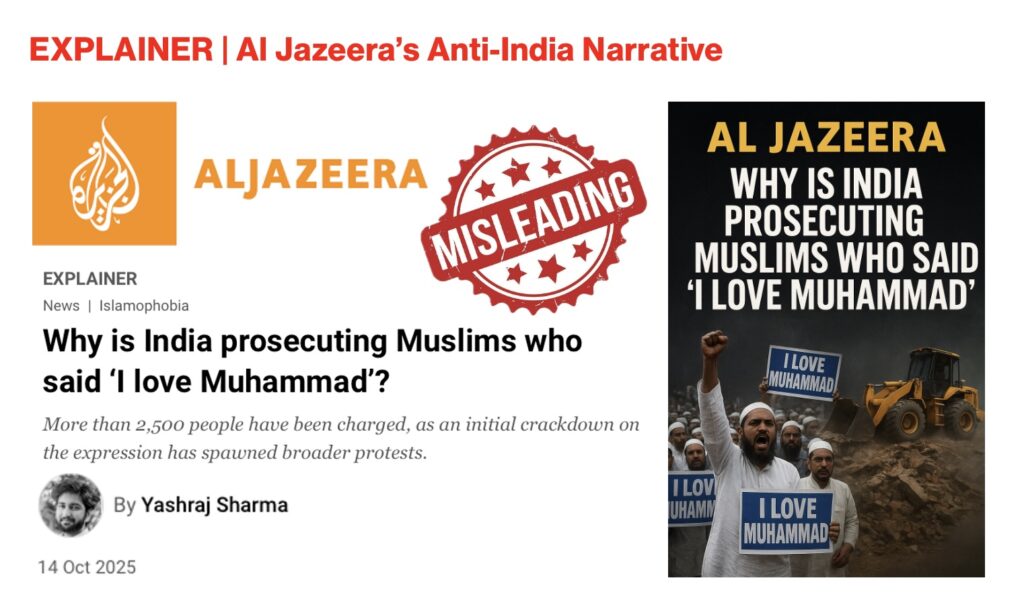
When Al Jazeera published its article titled “Why is India prosecuting Muslims who said ‘I Love Muhammad’” on 14 October 2025, it framed India as a country where a simple expression of faith could land believers in jail. The headline was calibrated to provoke outrage — implying that the world’s largest democracy criminalises love for the Prophet and persecutes its minorities.
Beneath that sensational title lies the familiar template of the Al Jazeera anti-India narrative: selective sourcing, omission of context, and emotional engineering. The story shrinks a complex, localised law-and-order episode in Uttar Pradesh into a morality play about “Muslim persecution.” It ignores the legal reality that arrests followed unauthorised gatherings, stone-pelting, and rioting, not devotional slogans, and that the events were limited to a few districts with evidence of organised mobilisation timed to a sensitive festive period.
By choosing rhetoric over record, Al Jazeera turns a regional policing challenge into an indictment of an entire nation — a form of narrative laundering disguised as journalism. This editorial sets the record straight: India’s actions were rooted in law, order, and constitutional duty, not in religious bias.
The Core Truth: Lawful Order vs. Lawlessness
The message from the state of ‘Uttar Pradesh’ is plain and constitutional: peaceful faith and devotion are protected; deliberate disruption of public order is not. When unauthorised processions become platforms for mobilisation, stone-pelting, or rioting, the state will act — firmly and lawfully. That firmness is not arbitrary; it flows directly from the constitutional duty to maintain order.
This is not a new posture. When Yogi Adityanath assumed CM’s office in 2017 he announced a zero-tolerance approach to crime, communal violence and encroachments. His government institutionalised this “Yogi model” through anti-land-mafia task forces and clear directives that illegal property and violent protest would be met with iron-handed enforcement. The warning has been on the wall for eight years. Anyone who still defies it does so knowing the consequences — no further “notice” is needed.
If you break the law — by turning prayer into unauthorised protest or violent riot — the state will hit hard, and it will do so within the law.
The Myth Factory: How Al Jazeera Distorts a Local Law-and-Order Episode
Al Jazeera’s article frames the issue as:
- Muslims are being prosecuted for saying “I Love Muhammad”;
- The state is engaged in religious persecution;
- Bulldozer demolitions are arbitrary collective punishment.
Each of these claims collapses when confronted with verifiable facts:
Arrests and FIRs in Kanpur, Bareilly and other districts were tied to public-order offences — unlawful assembly, rioting, stone-pelting and criminal conspiracy — not mere private devotional expression. Local reporting and FIR texts show the difference between being booked and being arrested: many names appear in FIRs; fewer people are physically detained.
The “I Love Muhammad” slogan is culturally unusual in Indian Muslim public practice; its orchestrated mass display during sensitive festival months, together with reports of outsiders and organised mobilisation, rightly triggered security concerns. The Bareilly mobilisation involved calls across many mosques and reports of thousands arriving from outside — a fact that blunts the narrative of spontaneous, peaceful worship.
The bulldozer as an enforcement tool is not unique to Uttar Pradesh, and the Supreme Court has made clear that illegal encroachments and criminally tainted properties may be removed, subject to procedural safeguards. The Court’s November 2024 jurisprudence emphasised due process — prior notice, opportunity to be heard, and reasoned orders — yet it did not outlaw lawful anti-encroachment action. International outlets that extract the Court’s language as a blanket condemnation risk misrepresenting this legal nuance.
Myths vs Verified Facts
Myth 1: India is prosecuting Muslims for simply saying “I Love Muhammad.”
Verified Fact: Arrests have nothing to do with the phrase itself. They relate to unlawful assemblies, vandalism, stone-pelting, and rioting in cities such as Kanpur and Bareilly. Context matters — law enforcement acted after violent incidents and breaches of public order, not against peaceful expression.
Myth 2: Bulldozers represent extrajudicial collective punishment.
Verified Fact: The “Yogi model” employs demolition only against illegal encroachments and properties linked to criminal activity. The Supreme Court of India has consistently upheld the state’s power to remove unauthorised structures, while simultaneously insisting on due process. Lawful removal of illegal structures is fully permitted within this framework.
Myth 3: The crackdown is a pan-India, centrally directed campaign.
Verified Fact: The incidents are concentrated in Uttar Pradesh, reflecting specific regional dynamics. There is no evidence of similar actions being carried out systematically across all states, and certainly none suggesting a central directive.
Myth 4: International media report the legal detail fairly.
Verified Fact: Most foreign outlets emphasise dramatic visuals and moral framing while omitting procedural facts and the documented role of organised mobilisation. This selective storytelling distorts reality and skews global perception of India’s governance and judicial oversight.
Myth 5: The Bareilly cleric is a peaceful preacher unfairly targeted for faith-based expression.
Verified Fact: The man at the centre of the Bareilly unrest, Maulana Tauqeer Raza Khan, is not a victim of religious persecution but a politically active cleric with a history of confrontation with the law. Head of the Ittehad-e-Millat Council and a descendant of Ala Hazrat Ahmed Raza Khan, he has repeatedly courted controversy through inflammatory speeches and organised mobilisation. In 2007, he publicly announced a ₹5 lakh bounty on author Taslima Nasreen; in 2010, he was accused of instigating communal violence during Eid Milad-un-Nabi processions in Bareilly and was arrested. His name resurfaced during the anti-CAA/NRC protests and several later rallies marked by provocative rhetoric. Multiple FIRs over the years cite him for incitement, promoting enmity and unlawful assembly. Yet, Al Jazeera’s coverage omitted this record entirely, portraying him as a benign cleric punished for devotion. This selective storytelling sanitises habitual provocation and disguises political orchestration as piety.
Law, Order, and the Limits of Tolerance
Indian law draws an uncompromising line between protected expression and unlawful conduct.
- Faith and expression enjoy constitutional protection.
- Unlawful assembly, incitement, and violence are penal offences.
- Encroachments on public land may be summarily removed under state and municipal statutes.
- Illegal construction on private land requires notice and a hearing.
- The Supreme Court upholds both principles: it allows removal of illegality yet insists on procedural fairness.
This balance defines the Yogi administration’s enforcement drive — strong in substance, accountable in procedure.
The Bulldozer-Justice Misinformation Loop
International outlets have turned “bulldozer justice” into a metaphor for majoritarian vengeance. In truth, the Supreme Court’s jurisprudence distinguishes between lawful demolition and procedural abuse. It has upheld governments’ right to clear illegal structures, particularly on public land, while censuring summary demolitions done without proper notice or used punitively.
The Yogi government’s actions fall within this constitutional framework. Where structures stand on public land or are linked to riot offences, authorities act under the U.P. Public Premises (Eviction of Unauthorised Occupants) Act 1972 and the Municipal Corporation Act 1959. Notice may be brief but it exists within law. The Supreme Court’s interventions refine this procedure; they do not forbid it.
When foreign media extract only the dramatic lines — “shocks our conscience,” “bulldozer justice” — and omit this dual reasoning, legal nuance becomes propaganda fodder.
Who Profits from Simplified Outrage
There is an industry that monetises moral certainty. Pictures of bulldozers and crying families travel faster than FIRs and court orders. Al Jazeera’s article belongs squarely to this economy of outrage — trimming complexity to fit a pre-decided script. It ignores criminal backgrounds, timing during Hindu festivals, and official efforts at restraint, because those facts spoil the story.
Balanced Scrutiny, Not Narrative Laundering
India’s democracy does not need foreign approval, but it deserves fair representation. The Uttar Pradesh government’s law-and-order response was anchored in legality, shaped by a policy declared in 2017, and executed with judicially reviewable safeguards.
To present this as persecution is dishonest; to ignore organised provocation is manipulative.
Peaceful devotion is inviolable. Violent disruption invites lawful reprisal. The warning has stood for eight years — the notice is already on the wall.
Those who ignore it will face the iron hand of the law — not vengeance, but consequence.














One Response
Extremely well researched , factual Article , Exposing Anti Bharat rehteroic by Al Zazeera . We need this fearless and honest Reportage , which is somehow lacking in our country .