Inside President Trump’s October 2025 Asia Tour
Introduction
President Donald Trump’s whirlwind Asia tour in late October 2025 combined high-stakes diplomacy, commercial bargaining and provocative rhetoric. Over roughly a week he travelled from Kuala Lumpur to Tokyo and Busan, pressing a mix of bilateral deals on trade and critical minerals, helping to facilitate a ceasefire between Thailand and Cambodia, and closing a headline one-year rare-earth supply understanding with China. The trip produced tangible short-term results — and a suite of unresolved strategic questions that will shape geopolitics in the months ahead.
Itinerary
26 October 2025 — ASEAN Summit, Kuala Lumpur, Malaysia: Trump attended ASEAN sessions where Thailand and Cambodia signed an expanded ceasefire package. U.S. engagement at the summit helped create momentum for the agreement.
28 October 2025 — Tokyo, Japan: A bilateral Japan–U.S. framework on rare earths and critical minerals was announced along with cooperation plans on investment in processing and resilient supply chains.
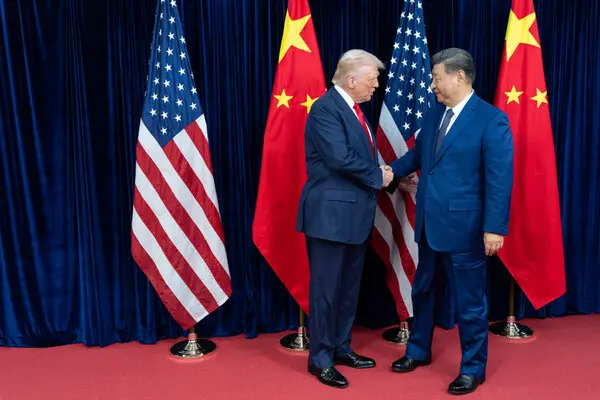
29–30 October 2025 — APEC Summit, Busan, South Korea: President Trump met Chinese leader Xi Jinping; the two leaders announced progress including a one-year understanding to stabilise rare-earth exports and reciprocal tariff adjustments on specified categories.
Doha stopover — an in-flight summit en route to Kuala Lumpur
On his way to the ASEAN summit in Kuala Lumpur, President Trump made an unplanned refuelling stop at Qatar’s Al Udeid Air Base on 25 October 2025, where Emir Sheikh Tamim bin Hamad Al Thani and Prime Minister Sheikh Mohammed bin Abdulrahman Al Thani boarded Air Force One for a short, private meeting. The Emir’s visit aboard the presidential aircraft underscored Doha’s role in regional diplomacy — notably its mediation in recent Middle East negotiations — and the leaders discussed Gaza stabilisation, energy cooperation and potential Qatari contributions to reconstruction and peacekeeping efforts. Neither side released a detailed joint communiqué, but Qatari and U.S. officials confirmed discussions on energy security, investment and the progress of the Gaza ceasefire negotiations.
Achievements and Agreements
Thailand–Cambodia Ceasefire
Leaders of Thailand and Cambodia signed a ceasefire package committing to withdraw heavy weapons from contested border zones, facilitate prisoner exchanges, allow humanitarian access and begin de-mining. The accord reduced the immediate risk of wider violence and was presented at ASEAN with U.S. diplomatic engagement helping to open space for the deal signed on October 26, 2025 in Kuala Lumpur.
Japan–U.S. Rare Earth and Critical Minerals Framework
On October 28, 2025, Tokyo and Washington announced a strategic framework to expand cooperation across mining, refining, alloy and magnet production beyond China’s supply chain dominance. The agreement is intended to accelerate joint investment and technology transfer to build non-Chinese refining capacity and strategic stockpiles — a long-term industrial effort that requires years to scale.
One Year Rare Earth Understanding, and More with China
On the APEC sidelines in Busan, October 30, 2025, President Trump and President Xi agreed on a one-year arrangement under which China would maintain exports of specified rare-earth elements and delay or moderate new export restrictions; in parallel the U.S. signalled targeted tariff reductions in categories tied to the negotiation framework. The understanding provides short-term market relief but leaves most structural policy disputes unresolved.
Here are the specific outcomes from the Donald Trump-Xi Jinping meeting in Busan on 30 October 2025:
Tariff reductions: Trump announced that U.S. tariffs on Chinese goods (which had been at ~57 %) will be reduced to ~47 %. More specifically, the “fentanyl-precursor” tariff was cut from 20 % to 10 %.
Rare-earth export assurance: China committed to maintain exports of certain rare-earth and critical-minerals for at least one year, effectively pausing newly announced Chinese export curbs.
Soybean and agricultural purchases: Trump mentioned that China has agreed to resume ‘significant’ soybean imports from the U.S., which had dropped substantially. It is to be noted that the commitments are somewhat vague about volume, timing and enforceability; market participants and traders caution that the reopening is modest and still under negotiation.
Chip and technology-trade signals: Trump indicated that he would permit U.S. firm NVIDIA to negotiate chip trade with China and said the chip supply business is between the company and Beijing (“I have no objection”).
Follow-up visits: Trump said he plans to visit China in April 2026, and Xi would visit the U.S. afterwards — signalling a reset in face-to-face diplomacy.
What they did not resolve / what remains ambiguous:
Sensitive issues like Taiwan, TikTok/Chinese tech platforms, and China’s oil imports from Russia were not addressed in any meaningful or publicly-detailed way.
The detailed legal text, timelines or enforcement mechanisms for the rare-earth export assurance and tariff cuts remain unclear—both sides stated frameworks rather than concrete binding agreements.
Although Trump described the meeting as “12 out of 10”, analysts warned this may mark a temporary de-escalation rather than a structural resolution of U.S.–China rivalry.
Bilateral trade and reciprocal frameworks with ASEAN partners
The tour produced multiple memoranda and trade frameworks with Malaysia, Cambodia, Thailand and Vietnam focused on tariff reductions, market access, and critical-minerals cooperation. These are tailored, bilateral arrangements designed to produce early wins rather than a single large regional trade pact.
Statements, Controversy and Political Theatre
Every leg of President Trump’s October 2025 Asia tour produced a policy headline — and nearly every stop also yielded a moment of political theatre that rippled through diplomatic circles.
“A little conflict” in Japan
While addressing business leaders in Tokyo on 28 October 2025, President Trump described the wartime bombings of Hiroshima and Nagasaki as “a little conflict we once had,” before pivoting to praise the post-war friendship between the United States and Japan. The phrase drew swift criticism in Japan. Survivors’ groups and civic leaders in Hiroshima and Nagasaki condemned the wording as deeply insensitive to the memory of more than 200,000 victims of the atomic bombings.
Tokyo’s national government offered a measured response, reaffirming the importance of remembrance and reconciliation. Japanese commentators said the remark betrayed a casual disregard for the trauma that defines modern Japan’s pacifist identity — a misstep that momentarily overshadowed the rare-earth and energy cooperation pact signed the same day.
The “I stopped the India–Pakistan war” refrain
During the APEC engagements that followed, President Trump repeated a familiar claim — that he had personally “stopped a war” between India and Pakistan. Observers noted this was at least the 30th time (if not more) he had used the phrase publicly since returning to office. Independent analysts emphasise that de-escalation involved multiple regional and international actors, not a single intervention. Indian commentators treated the renewed claim as typical Trumpian hyperbole; Pakistani media highlighted it as an implicit acknowledgement of Washington’s influence in South Asia while India has explicitly denied Trump’s claim.
The “killer” line about Prime Minister Modi
At another media appearance, Trump referred to Indian Prime Minister Narendra Modi as “a killer, tough as hell — like a father.” The comment, intended as a back-handed compliment on Modi’s political strength, triggered divergent reactions. In New Delhi, officials downplayed the phrase as the President’s characteristic bluntness, while opposition figures and editorialists called it demeaning and diplomatically crude. Analysts said the remark encapsulated Trump’s populist rhetorical style — earthy, unfiltered, and often polarising — which continues to confound conventional diplomatic expectations.
Political style as foreign policy
These three episodes — the “little conflict” line in Japan, the India–Pakistan war claim, and the Modi “killer” comment — reveal a consistent pattern in Trump’s diplomatic language. His off-script candour often amplifies media attention, creating domestic headlines that risk overshadowing substantive policy progress. Supporters argue that such unvarnished talk projects strength and authenticity; critics counter that it undermines the nuance required in international relations. Either way, Trump’s Asia tour underscored how personality and politics remain inseparable from U.S. diplomacy in the Indo-Pacific.
Why Outcomes Matter for Geopolitics
Cautious and Analytical Views
Major outlets like Reuters and Al Jazeera emphasised that while the interaction was cordial and important, no fundamental resolution of the broader trade and geopolitical disputes occurred. They described the meeting as stabilising tensions with follow-up talks planned, but with underlying conflicts unresolved.
Analysts on these networks pointed to China’s strategic leverage and Washington’s reactive posture, suggesting Beijing essentially “dictates the tempo” of the trade and tech rivalry.
Coverage noted that critical topics such as Taiwan did not surface in discussions, reflecting diplomatic sensitivities.
Overall Tone
Immediate market and security relief: The rare-earth understanding and the Japan–U.S. framework alleviated near-term supply anxieties for tech and defence sectors. Markets welcomed the reduced tail-risk from abrupt export controls.
A tactical U.S. approach: The administration emphasised fast bilateral pacts and memoranda rather than restarting broad multilateral trade negotiations — a strategy that can produce quick gains but risks leaving patchwork rules across the region.
Temporary management, not structural resolution: The one-year horizon with China buys breathing room. Core disputes over technology controls, export licensing, semiconductors and broader strategic competition remain unresolved and will require sustained, institutional diplomacy.
Diplomatic optics and domestic politics: Provocative rhetoric (the India–Pakistan claims; the “killer” remark) complicates partner relations even as officials attempt to convert memoranda into implementable policy. Domestic audiences and regional capitals will watch whether words translate into verifiable actions.
What to Watch Next
Implementation documents from the USTR and White House detailing the rare-earth list, monitoring and enforcement mechanisms for the China understanding.
Japan–U.S. investment timetables for processing capacity and refinery build-outs.
On-the-ground verification of the Thailand–Cambodia border commitments and presence of observers/de-mining teams.
Diplomatic follow-ups: scheduled ministerial talks, procurement commitments and private-sector investment announcements that will turn memoranda into durable supply-chain changes.
Bottom Line
President Trump’s Asia tour produced concrete short-term results — a Thailand–Cambodia ceasefire, a Japan–U.S. rare-earth cooperation framework, a one-year China rare-earth understanding, and multiple trade memoranda — but it also left many structural geopolitical issues unsettled. The trip’s blend of rapid deals and controversial rhetoric means implementation and verification will determine whether the tour becomes a lasting diplomatic turning point or a series of ephemeral headlines.