By Samir Gupta | Tattvam News Analysis
Halal Certification Controversy: India’s Call for Equal Food Freedom
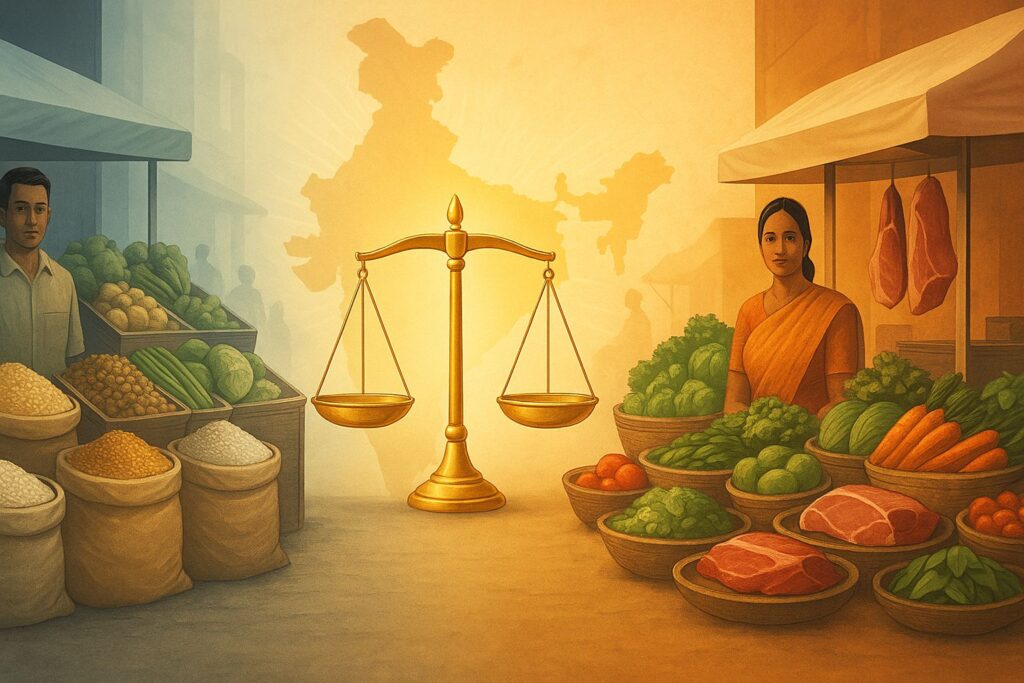
When consumer choice meets constitutional equality, should one faith’s label define everyone’s plate?
A new wave of online activism has reignited India’s debate over religious food certification. Under the viral banner #SayNoToHalal, with over 400,000 posts circulating within days, citizens from diverse backgrounds are questioning whether one faith’s dietary label should dominate how food is processed, packaged, and sold across the country.
The debate gained momentum after Uttar Pradesh Chief Minister Yogi Adityanath accused private halal certification bodies of operating without financial transparency and warned that such parallel systems could undermine consumer equality and national interests.
What began as a social-media campaign has now evolved into a broader national conversation — touching on religious freedom, consumer rights, transparency, and secular governance. The Halal Certification Controversy goes far beyond meat; it challenges how India balances belief and business in a plural democracy.
Historical and Current Context
Halal certification entered India’s economy primarily as an export requirement. Exporters to the Gulf and Southeast Asia needed documentation assuring that Indian meat met Islamic dietary laws. Private trusts such as Halal India Pvt Ltd and Jamiat Ulama-i-Hind Halal Trust stepped into this gap — collecting certification fees and issuing labels that facilitated trade.
Over time, the halal label spread domestically — appearing not only on meat but on packaged foods, cosmetics, medicines, and even restaurant menus. This expansion often happened without transparent disclosure or non-religious alternatives. Many consumers discovered that most commercial meat was processed as halal by default, leaving limited choice for those who preferred jhatka or secular preparation methods.
Yogi Adityanath’s remarks reignited this simmering issue. He claimed that halal certification fees, estimated at around ₹25,000 crore annually, operate beyond government oversight and could potentially be diverted to unaudited uses. Supporters hailed this as a bold move for accountability; critics denounced it as communal politics. Yet, beyond the rhetoric lies a constitutional question:
Should a secular nation allow private religious certification systems to influence public markets without state regulation?
India’s Position and Stakes
The Halal Certification Controversy strikes at the intersection of freedom and equality — both enshrined in India’s Constitution.
Under Article 25, every citizen enjoys the freedom to follow personal dietary laws and religious customs. But Article 14 guarantees ‘equal’ treatment before the law. If one community’s religious process becomes dominant in the national supply chain, it raises concerns of systemic imbalance and consumer inequality.
Economically, India’s halal-linked exports exceed ₹30,000 crore annually, driven by demand in Gulf countries and Southeast Asia. However, domestically, the dominance of halal processes has restricted competition. Smaller abattoirs and food vendors that use jhatka or secular methods report losing contracts to halal-exclusive tenders.
With no government-run or secular certification authority, the market has defaulted to a single religious system — by convenience, not choice.
For a country built on diversity, the solution lies in regulation, not polarisation. India’s challenge is to preserve export reliability while ensuring consumer parity and religious neutrality in the domestic market.
Human and Institutional Dimension
On the ground, the issue is far from abstract. Restaurant owners in cities like Delhi, Lucknow, and Jaipur now display dual boards — “Halal Certified” on one side and “Jhatka Available” on the other — to reassure customers of all faiths.
Many vendors are confused about whether they legally need halal certification to sell meat or packaged goods. Meanwhile, institutions face their own dilemmas.
-
The Food Safety and Standards Authority of India (FSSAI) regulates hygiene and food quality — not theology.
-
The Bureau of Indian Standards (BIS) has no mechanism for faith-based certification.
In this vacuum, private religious trusts have taken on what increasingly resembles a quasi-regulatory role — setting standards, collecting fees, and influencing trade practices without state audits.
This raises a vital question: when religious authorities perform functions of economic regulation, does it remain an expression of faith, or does it cross into a domain that requires public accountability and secular oversight?
Structured Analysis — Drivers, Risks, and Opportunities
(1.) Constitutional Symmetry
Hindus, Sikhs, and other non-Muslim communities argue that equality before law requires alternative or neutral certifications. Freedom of religion must also include freedom from enforced religious standards in trade and consumption.
(2.) Regulatory Gap
India currently lacks legislation governing religious food certification. With no central authority or licensing requirements, private organisations define standards, charge fees, and issue labels as they see fit — a regulatory loophole vulnerable to misuse and financial opacity.
(3.) Economic Transparency
With an estimated ₹20,000–₹25,000 crore annual turnover, halal certification has become a major economic activity. Regular audits and mandatory government registration could ensure accountability while safeguarding legitimate trade interests.
(4.) Social Harmony
Unequal recognition of food practices risks turning everyday commerce into a flashpoint for identity politics. Establishing parity between halal and jhatka methods can promote mutual respect and reduce communal tension.
(5.) Reform Opportunity
A pragmatic way forward could be the creation of a National Food Certification Authority under FSSAI or BIS, empowered to:
- Register all certifying bodies;
- Audit financial transactions;
- Enforce transparency; and
- Mandate clear labelling for all faith-based or ethical food standards (halal, jhatka, vegetarian, vegan, organic, etc.).
Global Comparison and Lessons
Globally, the treatment of religious food certification varies widely.
In Malaysia and Indonesia, both Muslim-majority nations, halal certification is government-controlled, aligning with demographic reality. Such systems cannot be transplanted directly into India’s multi-faith context.
The European Union, on the other hand, treats halal and kosher as voluntary disclosures. Labelling is designed for consumer information, not enforcement. Producers can freely choose to certify, and consumers can freely choose to buy — a model of market transparency without religious bias.
For India, the EU model offers a better fit: state-neutral regulation with full disclosure. The goal is parity, not prohibition. Every Indian should have the right to choose halal, jhatka, vegetarian, or vegan food — but none should be compelled by default.
Conclusion
The Halal Certification Controversy is more than a trend on social media; it represents a legitimate national dialogue about fairness, transparency, and secular governance. India’s strength lies in its pluralism — in allowing all beliefs to coexist without any becoming mandatory.
Recognising this imbalance and legislating transparent, audited, multi-faith certification standards will protect both belief and business. Such reform would uphold the Constitution’s promise of equality, ensuring that no Indian has to compromise faith for food.
Final Thought
In a truly secular market, your food label should reflect your choice — not someone else’s command.