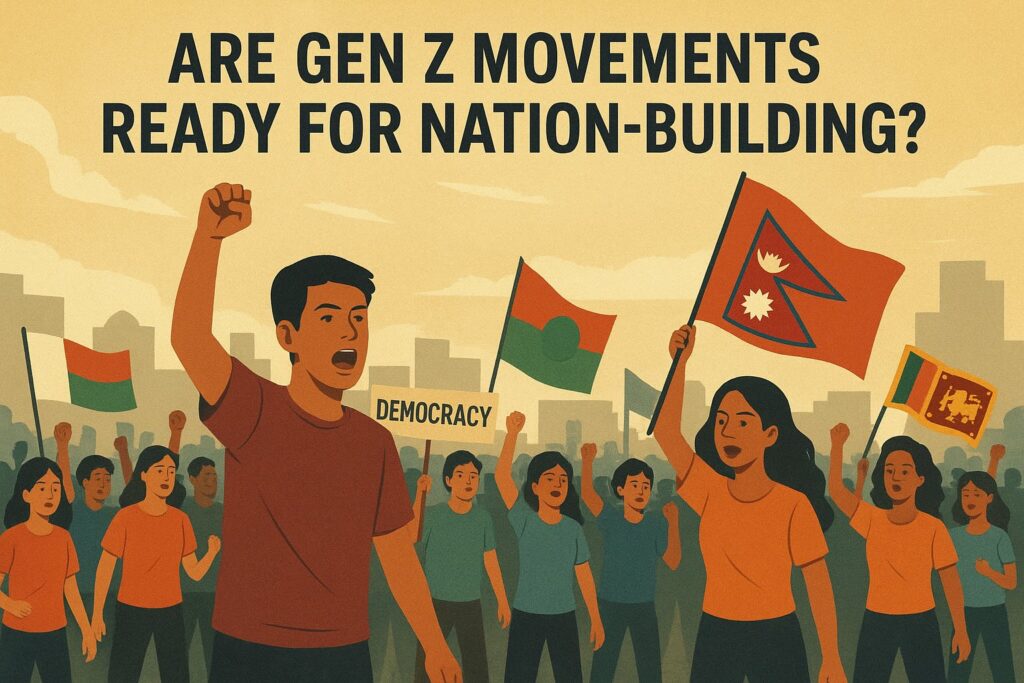
After the Hashtags: Can Movements Led by Youth Truly Lead and Govern?
From Madagascar to Bangladesh, youth-led revolts seem to be hijacked — will they ever achieve their original objectives?
The Global Youth-quake
Over the past three years, a generation raised on Wi-Fi and disillusionment has shaken the political foundations of fragile democracies — from Madagascar to Nepal, Bangladesh, and Sri Lanka. What began as viral hashtags and digital frustration erupted into street movements that dethroned presidents, humbled entrenched elites, and forced institutions to reckon with a demographic too restless to wait its turn.
Each uprising carried its own national grievance: poverty and hunger in Madagascar, corruption, nepotism and censorship in Nepal, job quotas in Bangladesh, economic collapse in Sri Lanka. But all were fuelled by the same generational fire — moral outrage magnified through smartphones.
Yet, as the chants faded, a harder truth emerged: these youth-led revolts have struggled to hold-on and govern what they conquered. Power vacuums appeared quickly, often filled by generals, technocrats, or recycled political elites. The same networks that mobilised millions online disintegrated once the adrenaline of protest subsided.
The result is a paradox: a generation powerful enough to bring down governments but not yet prepared to build new ones.
From Trend to Turning Point
When students and young professionals flooded the streets of Antananarivo, Kathmandu, Dhaka, and Colombo, it felt like a new democratic dawn. Within days to months, parliaments were dissolved, presidents/prime ministers resigned, and new interim leadership emerged. But that euphoria soon met the slow grind of governance.
The movements that defined this Gen Z awakening were never formally coordinated. They were leaderless, fast, and moral. That made them difficult to suppress — and equally difficult to sustain. The same social media infrastructure that allowed real-time mobilisation also encouraged volatility, misinformation, and internal fractures.
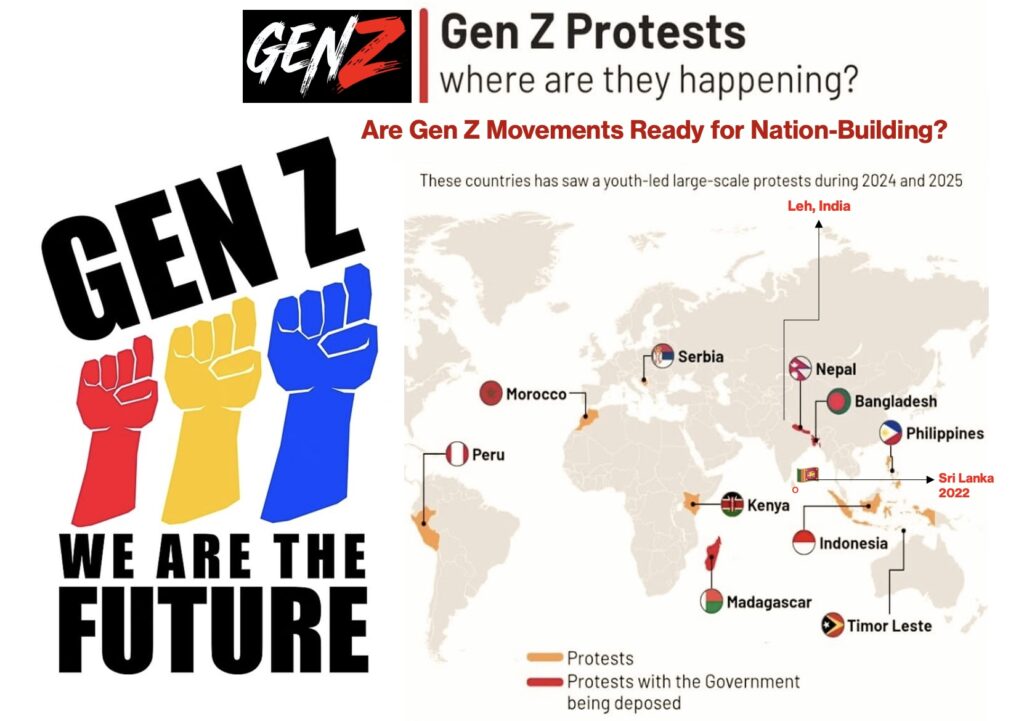
This generational pattern is now visible far beyond South Asia or the Indian Ocean rim. From Peru to Kenya, Morocco to Serbia, Indonesia to Timor-Leste, and the Philippines, digitally mobilised youth movements are once again challenging governments on corruption, taxation, unemployment, and climate inaction. Their tools are new — encrypted chat groups, TikTok live streams, crowdfunding apps — but their structural weakness remains old: moral unity without institutional depth.
Lessons from Four Revolts
Madagascar: From Hunger to Hijack
Madagascar’s October 2025 uprising began as a cry for food and dignity. Underemployment and corruption had crushed young hopes. Gen Z activists, united under the slogan “No More Empty Plates,” forced President Andry Rajoelina to flee the country. Within hours, however, the army stepped in, promising stability — but effectively placing the nation under de facto martial law.
The African Union suspended Madagascar, and Western partners froze aid. The same youth who risked their lives to reclaim democracy suddenly found themselves silenced by the martial law.
As one activist lamented, “We asked for jobs and justice, not uniforms with medals.”
Madagascar remains a cautionary tale — when youth energy lacks an organisational anchor, power reverts to those who already know how to wield it.
Nepal: From Protest to Political Formation
In Nepal, the September 2025 uprising was lightning-fast. What began as outrage over the banning of 26 global social media platforms by the K. P. Sharma Oli government turned into a full-blown revolt within 72 hours. Encrypted apps like Discord and Viber became the new streets of Kathmandu. Under Army’s pressure Prime Minister Oli had to resign for a safe passage.
The post-revolt transition, however, took a different route than Madagascar. Youth leaders such as Miraj Dhungana and civic reformer Sudan Gurung announced the formation of a reformist political party, aiming to institutionalise the protest’s ideals rather than let them fade. Kathmandu Mayor Balen Shah, once touted for the interim premiership, declined short-term power, positioning himself for longer-term reform.
But unity soon splintered. Reformists like Dhungana clashed with urban populists loyal to Shah. The ideological energy of the revolt began to fragment between technocratic policy drafting and grassroots populism.
Nepal’s youth revolution succeeded in turning protest into politics — but not yet into power, need to wait and watch until elections are held in March 2026 under the interim Prime Minister’s governance.
Bangladesh: Revolution Fades into Disillusion
Bangladesh’s 2024 quota protests began as a legitimate demand for job fairness but morphed into a nationwide revolt against decades of entrenched rule by Sheikh Hasina’s Awami League. Within weeks, the government fell, and the army ensured her safe passage out of Dhaka.
What followed was not a democratic renewal but a technocratic takeover. Nobel laureate Muhammad Yunus was parachuted in as caretaker leader with Western backing. The youth who had risked everything were effectively sidelined.
In the ensuing vacuum, extremist elements resurfaced. Violence against Hindus erupted in several districts, temples were vandalised, and properties torched. New Delhi expressed serious concern, with Prime Minister Narendra Modi and the Ministry of External Affairs urging Dhaka to protect minorities and uphold secular values. The interim government promised action, but little transparency followed.
The same youth who had demanded reform now watched as their revolution was rewritten. For many, the coup’s “civilian” face became a reminder that moral protests without political structure breed manipulation.
Sri Lanka: From Collapse to Course Correction
Sri Lanka’s Aragalaya of 2022 was the first major Gen Z uprising in this regional arc — and the most organised. What started as scattered demonstrations over power cuts and food shortages grew into months of coordinated civil resistance. By July, President Gotabaya Rajapaksa had fled.
Unlike elsewhere, Sri Lanka’s power transfer occurred constitutionally. The military stayed neutral; Parliament appointed Ranil Wickremesinghe as interim president; and India’s rapid economic aid, combined with an IMF rescue, prevented total collapse.
Three years later, Sri Lanka’s inflation has stabilised, tourism has revived, and many former protesters now run civic transparency networks and policy watchdog groups. Aragalaya didn’t just topple a regime — it seeded a culture of accountability.
Sri Lanka’s Gen Z may not hold office, but they now hold influence — a quiet evolution that most other movements have yet to achieve.
A Wave That Hasn’t Ebbed: New Fronts from Peru to Kenya
The spirit of youth rebellion has not receded. In Peru, protests reignited in mid-2025 over pension reforms and congressional corruption, led by a digitally literate middle class. In Kenya, the #RejectFinanceBill movement forced the government to retract unpopular tax measures.
Meanwhile, Morocco, Serbia, Indonesia, and the Philippines continue to witness sporadic, digitally driven protests against corruption and inequality. These newer movements share the same DNA: online coordination, decentralized leadership, and civic outrage.
They also share the same risk: speed without structure. The faster a movement rises, the faster it can fragment.
Power Without Preparation
In every uprising, the story ends the same way: youth win the moral argument, but someone else writes the political script. Gen Z movements are remarkable at mobilisation — they understand momentum, optics, and narrative. But governance is a slower language: it requires patience, compromise, and technical literacy.
Most youth-led groups lack:
Institutional understanding — how ministries, budgets, and parliaments work.
Organisational continuity — how to sustain networks once protests end.
Policy coherence — how to convert slogans into legislation.
So, once victory arrives, they face an administrative vacuum — one quickly occupied by militaries, bureaucrats, or opportunistic technocrats.
In Madagascar, it was the army.
In Bangladesh, Yunus’s elite caretaker circle.
In Nepal, the re-emergence of old party cadres.
This is not about capability; it’s about exposure. These young movements were never invited into power before — so they had to learn governance after seizing it.
Sri Lanka’s Cautious Success
Sri Lanka remains the closest example of what reform beyond revolt might look like. The Aragalaya generation learned to manage logistics, handle press, negotiate with police, and run relief operations. When power changed hands, they didn’t disappear.
Some now advise municipalities on budgeting and environmental projects. Others built civic-tech platforms to track government spending. Crucially, the military’s restraint and India’s stabilising role gave them room to mature.
The lesson: institutions matter more than intensity. A youth movement can only outlast its protests if the state it challenges still retains enough structure to absorb reform.
The Global Pattern: Digital Agility, Institutional Fragility
The pattern repeats across continents.
Social media provides velocity; bureaucracy demands endurance.
Hashtags build moral clarity; institutions require procedural skill.
From Lima to Nairobi, these digital-era revolts demonstrate what the Brookings Institution calls “flash democracy” — the ability to ignite moral outrage faster than systems can adapt. Yet moral intensity alone cannot run a state. Without the slow work of policy design, the energy dissipates — or worse, gets captured by those more practiced in power.
Can They Govern?
Governance is compromise, not catharsis. It demands negotiation, law, fiscal planning, and accountability — qualities not rewarded in the performative culture of viral politics.
Yet, all is not lost. Across the countries we’ve chronicled, small but meaningful efforts are taking root:
In Sri Lanka, youth activists are advising on transparency and green jobs.
In Nepal, Dhungana’s group has begun drafting charters for local governance reform.
In Kenya, protest leaders have launched civic boot camps teaching how to read government budgets.
If scaled, these micro-experiments could evolve into the civic literacy that every democracy needs.
Greed, Idealism, or Opportunity?
Skeptics dismiss these movements as naïve or opportunistic. Yet, greed is a symptom of the same political culture they inherited. Many youth leaders who appear co-opted are, in fact, learning survival in systems designed to marginalise them.
Still, accountability must start within.
If Gen Z revolutions want to escape the fate of their predecessors, they must institutionalise transparency — rotating leadership, publishing funding, and rejecting personality cults. The moral high ground is their only renewable resource.
The Real Test: From Protest to Policy
Nation-building is not the extension of protest — it is its antithesis. It demands bureaucratic stamina, administrative literacy, and a willingness to get things wrong before getting them right.
To truly govern, this generation must:
Create civic schools that teach how governance works.
Engage local governments where reform is visible and measurable.
Forge alliances with reformist elders, learning pragmatism without inheriting corruption.
If moral energy meets institutional discipline, these revolts could evolve into the most transformative democratic force since the Arab Spring.
After the Hashtags
Gen Z has already proven it can upend power faster than any generation in modern history. But power without process is still instability.
Whether in Madagascar or Dhaka, Kathmandu or Colombo, the true revolution will not be televised — it will be drafted in policy rooms, budget tables, and city councils.
Until that happens, the story of youth-led revolts will remain unfinished — brilliant at breaking, still learning to build.
The hashtags may have faded, but the question lingers:
Can a generation that dethroned presidents also learn to govern nations?
Explore Related Articles on Gen – Z Protests
After the Hashtags: Can Youth-Led Revolts Really Govern? | dated October 23, 2025 | 05:00 PM
Sri Lanka Gen Z Movement: From Aragalaya Revolt to Democratic Reset | dated October 21, 2025 | 12:45 PM
Bangladesh Gen Z Revolution: From Quota Rage to Political Disillusion | dated October 21, 2025 | 07:30 AM
Nepal Gen Z Movement: From Street Revolt to Political Formation | dated October 20, 2025 | 07:13 PM
Madagascar Gen Z Coup: Digital Youth Topple Rajoelina, Now Face Military Rule | dated October 20, 2025 | 04:31 PM