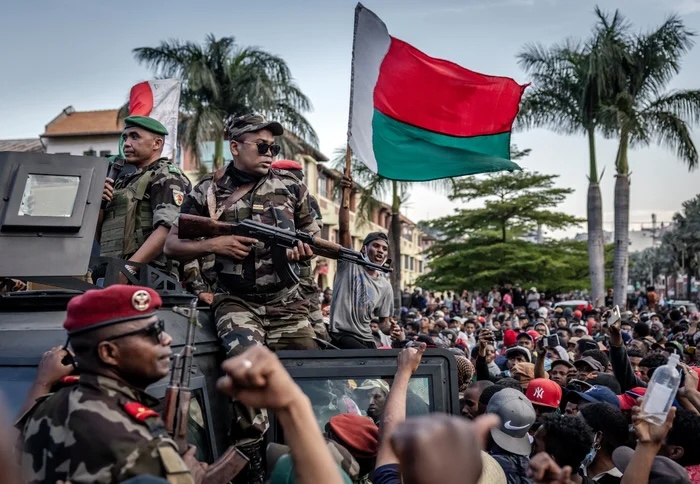
Madagascar Gen Z Coup: Digital Youth Topple Rajoelina, Now Face Military Rule
Turning the Page — but Not Yet Rewriting the Story
Antananarivo, Oct 20, 2025 | The Madagascar Gen Z coup that began as a digital rebellion for basic rights has now entered a darker, more complex phase. What started with students and jobless youth rallying online for food, water and electricity has culminated in the swearing-in of General Michael Randrianirina as president on 17 October 2025. The army promises “stability,” but many young activists fear their revolution has been stolen.
Youth Uprising vs Uniformed Reality
By early October, fuel shortages, inflation and corruption had ignited youth anger. TikTok videos showing empty shops spread faster than official statements could suppress them. Within days, massive protests forced President Andry Rajoelina to flee. But when the army seized control, proclaiming itself the guardian of order, the movement’s idealism collided with hard power.
Gen Z spokesperson Tolotra Andrianirina told (Reuters), “We asked for light, not new shadows. We wanted reforms, not replacements.” Yet the new military council insists it is acting “in the national interest” and will hold elections only after restoring order.
Euphoria Turns to Apprehension
The week after the coup, celebrations gave way to doubt. Internet access was briefly restricted; media outlets faced military monitoring. Many youth collectives have regrouped online, debating whether to negotiate with or resist the junta. Civil-society leaders warn that while the army calls this a “transition,” history suggests such transitions rarely end quickly.
The African Union has suspended Madagascar, and several Western partners have frozen aid — a signal that the international community views the current transition as de facto military rule. Still, public frustration with old elites remains so deep that parts of the population cautiously back the army, viewing it as a temporary stabiliser rather than a usurper.
The Real Question: Reform or Replacement?
Madagascar’s crisis has crystallised a generational dilemma: how can youthful outrage become sustainable governance? The Madagascar Gen Z coup demonstrates that viral mobilisation can unseat a regime but cannot instantly build institutions. Economists warn that unless the junta shares power with civic representatives, social unrest will return once the glow of change fades.
Regional Echoes: Nepal and Bangladesh Take Divergent Paths
Across South Asia, the same digital-native impulse is playing out in strikingly different ways.
In Nepal, the Gen Z uprising of 2025 has evolved into structured politics, with youth leader Miraj Dhungana and reformist blocs drafting party charters for the March 2026 elections, aiming to institutionalise change rather than ignite new revolts — although undercurrents remain visible.
By contrast, Bangladesh mirrors Madagascar’s frustration more closely. There, the post-Hasina transition has been dominated by Nobel laureate Muhammad Yunus, whose interim administration has stalled fresh elections. Many young activists who once led the 2024 revolution now accuse the new regime of “intellectual capture” — replacing one monopoly of power with another. Like Madagascar’s Gen Z, they find themselves shut out of the corridors they helped open.
These intertwined stories form the backbone of Tattvam News Today’s forthcoming special series, “Gen Z Revolutions 2025: Digital Youth and the New Regime Wars,” exploring how and whether a connected generation is reshaping — and being reshaped by — power across Africa and South Asia.
Conclusion
A week after the Madagascar Gen Z coup, the euphoria of victory has turned into the vigilance of survival. The same youth who toppled a president now confront the question that defines their era: can a digital revolution govern a real-world nation? Their answer — and the world’s response — will determine whether this becomes another cycle of coups or the dawn of a generational renaissance.