Chandrayaan-2 Observes Solar Impact on Moon – A Breakthrough in Lunar Science
India’s Chandrayaan-2 mission has achieved an extraordinary scientific milestone by recording the first-ever evidence of how the Sun’s Coronal Mass Ejection (CME) influences the Moon’s atmosphere. The Indian Space Research Organisation (ISRO) announced the discovery on October 18, 2025. This marks a remarkable advancement in planetary science, shedding light on how solar storms interact with airless celestial bodies.
Decoding the Solar Strike
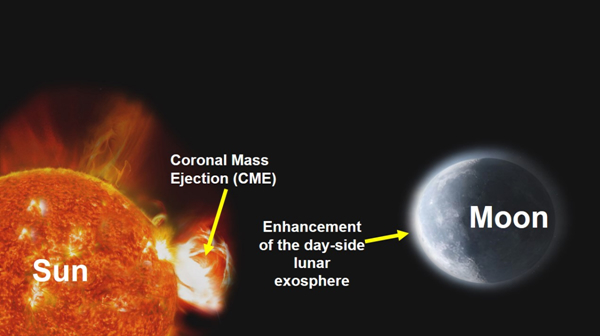
The breakthrough observation was made by the Chandra’s Atmospheric Composition Explorer-2 (CHACE-2) instrument onboard the Chandrayaan-2 orbiter. During a massive CME event on May 10, 2024, the sensor captured a sudden surge in both pressure and particle density within the Moon’s dayside exosphere. The readings showed a more than tenfold increase in these parameters, confirming long-held theories about the dramatic influence of solar activity on the lunar environment.
This direct evidence establishes Chandrayaan-2 as the first mission to measure the tangible effects of solar eruptions on the Moon, enhancing our understanding of how cosmic weather shapes planetary surfaces without protective atmospheres.
The 18 months’ delay in announcement reflects the standard scientific reporting cycle—from raw telemetry acquisition to publication in a global journal—before ISRO made the discovery public. This ensures that the findings are fully verified, reproducible, and credible for the wider scientific community.
What Are Coronal Mass Ejections?
Coronal Mass Ejections are colossal bursts of plasma and magnetic energy ejected from the Sun’s surface. These energetic clouds, composed mainly of charged hydrogen and helium particles, can travel at speeds up to three million kilometres per hour. When directed toward the Earth, they can disrupt satellites and power grids; when aimed toward the Moon, their charged particles directly interact with the exposed lunar surface, vaporising dust grains and releasing neutral atoms into the exosphere.
Findings Published in Global Journal
ISRO’s study, titled “Impact of a Coronal Mass Ejection on the Lunar Exosphere as Observed by CHACE-2 on Chandrayaan-2 Orbiter,” was published in Geophysical Research Letters on August 16, 2025. The paper, co-authored by Dhanya M. B., Chemukula Mathin Yadav, Smitha V. Thampi, and Tirtha Pratim Das, documents how CME-driven solar particles modify the lunar exosphere’s neutral composition and pressure.
These findings validate theoretical predictions that had previously lacked observational data. The results also strengthen the view that the Moon’s near-vacuum atmosphere is highly dynamic, responding rapidly to external solar influences.
The Moon’s Fragile Exosphere
Unlike Earth, the Moon lacks a global magnetic field to shield it from solar radiation. As a result, its tenuous exosphere—comprising trace amounts of hydrogen, helium, sodium, and potassium—acts like a sensitive scientific gauge of solar activity. The Chandrayaan-2 findings prove that the lunar environment is not static but highly variable, fluctuating with each solar storm or flare that hits the surface.
Understanding these variations is critical for future lunar base construction, where astronauts and instruments will need protection from radiation and electrostatic disturbances caused by solar gusts.
Chandrayaan-2’s Continuing Legacy
Launched on July 22, 2019, aboard a GSLV Mk-III rocket from Sriharikota, Chandrayaan-2 carries eight scientific instruments. Despite the crash of the Vikram lander in 2019, the orbiter continues to operate in a 100×100 km polar orbit, transmitting high-value data six years after launch. It remains one of ISRO’s most productive missions, often called the “quiet workhorse” of India’s lunar exploration programme.
The CHACE-2 instrument, developed by ISRO’s Space Physics Laboratory, has now delivered groundbreaking insights that will guide upcoming lunar missions, including Chandrayaan-3 and planned international collaborations for Moon-based observatories.
Implications for Future Missions
These observations open new doors for research on space weather impacts on airless planetary bodies like Mercury and asteroids. By quantifying how solar plasma interacts with surface materials, scientists can predict radiation hazards and chemical changes more accurately.
For India, this success reinforces ISRO’s reputation as a global leader in space science, capable of performing long-term, high-precision observations that enrich humanity’s understanding of the cosmos.