The Girl with the Green Eyes: She Didn’t Know She Was Famous
Sharbat Gula’s extraordinary journey — from a war-scarred child to an unwitting global icon, to a refugee rebuilding life in Italy.
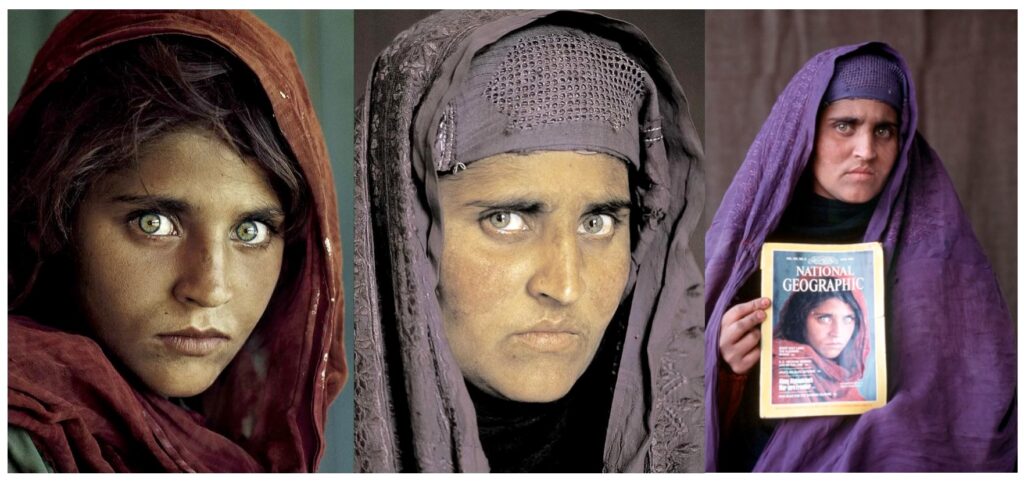
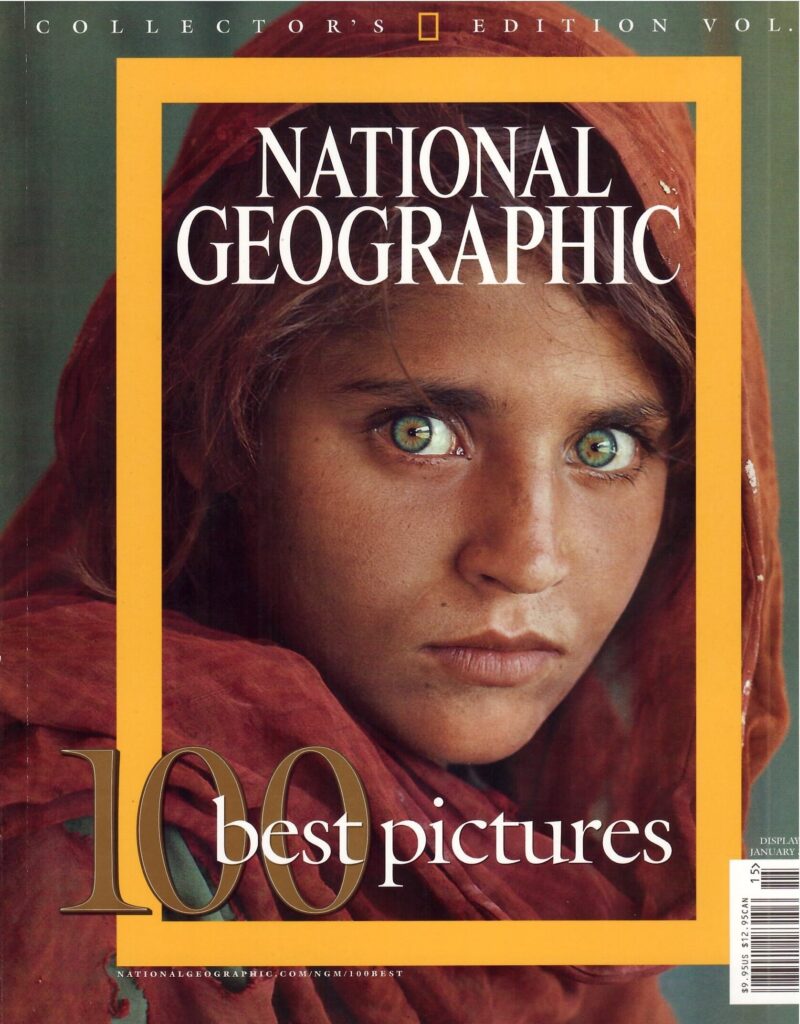
In the summer of 1985, a photograph stopped the world in its tracks. A young Afghan refugee girl with sea-green eyes stared directly into the camera — her gaze fierce, frightened, unforgettable. Draped in a torn red shawl, she seemed to embody both the beauty and the brutality of her homeland. When National Geographic published that image on its June cover, it became one of the most recognized portraits of the twentieth century — an instant emblem of Afghanistan’s pain and perseverance.
The world called her The Afghan Girl.
But the girl herself, Sharbat Gula, had no idea the photograph existed.
For 17 years she lived in anonymity — raising children in refugee camps, struggling to survive, utterly unaware that her face had become a global symbol. By the time she first saw her own image in 2002, it had already hung in museums, won awards, and defined a generation’s idea of the “victim of war.”
A Childhood in the Crossfire
Sharbat Gula was born around 1972 in the Kot district of Nangarhar, eastern Afghanistan, into a Pashtun family of modest farmers. Her early childhood unfolded amid orchards and clay-walled homes — until Soviet helicopters appeared over the mountains in 1979. She was six.
Her mother died of appendicitis just before the bombing began; her father fled with Sharbat, her siblings, and her grandmother across the Khyber Pass into Pakistan. They ended up in Nasir Bagh, a sprawling refugee camp outside Peshawar that, at its height, held over three million Afghans.
“I remember the dust,” she later told an Afghan reporter. “Everything was dust — our faces, our food, even our dreams.”
The camp’s makeshift schools offered the only escape from monotony. One winter morning in 1984, a foreign photographer entered her classroom — a man she’d never seen before.
The Photograph
That man was Steve McCurry, an American photojournalist documenting the fallout of the Soviet invasion. When his eyes met the twelve-year-old girl’s, he sensed what he called “the whole tragedy of Afghanistan in one face.” He raised his Nikon, took a few frames, and moved on.
Months later, one of those frames — the girl in the red scarf, eyes blazing — appeared on National Geographic’s cover. The editors never learned her name. They captioned it simply: Afghan Girl.
The image became an icon of the Cold War era — reprinted on posters, postage stamps, and humanitarian appeals. It symbolised innocence amid devastation, beauty amid ruin. Yet the subject herself vanished into the refugee sprawl, her identity a mystery even to the magazine that had immortalised her.
Life Behind the Legend
While the photograph traveled the world, Sharbat’s life followed a familiar refugee rhythm — hardship, marriage, motherhood, grief. She wed Rahmat Gul, a fellow refugee, at about 13 and settled in Peshawar. They had four daughters; one died in infancy. Her husband later succumbed to hepatitis C.
“We were refugees in someone else’s country,” she once told the BBC. “We had no home, no papers, no tomorrow.”
For nearly two decades, she never heard of National Geographic or of the Western fascination with her portrait. Her children grew up in poverty, and she blended into the vast, forgotten population that her own face had come to represent.
The Rediscovery
In 2002, as the refugee camp prepared to close, McCurry returned to Pakistan on a mission to find the Afghan Girl. After weeks of dead ends, a man recognised her description: “That is my sister.”
Soon McCurry stood again before Sharbat Gula — now a woman in her late twenties, veiled and wary. She didn’t remember the photograph being taken. Scientists used iris-pattern recognition to confirm the match: the same unmistakable eyes.
When she was shown the famous cover, she stared quietly for a long time. “That is me,” she said at last.
National Geographic funded her family’s medical treatment and a pilgrimage to Mecca. She accepted politely but avoided publicity. “I do not like being famous,” she told the team. “My life is hard enough.”
From Icon to Outcast
Her fame caught up with her again in 2016 — this time for the wrong reasons. As Pakistan tightened its border controls, authorities accused Sharbat of obtaining a fake national ID card. Her face, once celebrated, now appeared in police mug shots.
She spent 15 days in jail before being deported to Afghanistan. Then-President Ashraf Ghani personally welcomed her at the palace, calling her “a symbol of the suffering of Afghan refugees.” He gifted her an apartment in Kabul and a $700 monthly stipend. Posters across the capital read Welcome Home, Daughter of Afghanistan.
But homecoming did not mean peace. Kabul’s economy faltered, insurgents prowled nearby provinces, and Sharbat kept mostly to herself. “I feel like a tree without roots,” she told a local journalist.
Controversies and Shadows
Even the photograph that made her famous carried its own controversies. Some critics later accused National Geographicof exploiting a child refugee without consent, arguing that her identity and privacy had been compromised for artistic glory. The image, they said, reflected the West’s appetite for “beautiful suffering.”
McCurry himself faced separate scrutiny in 2016 when experts discovered that several of his published images — though not the original Afghan Girl portrait — had been digitally altered to remove background elements or adjust composition. The revelations reignited debate about whether photojournalism should ever cross into aesthetic manipulation.
Defending himself, McCurry insisted he had long since moved from journalism to “visual storytelling.” About Sharbat’s portrait, however, he maintained: “That picture was pure truth. Her eyes told everything — war, loss, hope — in one look.”
The Fall of Kabul and a Second Exile
When the Taliban retook Kabul in August 2021, Sharbat Gula once again felt history closing in. Her fame, once her shield, now marked her as vulnerable — a woman known for defying the Taliban’s strict views of female visibility.
Humanitarian networks appealed for help. Responding swiftly, the Italian government arranged her evacuation as part of its refugee resettlement initiative. In November 2021, she landed in Rome with her children, greeted quietly by aid workers. Prime Minister Mario Draghi’s office described her relocation as “a gesture of solidarity and respect for Afghan women.”
A Fragile Peace in Italy
Today, in her early fifties, Sharbat Gula lives in a modest apartment in a small Italian town. She rarely grants interviews, preferring privacy after a lifetime of involuntary exposure. Local organizations help her with language lessons, health care, and schooling for her daughters.
“She is shy but determined,” said a volunteer from the refugee agency that supports her. “She wants her children to grow educated, not photographed.”
Learning Italian, she admits, has been difficult. “Every word reminds me how far I have come,” she said in a 2024 interview. “But at least now my children sleep without fear.”
The Weight of an Image
Steve McCurry still calls Sharbat Gula “the most extraordinary subject I ever photographed.” Yet he has also expressed regret that the image overshadowed the person. “We made her a symbol,” he said. “I hope now she can simply be herself.”
Sharbat’s own feelings remain conflicted. In rare public comments, she has said she wishes her photo “had not brought me so much trouble.” And yet she recognises its strange power: “If my eyes showed the pain of my people, then I am glad they were seen.”
A Full Circle
From a barefoot girl fleeing bombs to a mother rebuilding life in exile, Sharbat Gula’s story mirrors the history of modern Afghanistan — invasion, loss, endurance, and diaspora. Her photograph froze a moment of fear; her life has been an exercise in survival.
Four decades on, she is no longer merely the face of war. She is a woman learning peace, slowly, word by word, in a foreign language, on a foreign shore.
And perhaps, for the first time, the world is looking at her not as an icon — but as a person.