Bagram and Beyond: Part 3 – Trump’s ‘China Nuke Containment’ Smoke Screen and the Rare Earth Reality
The Return of Bagram – A Ghost from America’s Past
When Donald Trump thundered on a U.S. campaign stage that he wanted to “retake Bagram Airbase” in Afghanistan, many dismissed it as bluster. But behind that statement lies a deeper truth: Bagram is not about the past — it’s about the future of power in Asia.
Bagram, lying 50~60 kilometres north of Kabul, was once the operational heart of America’s two-decade-long “War on Terror.” Originally built by the Soviets, expanded by the U.S., and abandoned in 2021, it now sits as a symbol of lost dominance.
Yet suddenly, Washington wants it back.
Why?
Because this old airbase is a gateway to new ambitions — where the real war is not about terrorism or ideology, but about minerals, markets, and influence.
Trump’s Nuclear Rationale – The Perfect Smoke Screen
Trump’s justification sounded grandiose:
“Bagram is just an hour away from where China makes its nuclear weapons.”
But this claim is strategically hollow.
In the 21st century, America doesn’t need a dusty Afghan airbase to monitor China’s nuclear facilities. It can do so through satellites orbiting the Earth. Why rely on Bagram when every inch of China is already within reach — whether from undisclosed nuclear submarine positions in the Pacific or from airbases spread across Europe and the Indian Ocean?
So why revive Bagram?
Because “nuclear monitoring” is the public excuse. The real agenda is far more material — Afghanistan’s hidden treasure beneath its mountains.
The Real Prize Beneath – Afghanistan’s Trillion-Dollar Treasure
Afghanistan, often called the “graveyard of empires,” might soon be known for something else — a goldmine of critical minerals.
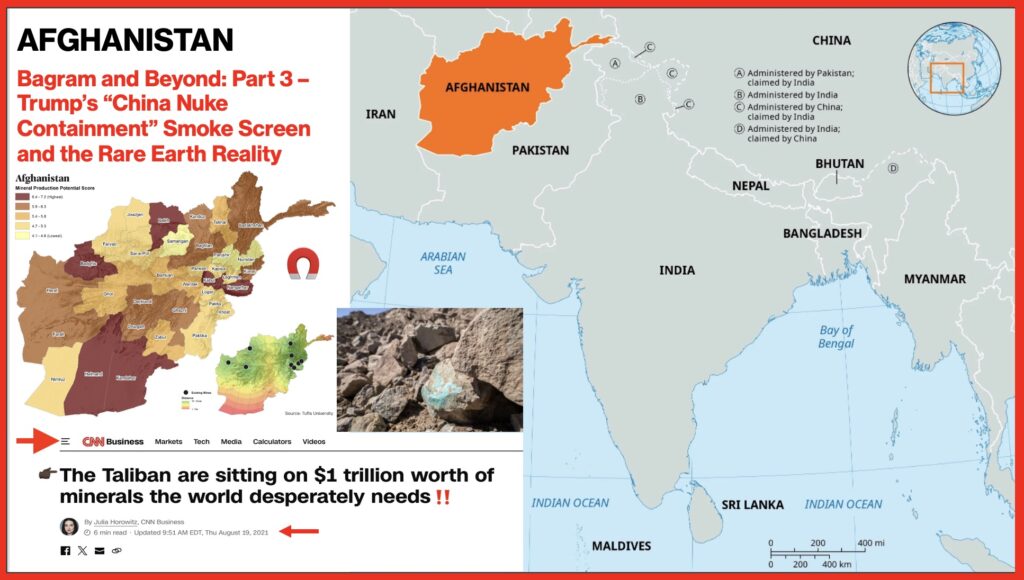
In 2010, the U.S. Geological Survey (USGS) and the Pentagon estimated that Afghanistan holds nearly US $1 trillion worth of mineral wealth — including lithium, cobalt, copper, rare earths, and iron ore.
These are not ordinary metals. They are the DNA of the future — the raw materials for batteries, smartphones, solar panels, and advanced missiles.
Whoever controls these minerals will control the supply chains of the 21st century.
And that is what has quietly drawn Washington’s eyes back to Kabul.
Why Rare Earths Matter to the United States
Lithium and rare earths power everything from Teslas to Tomahawks.
Yet the uncomfortable truth is this: America depends on China for almost 80% of its processed rare earth imports.
For years, Beijing dominated extraction, refining, and export — turning itself into the world’s refinery for the modern age.
Now, as U.S.–China tensions escalate, Beijing has begun using that dominance as leverage. It has restricted exports of gallium, germanium, and graphite — all vital for chips and batteries. In short, China has weaponised its minerals.
For Washington, this was a wake-up call.
The U.S. cannot afford to have its technological lifeline throttled by a rival power.
Hence, it is desperately searching for alternate sources — and its eyes have turned to Afghanistan and Pakistan, both rich in untapped reserves and conveniently located at the crossroads of Eurasia.
Keeping “options open” is the new strategy: if not China, then the Hindu Kush.
Thus, when Trump speaks of “retaking Bagram,” what he really means is re-entering Afghanistan’s mineral geography.
China’s Quiet Head Start – The Mineral Silk Road
While Washington debates and postures, China has already moved.
Through its Belt and Road Initiative (BRI) and state-linked companies, Beijing has quietly secured mining rights in northern Afghanistan — particularly in Mes Aynak, one of the world’s largest copper deposits, and rare earth zones near the Amu Darya Basin.
For China, the logic is simple:
- Stabilise Afghanistan enough to extract resources.
- Build logistics corridors linking it to Xinjiang.
- Keep the U.S. out of Central Asia.
By contrast, for the U.S., a revived presence in Bagram would allow intelligence mapping, contract oversight, and proximity to future resource hubs — all justified as “counter-terror cooperation.”
In this new “Great Game,” the player with the drill bit, not the drone, wins.
Why Afghanistan May Prefer India – Trust Over Power
Amid this tug of war, Afghanistan finds itself courted by all — but truly trusting only one: India.
India’s record in Afghanistan has been constructive, not coercive.
Over the past two decades, New Delhi has invested over US $3 billion in rebuilding Afghanistan — from the Zaranj–Delaram highway to the Parliament building and the Salma Dam.
Unlike the U.S. or China, India never demanded military bases or mineral concessions in return.
Security Without Occupation
India’s approach has always been to help Afghanistan stand on its own feet — through education, medical aid, training, and limited defence support, but without imposing foreign boots.
For Kabul, this model is politically acceptable and emotionally resonant: it strengthens sovereignty, not dependency.
India’s recent decision to upgrade its embassy in Kabul signals a readiness to engage cautiously but consistently — focusing on infrastructure, healthcare, and possibly limited security cooperation under Afghan control.
Resource Diplomacy Under Afghan Ownership
Afghanistan knows its minerals are both a blessing and a curse.
What it seeks is a partner who can develop resources without dominating politics.
China’s experiences in Sri Lanka’s Hambantota Port and Pakistan’s CPEC have become cautionary tales.
Kabul does not want another debt trap.
India’s track record — transparent funding, developmental focus, and absence of coercion — makes it the preferred partner for future exploration of lithium and rare earth projects.
It is not just about economics; it is about respect and sovereignty.
Why the U.S. and Russia Are No Longer Welcome
Afghanistan has long memories.
The Soviet invasion in 1979 and the American occupation after 2001 both ended in destruction and distrust.
Today’s Taliban government may seek recognition, but it will not tolerate foreign troops or military control again — no matter who offers it.
That makes any U.S. talk of returning to Bagram politically radioactive.
Even Russia’s occasional gestures toward “regional stability” are met with scepticism in Kabul.
Both powers symbolise interference; neither represents partnership.
India, on the other hand, offers what neither could: cooperation without control.
India’s Realisation – Guarding the Asian Chessboard
New Delhi understands the subtext of America’s new interest.
Behind every word about “security” or “terrorism” lies the shadow of resource diplomacy.
India’s renewed engagement with Afghanistan — from humanitarian aid to potential geological cooperation — is therefore strategic, not sentimental.
By keeping communication open with the Taliban, maintaining ties with Iran and Russia, and participating in the Moscow Format talks, India ensures that no extra-regional force monopolises continental Asia again.
For India, the objective is twofold:
- Prevent American re-entry under economic camouflage.
- Keep Afghanistan’s mineral wealth within a regional framework led by Asia — particularly India, Iran, and Central Asia — not by Western corporations.
The Bigger Picture – From Bagram to Chabahar
Zoom out, and a pattern emerges.
While Bagram symbolises the West’s military legacy, Chabahar Port in Iran represents Asia’s answer — development through connectivity.
For India, the two are connected by principle:
- Bagram is the symbol of coercive control.
- Chabahar is the symbol of cooperative connectivity.
Ironically, as Washington tries to reassert itself in Afghanistan, it has simultaneously imposed sanctions on Chabahar, undermining India’s legitimate route to Afghanistan and Central Asia.
The more it squeezes, the more New Delhi looks east and north — toward Eurasian alliances and self-reliant trade corridors.
If the U.S. truly wishes to remain relevant in Asia, it must learn to influence without occupying.
The Emerging Balance – The Asian Equation Resets
Across Eurasia, a new consensus is taking shape.
Regional powers — India, Iran, Russia, and even China — agree on one principle: “No more foreign bases.”
Security in Asia must be decided by Asians themselves.
This is the real outcome of the Moscow Format consultations — a quiet but historic shift from dependency to autonomy.
For India, it perfectly aligns with its doctrines of “Neighbourhood First” and “Strategic Autonomy.”
India’s message to Washington is subtle but firm:
“Partnership, yes. Patronage, no.”
Finally, The Great Game Rewritten
The drama surrounding Bagram is not about a single airbase; it is about who writes the next chapter of Asian geopolitics.
Bagram represents the ghost of past dominance — an era of bombers and bases.
Chabahar, by contrast, represents the promise of the future — corridors, commerce, and cooperation.
Afghanistan stands between the two — a country of immense potential, still searching for partners who will build, not occupy.
For the first time in decades, India is no longer a spectator in this Great Game; it is a shaper of the board itself.
By opposing militarisation, supporting diplomacy, and focusing on shared development, New Delhi is laying the foundations of a continental order defined by consent, not coercion.
In this new Great Game, power will not be measured by the bases one holds — but by the corridors one builds.
Explore Related Articles
Bagram and Beyond: Part 3 – Trump’s “China Nuke Containment” Smoke Screen and the Rare Earth Reality | dated October 18, 2025 | 05:00 PM
Bagram and Beyond: Part 2 – India + Afghanistan’s New Game | dated October 18, 2025 | 04:00 PM
Bagram and Beyond: Part 1 – Regional Power Realignments | dated October 17, 2025 | 08:33 PM
India–Taliban Diplomatic Relations: A New Geopolitical Chapter in South Asia | dated October 10, 2025 | 01:44 PM
Early Moves on Bagram Air Base: US–Taliban Handover Reports and Strategic Analysis from April 2025 | dated September 19, 2025 | 02:27 PM
Trump Seeks to Reclaim Bagram Air Base from Taliban: Full Coverage and Reactions | dated September 19, 2025 | 12:37 PM
US Revokes Sanctions Exemption on Iran’s Chabahar Port, Impacting India’s Strategic Gateway | dated September 18, 2025 | 11:05 PM
Afghanistan, China, Pakistan Hold 6th FMs Meeting in Kabul on Regional Ties, India Watchful | dated August 21, 2025 | 09:04 PM