Bagram and Beyond: Part 1 – Evolving Regional Power Alliances
The Bagram Airbase Dispute and Emerging Regional Alignments
Afghanistan has once again become the focal point of global geopolitical turbulence. U.S. President Donald Trump’s recent declaration that he intends to “retake Bagram Airbase” has reignited debate about America’s unfulfilled ambitions in Central Asia. Speaking at a televised event covered by Deutsche Welle (DW), Trump claimed, “We’re trying to get it back… we want that base back soon, and if they don’t do it, bad things will happen.” What seemed like campaign bravado has transformed into a declared geopolitical objective.
Bagram’s Strategic Geography and Historical Role
Bagram lies about 50~60 kilometres north of Kabul and is one of the largest military installations ever built in Central Asia. Initially constructed by the Soviets in the 1950s and later expanded by the U.S., it served as the operational core of America’s “Global War on Terror” for two decades. From 2001 until the final withdrawal in 2021, Bagram functioned as the command centre for drone operations, logistics, and surveillance across Afghanistan, Pakistan, and parts of western China.
Its location makes it pivotal. Within operational range of China’s Xinjiang, the Central Asian republics, and the Iranian plateau, Bagram offers the ability to project airpower across the northern Asian heartland. Equally significant is its southern reach — less than an hour’s flight from Islamabad and within extended reconnaissance range of northern India. In an era where the U.S. views India not merely as an ally but an autonomous regional power shaping supply chains and technology ecosystems, this proximity has new meaning.
A revitalised Bagram would serve as a pressure node on China, Iran, and Russia’s southern flank, while also offering surveillance leverage over South Asia. This multidirectional reach explains why the base remains coveted for any U.S. administration seeking a continental foothold after its 2021 withdrawal.
Trump underscored this advantage bluntly in the DW interview: “One of the reasons we want the base is it’s an hour away from where China makes its nuclear weapons.” Though geographically exaggerated, the remark underscores that Bagram’s purpose lies not in counterterrorism but in strategic containment — primarily of China and, secondarily, other regional challengers.
The Contradiction within U.S. Policy
The irony runs deep. As Lisa Curtis, former Deputy Assistant to the President and Senior Director for South and Central Asia at the U.S. National Security Council, reminded DW, the 2020 Doha Agreement negotiated under Trump himself mandated the complete withdrawal of all U.S. forces by May 2021. “There was never any mention in the agreement about U.S. forces staying at Bagram,” she stated.
Thus, the same administration that now seeks to “retake” Bagram had already committed to abandoning it — revealing a domestic political calculus behind Trump’s renewed rhetoric. Domestically, such remarks fuel his campaign narrative of reversing President Biden’s “chaotic withdrawal.” Internationally, they signal an attempt to reassert American primacy in a region now dominated by Eurasian powers.
Even within the U.S. strategic community, experts admit that a reoccupation of Bagram is militarily implausible. A Taliban Foreign Ministry official quickly rejected the idea, stating that “military presence has never been accepted by Afghans throughout history.”
DW analysts noted that even in the unlikely event the U.S. were invited back, its role would likely be confined to covert counterterrorism missions against ISIS-K — a common adversary of both Washington and the Taliban. As one analyst observed, “The Taliban fought U.S. and NATO forces for twenty years; they will not now surrender sovereignty to the same occupiers.”
Regional Reactions and the Moscow Format Consensus
If Trump’s rhetoric was meant to test regional waters, it did — and none were favourable. The Moscow Format Consultations on Afghanistan, attended by Russia, China, Iran, India, Pakistan, and the Taliban government, produced a joint declaration rejecting any extra-regional military basing in Afghanistan. The statement, though diplomatically phrased, unmistakably targeted Washington’s revived interest in Bagram.
A Rare Convergence in Eurasian Diplomacy
For the first time in years, India’s position coincided with that of China, Iran, and even Pakistan (and Russia) — all opposing foreign militarisation of Afghanistan. India’s rationale, however, differed. While Moscow and Beijing viewed it as part of a multipolar order and Islamabad aimed to limit U.S. oversight, New Delhi prioritised stability and protection of trade corridors such as the International North–South Transport Corridor (INSTC) and the Chabahar Port project in Iran.
This convergence marks a decisive shift: the era of uncontested U.S. dominance in continental Asia has ended.
Afghanistan’s Diplomatic Recalibration and Engagement with India
The historic visit of Afghanistan’s Foreign Minister Amir Khan Muttaqi to India in October 2025 cemented this new orientation — the first high-level contact since 2021. Discussions focused on humanitarian aid, regional trade, and counterterrorism cooperation.
India’s Subtle Diplomatic Reframing
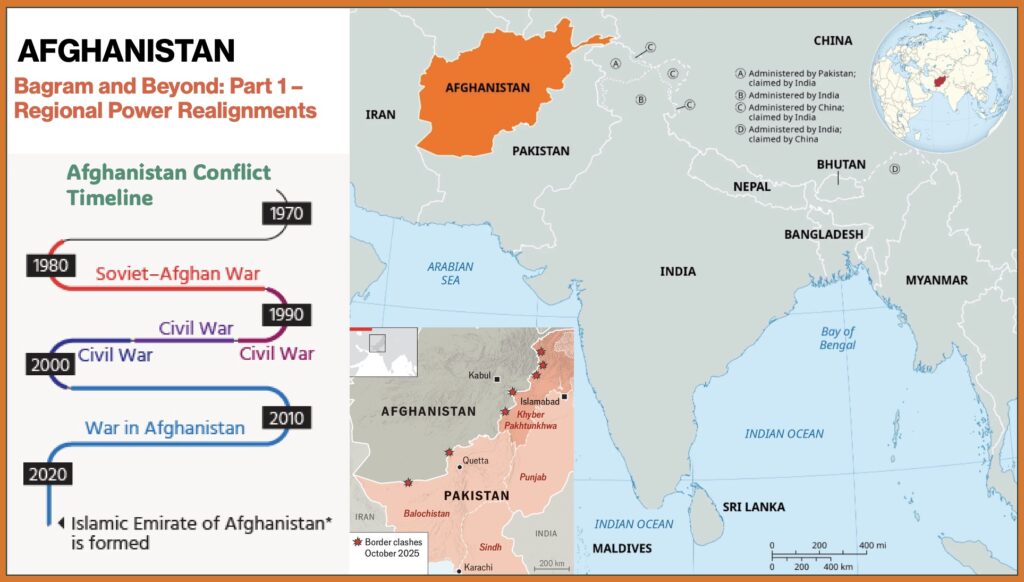
Official statements referred to Afghanistan as a “contiguous neighbour,” invoking the 106-kilometre Wakhan Corridor that links Afghanistan to Ladakh through Pakistan-occupied territory. This phrasing bypassed Pakistan and implied a geopolitical reframing of South Asia’s map. It challenged Islamabad’s claim to being Afghanistan’s only gateway and signalled India’s reassertion of historic geography.
India’s Pragmatic Diplomacy and Kabul’s Response
New Delhi also quietly upgraded its presence in Kabul from a technical office to a full embassy, demonstrating commitment to sustained engagement. The approach serves multiple purposes: securing Indian investments, retaining influence among Afghan technocrats, and countering Pakistan’s dominance in Afghan politics.
For the Taliban government, India represents an economic partner free from coercive strings. Unlike Beijing or Islamabad, India’s developmental projects — roads, dams, hospitals, education — focus on welfare, not extraction. Reopening these diplomatic channels diversifies Kabul’s external relations and enhances its leverage over Pakistan.
Pakistan–Afghanistan Border Escalations and the Durand Line Flashpoint
Violent border clashes between Afghanistan and Pakistan in October 2025 exposed the structural collapse of Islamabad’s long-standing “strategic depth” doctrine. Pakistan claimed its airstrikes near Kabul targeted TTP operatives, but Afghanistan condemned them as sovereignty violations. Afghan forces retaliated with cross-border artillery and temporary occupation of Pakistani forward posts.
Pakistan’s Strategic Dilemma
Independent UN and media reports confirmed dozens of casualties and hundreds wounded on both sides before a Qatari-mediated ceasefire on October 15. The skirmishes illustrate a complete inversion of dependency: the Taliban, once a Pakistani proxy, now asserts nationalist sovereignty.
For India, this geopolitical shift offers indirect advantages. A Pakistan preoccupied with internal insurgency and external friction has reduced capacity to destabilise Kashmir or counter India’s regional initiatives.
The Chabahar Port Sanctions and the Question of Strategic Autonomy
Simultaneously, the United States tightened sanctions on the Chabahar Port project in Iran, operated by India under a long-term agreement. Revocation of earlier exemptions penalises entities engaged in transactions linked to Iranian ports, shipping, or banking.
Chabahar’s Strategic Centrality for India
For India, this is not just an economic setback but a strategic constraint. Chabahar is the linchpin of its westward connectivity, providing a maritime route to Afghanistan and Central Asia that circumvents Pakistan. It anchors the INSTC linking India to Iran, the Caucasus, Russia, and Europe.
India’s 10-year operational commitment worth $120 million — and a $250 million credit line — are now jeopardised. Sanctions threaten financial, shipping, and insurance components of the project, thereby challenging India’s policy of strategic autonomy.
Washington justifies the move as part of its pressure on Tehran; New Delhi perceives it as coercive diplomacy. The timing is conspicuous — sanctions resurfaced just as India deepened its Eurasian engagements through the SCO, the Moscow Format, and its diplomatic outreach to Kabul.
Regional Implications and the Reassertion of Continental Autonomy
The combined effects of the Bagram discourse, the Pakistan–Afghanistan clashes, and U.S. sanctions point toward a reassertion of continental autonomy — a belief that regional security must be decided by regional actors.
The Continental Logic
The Moscow Format’s message was clear: Western militarisation no longer guarantees stability. From India to Iran to Russia, nations advocate “regional solutions to regional problems.” This aligns with India’s “Neighbourhood First” and “Extended Neighbourhood” policies that prioritise development partnerships over military dependency.
The U.S. Strategic Dilemma
By withdrawing from Afghanistan, Washington forfeited its logistical foothold. Attempting to return through Bagram risks uniting adversaries and competitors alike. As DW observed, “Even if the U.S. were somehow allowed back, it would likely be limited to intelligence-sharing against ISIS-K — not to re-establish dominance.”
America’s hard-power tools in continental Asia have expired, leaving it reliant on sanctions and symbolic gestures.
China, Russia, and Iran’s Calculated Roles
China, which swiftly appointed an ambassador to Kabul after 2021, aims to integrate Afghanistan into the Belt and Road Initiative while curbing militant spillover into Xinjiang. A revived U.S. base at Bagram would threaten that agenda, so Beijing tacitly supports Moscow’s anti-basing stance.
Russia views Afghanistan as a buffer against NATO’s southern reach, while Iran treats it as an extension of its trade corridor with India. Both see India’s engagement as stabilising — provided it excludes Western military footprints.
Strategic Implications: From Bagram to Chabahar
The evolving power play across Afghanistan, Pakistan, and Iran exposes three strands of strategic logic:
Containment of U.S. Reassertion – Regional powers collectively oppose an American return to Bagram. India’s participation in this front ensures that no extra-regional force dominates its extended neighbourhood.
Erosion of Pakistan’s Strategic Depth – The Taliban’s independence, India’s calibrated engagement, and the absence of U.S. patronage erode Islamabad’s leverage in Afghanistan.
Chabahar as a Test of Strategic Resilience – U.S. sanctions challenge India’s ability to sustain autonomous policy choices. Yet, limiting Chabahar would push New Delhi closer to Russia and Iran, even encouraging selective cooperation with China within the INSTC framework.
Strategic Triangles: India, the U.S., and Afghanistan
India’s position remains uniquely balanced yet pressured. With the U.S., it shares an Indo-Pacific maritime partnership aimed at countering Chinese influence. Simultaneously, its continental policy — engaging Iran, Russia, and Afghanistan — diverges from American objectives.
External Affairs Minister S. Jaishankar summarised this doctrine succinctly: “India will not be boxed into choices between partners.” Hence, India’s participation in the Moscow Format and its diplomatic revival in Kabul are not anti-U.S. gestures but assertions of independent agency.
From Bagram to Chabahar: The New Great Game
Bagram and Chabahar represent two paradigms of Asian order:
Bagram symbolises the Western model — coercive influence through military presence.
Chabahar embodies the Eastern model — influence through connectivity, trade, and development.
India stands at the crossroads. If Washington persists with military ambitions while sanctioning developmental projects, it risks alienating India toward the Eurasian camp. If it acknowledges India’s stabilising role through Chabahar, it can retain influence without deploying troops.
Thus, the question is no longer whether the U.S. can return to Afghanistan, but whether it can adapt to a multipolar Asia defined by regional autonomy.
The Emerging Balance and India’s Message to Washington
India’s subtle yet firm actions — supporting the Moscow consensus, expanding Kabul engagement, and resisting sanctions — convey a diplomatic message:
New Delhi will defend its regional projects and strategic autonomy regardless of external pressure.
By leveraging partnerships with Iran, Russia, and Central Asia, India can protect corridors like Chabahar and the INSTC while maintaining cooperation with the U.S. in the Indo-Pacific. This dual-continuity policy allows India to balance both theatres — maritime and continental — without compromising sovereignty.
Finally, The Return of the Asian Balance
The turbulence surrounding Bagram, Chabahar, and Afghanistan’s diplomacy signals the re-emergence of Asia’s internal balance. The era of single-power dominance is over; what follows is an intricate web of regional autonomies, connectivity, and strategic hedging.
Bagram epitomises the remnants of military hegemony.
Chabahar represents the future — trade, connectivity, and consent.
Afghanistan is no longer a buffer but an autonomous actor.
India’s role is pivotal. By opposing militarisation, engaging Kabul diplomatically, and upholding strategic autonomy despite sanctions, it is quietly shaping a new continental equilibrium.
In this century’s Great Game, power will no longer be measured by the bases one occupies — but by the corridors one builds.
Explore Related Articles
Bagram and Beyond: Part 3 – Trump’s “China Nuke Containment” Smoke Screen and the Rare Earth Reality | dated October 18, 2025 | 05:00 PM
Bagram and Beyond: Part 2 – India + Afghanistan’s New Game | dated October 18, 2025 | 04:00 PM
Bagram and Beyond: Part 1 – Regional Power Realignments | dated October 17, 2025 | 08:33 PM
India–Taliban Diplomatic Relations: A New Geopolitical Chapter in South Asia | dated October 10, 2025 | 01:44 PM
Early Moves on Bagram Air Base: US–Taliban Handover Reports and Strategic Analysis from April 2025 | dated September 19, 2025 | 02:27 PM
Trump Seeks to Reclaim Bagram Air Base from Taliban: Full Coverage and Reactions | dated September 19, 2025 | 12:37 PM
US Revokes Sanctions Exemption on Iran’s Chabahar Port, Impacting India’s Strategic Gateway | dated September 18, 2025 | 11:05 PM
Afghanistan, China, Pakistan Hold 6th FMs Meeting in Kabul on Regional Ties, India Watchful | dated August 21, 2025 | 09:04 PM