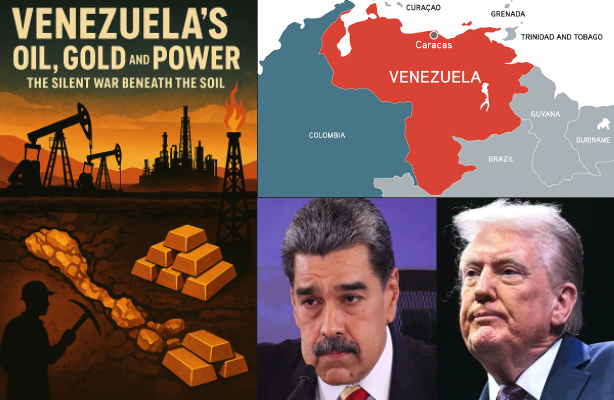
Venezuela’s Oil, Gold and Power: The Silent War Beneath the Soil
Venezuela, once Latin America’s wealthiest nation, is again under global scrutiny. Behind the headlines about the Nobel Peace Prize awarded to opposition leader María Corina Machado, a deeper struggle continues — a fight over who controls Venezuela’s vast oil, gas, and mineral wealth, and how that control shapes the future of U.S.–Latin America relations.
The South American country holds the world’s largest proven oil reserves, immense gold deposits, and emerging lithium and coltan prospects. But decades of authoritarian rule, economic collapse, and geopolitical entanglements have left Venezuela’s riches both a blessing and a curse.
Inside Venezuela’s Political Divide
Since 2013, President Nicolás Maduro has ruled Venezuela with an iron grip, inheriting Hugo Chávez’s socialist “Bolivarian Revolution.” Maduro’s power rests on a mix of military loyalty, patronage networks, and fear.
Despite global condemnation for electoral fraud, corruption, and human rights abuses, his party — the United Socialist Party of Venezuela (PSUV) — maintains control through a combination of manipulated elections and coercive tactics.
Opposition movements, now symbolised by Nobel laureate María Corina Machado, have long been fractured but resilient. Machado’s 2024 endorsement of Edmundo González, widely seen as the true winner of the disputed election, reignited hopes of democratic transition. However, Maduro’s regime suppressed dissent, jailing over a thousand protesters and expelling independent observers.
The political equation in Caracas is brutally simple: whoever controls the oil, controls the state. And whoever backs the state — whether Moscow, Beijing, or Washington — controls a strategic piece of Latin America.
The Geopolitical Chessboard: Caracas at the Centre
Venezuela’s politics cannot be separated from its global entanglements.
Over the past two decades, it has become a proxy battleground among the world’s major powers.
The Pro-Maduro Bloc: Russia, China and Iran
Russia: A steadfast ally since the Chávez era, Moscow has supplied over $4 billion in arms and extended $17 billion in loans, often repaid in oil shipments.
Russian oil giant Rosneft holds stakes in Venezuela’s Orinoco Belt fields, and Russian technicians continue advising Venezuelan security forces.
Joint naval drills and defence agreements project Russian power into the Western Hemisphere — a strategic counterweight to NATO’s expansion in Eastern Europe.
China: Beijing’s interest is pragmatic. Through the China Development Bank and state firms, it has lent over $60 billion to Caracas in exchange for long-term oil deliveries. While it keeps a lower political profile than Russia, China’s economic influence is far greater.
It also eyes Venezuela’s lithium and coltan deposits as part of its global battery and technology strategy.
Iran: In a symbiotic relationship, Iran helps Venezuela evade U.S. sanctions by supplying fuel, refining technology, and smuggling expertise. In return, it gains gold and geopolitical foothold close to U.S. shores.
The Opposition Bloc: U.S., EU, and Democratic Allies
The U.S., EU, Canada, and democratic Latin American nations back Venezuela’s opposition and refuse to recognise Maduro’s legitimacy. Their tools include economic sanctions, diplomatic isolation, and symbolic actions — from freezing assets to supporting opposition leaders like Machado.
The West views Venezuela as both a human rights cause and a strategic energy opportunity. With oil prices volatile and the U.S. seeking to reduce reliance on the Middle East and Russia, Venezuela’s proximity and petroleum potential are irresistible.
U.S. Interests: Democracy Meets Energy Security
Washington’s policy toward Caracas blends idealism and realpolitik.
Officially, the U.S. seeks “democratic restoration.” Unofficially, it wants energy diversification and to limit Russia and China’s influence in its near abroad.
Energy Leverage:
Before sanctions, Venezuela exported nearly 1.2 million barrels of oil daily to the U.S. Restoring even part of that flow could ease market shocks and stabilise prices. Chevron already operates under limited waivers, signalling U.S. interest in keeping one foot inside Venezuela’s oil sector — ready for a post-Maduro future.Mineral Resources:
Venezuela’s Orinoco Mining Arc is rich in gold, iron, bauxite, and lithium — minerals critical for renewable energy technologies. U.S. corporations are watching closely, aware that Chinese firms already have early access through state-backed ventures.Geopolitical Balance:
For Washington, losing Venezuela to a Russia–China–Iran axis would be strategically unacceptable. The U.S. considers Venezuela not merely an oil well, but a linchpin for regional stability and an ideological bellwether for Latin America.
Economic Collapse and Human Exodus
Venezuela’s economic statistics tell a story of spectacular decline. Since 2013, GDP has shrunk by nearly 80%, hyperinflation once reached 1.7 million percent, and over seven million citizens have fled the country — one of the largest migration crises in modern history.
Oil production plummeted from 3 million barrels per day in 2000 to under 700,000 in 2025. Refineries operate at minimal capacity, and power outages are routine. Yet amid this devastation, Maduro’s government has survived — propped up by military elites, Russian arms, and Chinese credit.
The regime’s endurance illustrates how geopolitical alliances can sustain authoritarianism, even against overwhelming domestic failure.
A New Energy Frontier: Post-Maduro Scenarios
If political change comes — whether through negotiation, sanctions fatigue, or domestic upheaval — Venezuela could rapidly re-emerge as an energy powerhouse.
Analysts suggest that with foreign investment and governance reform, Venezuela could restore output to 2 million barrels per day within five years.
The U.S. and EU would likely move quickly to normalise relations and re-engage in oil and mineral projects, while Russia and China would fight to retain influence through existing debt and infrastructure ties.
But as long as Maduro holds power, geopolitics will trump geology — oil and minerals remain weapons of statecraft, not engines of recovery.
Conclusion: The Resource Curse Reinvented
Venezuela’s crisis is more than a story of dictatorship and decay. It is the modern face of the resource curse — where abundance breeds dependency, corruption, and foreign interference.
For Washington, Caracas represents both a humanitarian challenge and a strategic opportunity. For Moscow and Beijing, it’s a foothold in the Western Hemisphere.
And for Venezuelans themselves, it is a daily struggle to reclaim a nation rich in resources but impoverished in governance.
The next chapter of Venezuela’s story may not be written by generals or oil ministers, but by how the world chooses to balance principles and power — democracy and energy — in the heart of Latin America.