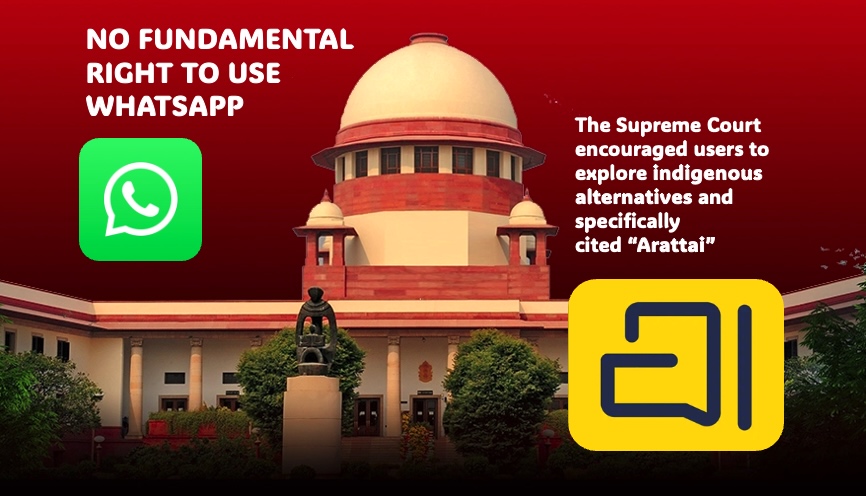
No Fundamental Right to Use WhatsApp: Supreme Court Rejects Account Restoration Plea, Suggests Indigenous Messaging App ‘Arattai’
Supreme Court Defines Digital Boundaries
New Delhi | In a landmark ruling on October 10, 2025, the Supreme Court of India decisively outlined the limits of constitutional rights in the digital age by rejecting a plea to restore a blocked WhatsApp account.
The petitioners — operators of a medical clinic — claimed that their WhatsApp account had been unfairly blocked, violating their fundamental rights under Article 32 of the Constitution. They argued that, as the platform was essential for communication with patients, the suspension had infringed upon their livelihood and freedom of expression.
However, the Court drew a firm line: there is no fundamental right to use WhatsApp.
Supreme Court’s Observations: WhatsApp Is Not a State Actor
A bench comprising Justices Vikram Nath and Sandeep Mehta dismissed the plea, emphasising that WhatsApp is a private company, not a public authority, and therefore cannot be held liable under constitutional writ jurisdiction.
“There is no fundamental right to use WhatsApp,” the Court stated, clarifying that private digital intermediaries operate under contractual frameworks, not constitutional obligations.
The bench advised the petitioners to seek remedies under civil law or approach appropriate grievance redressal forums rather than invoking Article 32. This establishes an important legal precedent limiting direct constitutional challenges against private digital platforms.
Digital Rights vs. Private Contracts: A Modern Legal Dilemma
The Court acknowledged concerns surrounding account suspensions and transparency in decisions made by social media intermediaries. Petitioners had argued for a clearer due process when blocking user accounts, citing potential abuse of discretion and lack of user protection mechanisms.
While sympathetic to these concerns, the Supreme Court held that creating such safeguards falls within the domain of legislative and regulatory bodies, not the judiciary. The ruling reiterates that digital access is governed by private contracts, not by fundamental rights, and that users voluntarily accept terms of service upon registration.
This judgment reinforces the principle that privacy may be a fundamental right, but the use of private platforms remains a contractual privilege, subject to terms and conditions.
Why the Account Was Blocked: WhatsApp’s Policy Standpoint
WhatsApp commonly suspends or disables accounts that violate its Terms of Service. The reasons include:
- Sending bulk or spam messages.
- Using unauthorised third-party applications.
- Engaging in abusive, fraudulent, or harmful behaviour.
- Being reported by multiple users.
These measures are designed to protect millions of users and maintain service integrity. However, the lack of transparency in enforcement and appeal mechanisms has drawn criticism, prompting calls for platform accountability in India’s rapidly evolving digital rights landscape.
Court Promotes Homegrown Alternatives: Spotlight on Arattai
In a notable observation, the Supreme Court encouraged users to explore indigenous alternatives and specifically cited “Arattai,” a Made-in-India messaging app developed by Zoho Corporation.
The bench highlighted Arattai as a secure, robust, and privacy-driven platform aligned with India’s goals of digital sovereignty and self-reliance.
Arattai offers:
- End-to-end encryption and multi-device support.
- Strong privacy controls.
- Seamless group communication and media sharing.
- A commitment to data localisation and user control.
By promoting Arattai, the Court indirectly underscored the government’s “Atmanirbhar Digital India” vision — encouraging users to adopt secure, indigenous technologies instead of relying solely on global tech giants.
Implications: Strengthening India’s Digital Sovereignty
This Supreme Court WhatsApp blocked account ruling has far-reaching implications for India’s digital governance ecosystem.
- It reaffirms that fundamental rights apply primarily against the state, not private entities.
- It clarifies that users’ digital grievances must follow contractual or statutory redressal routes.
- It reinforces India’s movement toward technological self-reliance through indigenous innovation.
The ruling thus serves as both a legal clarification and a policy signal — strengthening India’s stand on protecting sovereignty while promoting native platforms in a globalised digital economy.
A Wake-Up Call for Digital Users
The Supreme Court’s rejection of the WhatsApp restoration plea underscores a vital modern principle — constitutional rights stop where private contracts begin.
While privacy remains a fundamental right, using WhatsApp or any private messaging service is a matter of private agreement, not public entitlement.
The Court’s suggestion to explore Indian alternatives like Arattai represents a growing judicial and governmental push toward building a secure, independent, and transparent digital ecosystem in India.
For users facing similar suspensions, the judgment offers clear guidance: pursue available legal remedies under civil law — and perhaps, start texting on Arattai.