India’s aggressive posture: warning or preparation for attack?
Introduction — India aggressive posture
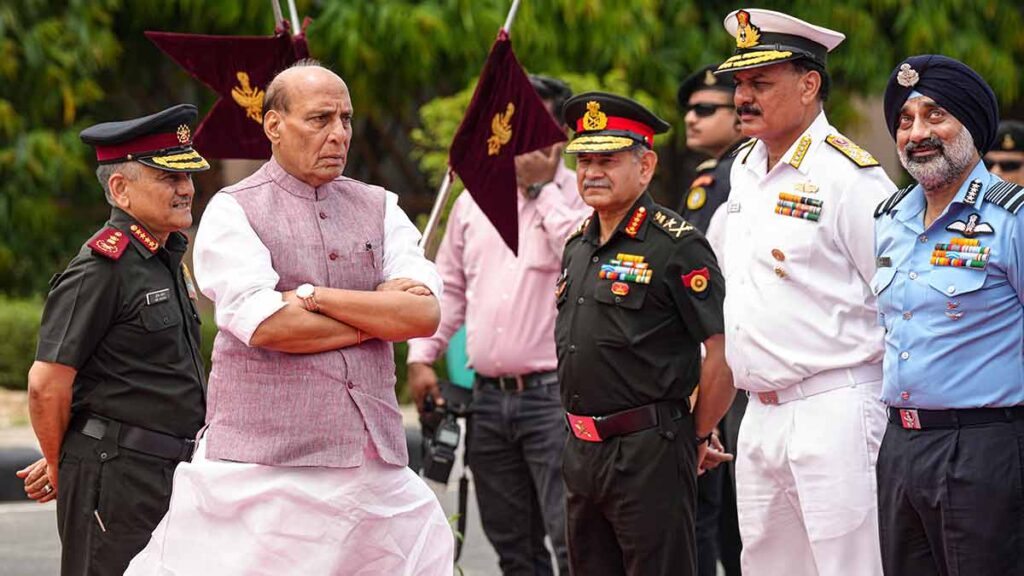
The phrase India aggressive posture appears not as rhetoric only but as coordinated public signalling. In early October 2025, India’s top defence leaders issued a string of sharp statements. Taken together, these remarks formed a clear narrative: deterrence backed by demonstrated capability. The rhetoric ranged from stern warnings over Sir Creek to detailed claims about Operation Sindoor’s successes. Reuters reported that the Air Chief confirmed five Pakistani jets were downed during the May exchanges — a claim that underpins India’s public posture.
What the leaders said — concise timeline
Defence Minister Rajnath Singh warned Pakistan over Sir Creek and invoked decisive consequences if provoked. Independent reporting captured his strong phrasing and concern about Pakistani infrastructure build-up near the creek.
Air Chief Marshal Amar Preet Singh publicly detailed aerial results from Operation Sindoor and rebutted Pakistani counter-claims. The chief’s statements included counts of downed Pakistani aircraft and descriptions of damage to enemy assets.
Army Chief General Upendra Dwivedi issued an explicit ultimatum: stop state-sponsored terrorism or risk losing geopolitical standing. He warned India might not show the restraint seen during Operation Sindoor.
CDS General Anil Chauhan reiterated integrated readiness and the need for coordinated deterrence. His prior remarks also framed Operation Sindoor as having produced a psychological effect on Pakistan.
Interestingly, all these statements were made within a short span of two to three days during the first week of October 2025, suggesting a coordinated and deliberate communication strategy.
Tone and intent — is this a warning or posture-building?
The leaders used two parallel levers. First, they stressed capability — citing precise operational outcomes and technical achievements. Second, they issued deterrent warnings — invoking geography, history, and consequences. This pattern suggests both signalling and posture-building. In short, the speeches are a deliberate mix of reassurance to domestic audiences and red lines directed at Islamabad.
Indicators that point to preparation
Detailed operational claims. Public confirmation of specific gains — such as aircraft losses — moves rhetoric beyond vague threats. This lends credibility to follow-through.
Integrated messaging. Defence Minister, service chiefs, and CDS spoke in a unified tone. That coordination often precedes operational readiness.
Focus on strategic locations. Repeated references to Sir Creek signal interest in contested, operationally meaningful terrain.
These indicators do not, however, prove imminent offensive action. They do show that India has leapt from signalling to a posture that would allow rapid escalation if political leadership so decides.
Indicators that suggest deterrence, not an imminent attack
Public restraint messaging. Leaders emphasised measured response and targeted action during Operation Sindoor. They framed past moves as limited, precise reprisals rather than attempts at territorial conquest.
Domestic political signalling. Strong public statements often aim to shore up national resolve and manage domestic narratives after terror incidents. They can therefore be defensive in intent.
International cost considerations. Any cross-border offensive carries diplomatic, economic and escalatory risks. Public warnings may aim to deter rather than invite further escalation.
Strategic implications — what this posture could mean
Firstly, India seeks deterrence by denial: make the cost of hostile action unacceptable. Secondly, the messaging signals readiness to conduct precision punitive strikes against terror infrastructure. Thirdly, it establishes a narrative that any future action would be framed as limited, targeted, and legal in the name of national security.
However, deterrence is fragile. Misperception, information fog, or a domestic political shock could change calculations rapidly. Therefore, while the public posture communicates capability and will, it also increases the stakes of any misstep.
Conclusion — calibrated analysis and likely outcomes
India’s recent statements amount to an unmistakable warning. At the same time, they reflect deliberate preparation: the services publicly showcased capability and unity. Nevertheless, the available evidence points more strongly to reinforced deterrence and readiness than to proof of an immediate plan to launch a broad offensive. The leadership has created the political and military conditions necessary to strike if required. Whether they convert that capacity into action will depend on future provocations, political will, and international pressure.