Counter-Signalling in Practice: India’s Strategic Message to Pakistan and Washington
Introduction — From Deterrence to Diplomacy by Proxy
In early October 2025, India’s top defence leadership issued an extraordinary series of statements.
Defence Minister Rajnath Singh warned Pakistan that any misadventure in the Sir Creek sector would elicit a response “strong enough to change both history and geography.” Air Chief Marshal Amar Preet Singh detailed Operation Sindoor, which had destroyed Pakistani aircrafts and infrastructure, while Army Chief Gen. Upendra Dwivedi threatened that India would “not show restraint like Operation Sindoor 1.0” if provoked again. Finally, CDS Gen. Anil Chauhan reaffirmed integrated readiness against “state-sponsored terrorism.”
At first glance, this appears to be classic deterrence messaging aimed at Islamabad. Yet, within the broader geopolitical context—particularly the chill between New Delhi and Washington over U.S. sanctions on Indian imports of Russian crude, and U.S. warming up with Pakistan—these statements acquire an additional layer of meaning. They form a textbook case of strategic counter-signalling: India demonstrating power in one theatre to communicate resolve and autonomy to another actor.
The Context — Sanctions, Selectivity, and Strategic Friction
By mid-2025, U.S.–India relations had entered an uneasy phase. President Donald Trump, restored to office, criticized what he termed India’s “energy opportunism,” targeting its continued purchase of discounted Russian crude. Washington imposed financial restrictions, tariffs, strategic sanctions and technology-transfer curbs, even as far larger imports by NATO allies, the EU, and China went largely unchallenged.
From India’s perspective, these sanctions were inconsistent and economically punitive. New Delhi’s position remained clear: diversification of energy imports is a sovereign necessity, not an ideological choice. The selective enforcement underscored a broader lesson: strategic autonomy appears limited only for non-Western states.
It is also pertinent that India has consistently rejected third-party involvement in bilateral disputes with Pakistan—a principle deeply rooted in its foreign policy and domestic political consensus. Despite this, President Trump described American – facilitated ‘mediation’ during Operation Sindoor, claiming his intervention had averted a full-scale war. India categorically dismissed this, reaffirming that no external mediation was sought or accepted, and India accepted Pakistan’s direct request for ceasefire.
Meanwhile, Pakistan’s renewed assertiveness along Sir Creek presented both provocation and opportunity. A firm military posture enabled India to reinforce regional deterrence while simultaneously broadcasting strength and independence to Washington—without direct confrontation.
What Is Counter-Signalling?
In diplomatic theory, counter-signalling occurs when a state uses an indirect arena to influence or deter another power. Instead of addressing the target state directly, the signalling state demonstrates capability and resolve elsewhere, forcing the target to reassess its assumptions.
Operation Sindoor—a limited yet decisive May 2025 strike reportedly downing five Pakistani fighter jets, including American F-16s and Chinese JF-17s (in addition to one AEW&C aircraft and several grounded fighter planes in the hangers)—achieved more than battlefield success. By publicising these results months later, the Indian defence establishment reminded Pakistan of its vulnerabilities while subtly signalling to Washington that India can act autonomously despite U.S. pressure. The timing of the October statements—just after Trump threatened to “tighten trade levers” over Russian oil—was deliberate, reinforcing a single subtext: India will not be coerced.
Rajnath Singh’s Sir Creek Doctrine — Symbolism Beyond Geography
By invoking the 1965 war and warning that “one route to Karachi passes through the creek,” Defence Minister Rajnath Singh transformed a minor marshy strip in the Rann of Kutch into a strategic metaphor.
The message was multi-layered:
To Pakistan: a reminder of vulnerability and deterrence.
To domestic voters: proof of leadership resolve and continuity.
To Washington: assertion that India’s regional priorities cannot be subordinated to U.S. preferences or sanctions diktats.
Sir Creek, distant from the Russian oil issue yet rich in historical resonance, became a theatre of proxy signalling—a classic tool in great-power diplomacy.
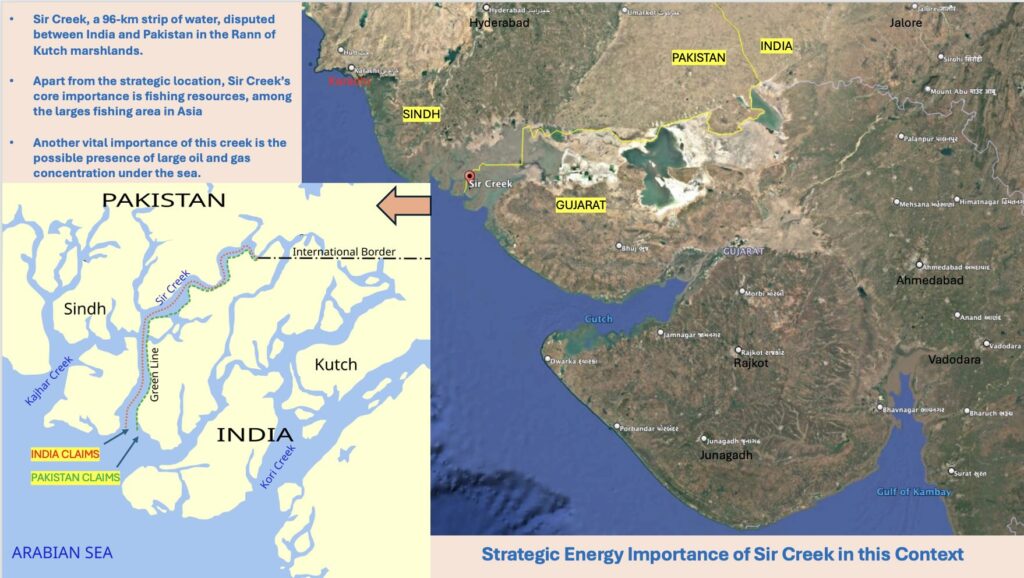
India’s repeated mention of Sir Creek in diplomatic and defense statements is not merely about boundary pride but is strongly connected to the potential hydrocarbon reserves in the Arabian Sea. The U.S. interest in Pakistan’s offshore blocks—including near Sir Creek—makes Washington’s involvement highly strategic, not altruistic.
Operation Sindoor as Strategic Theatre
The Air Force chief’s unprecedented disclosure of air-combat data—five Pakistani aircraft destroyed, radar and command-centre neutralisation, long-range missile “kills” up to 300 km inside Pakistani territory—served as both proof of capability and a signalling mechanism. Public transparency projected deterrence credibility while conveying operational independence to Washington, subtly rebutting assumptions that U.S. pressure could restrict India’s strategic autonomy.
Counter-Signalling in Practice — Lessons from History
Historically, states have long used third-party theatres to communicate with primary adversaries:
The Soviet intervention in Angola (1970s) sent indirect signals to Washington.
The U.S. bombing of Libya in 1986 communicated messages to both Tehran and Moscow.
India’s Balakot strike in 2019 redefined acceptable thresholds for cross-border action.
Similarly, Operation Sindoor, which is officially yet not over, and the October 2025 statements exemplify demonstrative limited force as communication, targeting not just Pakistan but also global observers, notably the Trump White House.
The U.S.–Pakistan Rapprochement and India’s Recalibration
By mid-2025, renewed U.S.–Pakistan warmth—Trump praising Pakistan’s “stabilising role” while U.S. firms pursued energy and infrastructure projects—raised concerns of strategic triangulation for India. The sharper Indian rhetoric functioned as preventive signalling: a reminder that New Delhi will not tolerate Cold-War-style patron-client arrangements at its expense. It was coercive diplomacy executed through regional dominance rather than direct confrontation.
Domestic Optics and the Politics of Strength
Muscular foreign-policy statements resonate domestically. Post-Sindoor rhetoric simultaneously:
Communicated deterrence and autonomy externally.
Reaffirmed leadership strength internally, countering sanctions and opposition criticism.
By externalising defiance toward Pakistan, the government converted foreign policy into domestic political capital while signalling autonomy to the U.S.
The Calculus of Controlled Escalation
Counter-signalling requires balancing intensity without triggering uncontrolled escalation. India’s October statements combined extreme rhetoric with measured restraint: no new cross-border strikes or abnormal troop mobilisations followed. This combination—loud language, controlled action—is the hallmark of a confident power, executing coercive diplomacy without open conflict.
Reading Washington’s Response
The Trump administration reacted cautiously, reiterating calls for “regional stability.” Privately, U.S. defence analysts acknowledged India’s firmness reduced Washington’s leverage. Operational independence and domestic backing narrowed the window for external coercion, reflecting partial success in strategic signalling.
Risks and Rewards of Counter-Signalling
Risks: misinterpretation by Pakistan, over-projection to Washington, domestic over-confidence.
Rewards: preservation of strategic autonomy, reinforcement of deterrence, and reassertion of India’s decision-making independence in a multipolar world.
Strategic Takeaways
Deterrence Communication Has Layers: Messages reach adversaries, domestic constituencies, and global observers simultaneously.
Operation Sindoor Was a Message Beyond the Battlefield: Publicisation ensured the U.S. received the subtext of self-reliant capability.
Counter-Signalling Is Cost-Effective Power Projection: It avoids direct confrontation while compelling policy reconsideration.
Strategic Autonomy Remains Central: India’s willingness to absorb short-term economic pain demonstrates a maturing great-power mindset.
Conclusion — The Quiet Dialogue of Power
The October 2025 chorus from India’s defence establishment was a choreographed exercise in strategic communication: warning Pakistan, steadying domestic opinion, and subtly reminding Washington that coercion has limits. Leveraging regional deterrence as a global signal, New Delhi revived an ancient diplomatic craft: saying one thing, meaning three.
The outcome is clear: India has reasserted that strategic partnerships cannot be dictated through sanctions alone, and that deterrence—whether military or economic—remains a two-way street.