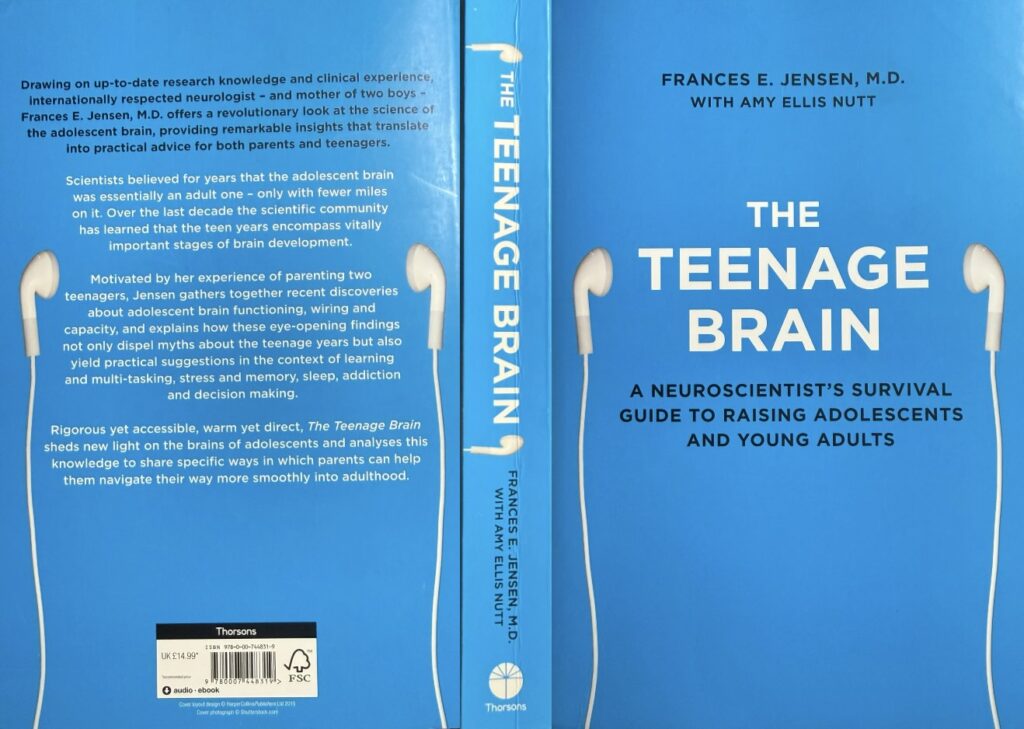
Why Every Parent Should Read The Teenage Brain
If you ve ever asked your teenager, What were you thinking? only to be met with silence, or worse, a shrug, Frances E. Jensen’s The Teenage Brain offers answers backed by science. As a neuroscientist and a mother of two teenage boys, Jensen blends research with her own parental struggles, making this book both credible and relatable.
Early on she writes, “We have a natural tendency to believe that by the time our children hit high school, they are mini-adults. In truth, they are far from it.” This opening insight sets the tone: teenagers are not defiant by design, but shaped by a brain still in the making.
Understanding Adolescence Through Science
One of the book’s strongest qualities is its ability to demystify teenage behaviour. Jensen explains how the prefrontal cortex, the centre for judgement and decision-making, matures slowly compared to other brain regions. This is why your teen might solve complex algebra one minute and forget to carry house keys the next.
She notes, “Adolescents are not an alien species. They are just unfinished versions of us.”
Parents often misinterpret recklessness as rebellion, but neuroscience shows it is more about development gaps. The emotional regions of the brain are turbo-charged by hormones, while logical brakes are still under construction. This explains why teenagers are so prone to risk-taking, impulsivity, and dramatic mood swings.
Key Insights from The Teenage Brain
Frances Jensen enriches her analysis with examples from everyday life:
- Risk and Reward: She cites research showing how teenagers light up more intensely in brain scans when presented with rewards, which makes them naturally prone to thrill-seeking.
- Sleep and Learning: Jensen emphasises, “Adolescents need about nine hours of sleep a night. When they don t get it, their brains, especially memory functions, pay the price.” No wonder late-night social media sessions undermine exam results.
- Substance Sensitivity: A particularly sobering line is, “What might be a casual experimentation for an adult can be a lasting memory stamp for a teen brain.” Alcohol and nicotine create stronger and longer-lasting patterns of dependence in teenagers.
- Technology and Social Media: While she acknowledges the learning potential of digital tools, she warns that “the developing brain is especially sensitive to overstimulation, and today’s digital barrage offers plenty of that.”
Why The Teenage Brain Resonates with Families
What makes this book so engaging is that Jensen is not just a scientist in a lab coat; she is a mother who has dealt with slammed doors and unfinished chores. She writes candidly, “Even armed with all my knowledge of neuroscience, I was not spared the challenges of raising teenagers.”
Families reading this book will relate to her anecdotes. For example, she describes her own frustration when her sons forgot simple instructions, only to later realise that their working memory was biologically limited. Her honesty brings a human touch to hard science.
Parenting Takeaways from The Teenage Brain
Jensen doesn’t leave readers with theory alone; she equips parents with strategies. Some of her most powerful advice includes:
- Encourage Sleep Discipline: Reinforce sleep routines, as staying up late to finish homework can be counterproductive. “The sleep-deprived brain is not a learning brain.”
- Open Conversations About Risk: Instead of threats, explain the neurological reality: their brains are more vulnerable to long-term consequences.
- Technology Awareness: She suggests setting family “tech-free” times rather than outright bans, promoting balance rather than rebellion.
- Guide Independence: Parents must resist micromanaging. As she writes, “Adolescence is practice for adulthood, and practice requires mistakes.”
- Be a Model, Not a Monitor: Your habits speak louder than lectures.
Comparisons and Relevance Today
The strength of The “Teenage Brain” is its ability to straddle science and everyday struggles. It has often been compared to Daniel Siegel’s Brainstorm, but where Siegel emphasises mindfulness and emotional connection, Jensen anchors her guidance in hard neuroscience.
In today’s digital, high-pressure world, Jensen’s voice feels timely. Consider her remark on multitasking: “The adolescent brain is not wired to multitask, though many teens will swear otherwise.” This is a wake-up call for parents who assume their children can study effectively while toggling between social media and assignments.
A Compass for the Teenage Years
The Teenage Brain is not simply a book; it’s a survival guide. Jensen offers both reassurance and responsibility: reassurance that adolescent chaos has scientific explanations, and responsibility for parents to use this window of growth wisely.
She closes with a powerful reminder: “Adolescence is not a problem to be solved, but a stage to be nurtured.”
For parents, guardians, and educators, this book is an essential read. It helps you replace frustration with understanding, and worry with practical tools.
👉 Takeaway for Families: If your home echoes with slammed doors, late-night phone scrolling, and baffling mood swings, this book will help you see not just the chaos but the extraordinary potential of the teenage brain.
👉 Further Recommendations: For parents of children aged 3 to 8, a must-read is The Incredible Years: A Trouble-Shooting Guide for Parents of Children Aged 3-8 by Carolyn Webster-Stratton.