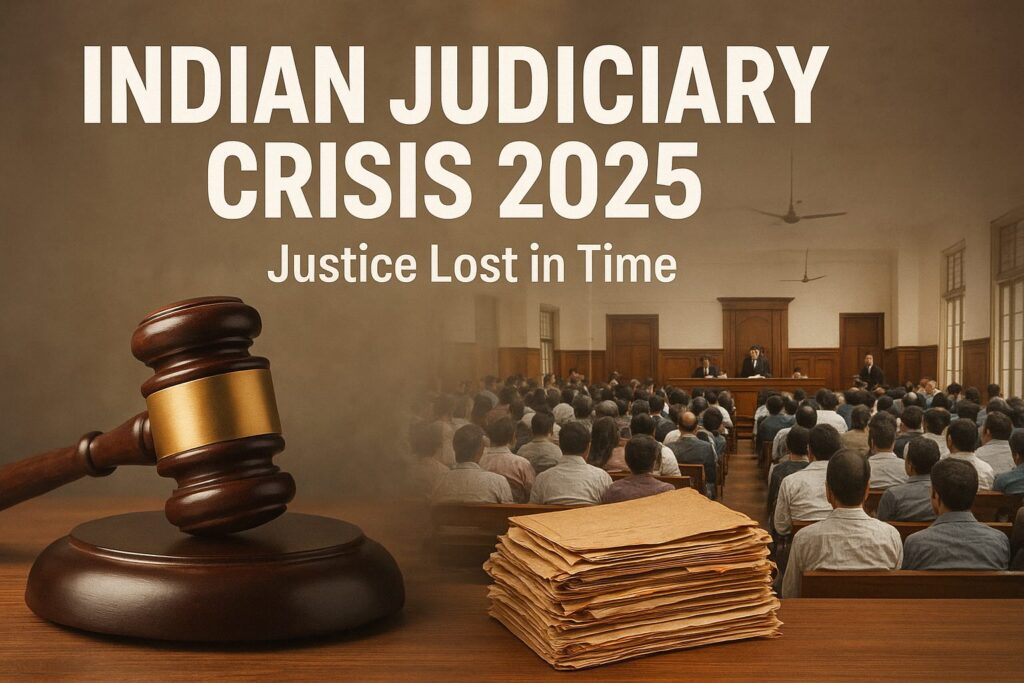
Indian Judiciary Crisis 2025: Justice Lost in Time
India’s judiciary has long been regarded as the guardian of the Constitution and the last refuge for citizens against state excesses. However, in 2025, it stands as both a pillar of democracy and one of its greatest bottlenecks. The crisis is starkly revealed by the overwhelming backlog of more than 5.3 crore pending cases across all court levels. Of these, an astounding 4.7 crore cases are stuck in district and subordinate courts, while 58 lakh cases congest the High Courts. Even more concerning is that 1.8 lakh cases have been pending for over 30 years, and nearly a quarter of all High Court cases are older than a decade. The ancient adage, “Justice delayed is justice denied,” resonates deeply today as millions of Indians live this reality daily.
The Burden on District Courts and Judicial Vacancies
District courts bear the heaviest load, accounting for the overwhelming majority of pending cases. The strain on judicial resources and public patience is immense. Judicial vacancies exacerbate the issue, with nearly 30 percent of High Court posts and thousands of district-level positions remaining unfilled.
India currently has only 20 to 25 judges per million people, less than half of the 50 judges per million benchmark recommended by expert committees and law commissions. This critical shortage means existing judges are overburdened, causing slower disposals of cases and heightened delays.
Outdated Infrastructure and Administrative Challenges
The physical and technological infrastructure supporting courts is severely outdated. Many courts lack adequate halls, effective digital connectivity, or video conferencing facilities that link courtrooms to prisons — tools that could significantly expedite trials.
Administrative inefficiencies also contribute heavily to delays:
-
Routine adjournments and procedural abuses.
-
Case dithering by lawyers exploiting loopholes.
-
Lack of strict timelines, making justice routinely postponed.
Worryingly, nearly half of all pending cases involve the government as a litigant. State agencies file appeals reflexively and simultaneously starve courts of resources, further clogging the system.
Technology adoption has not yet been citizen-friendly either. Without proper training, accountability, or regional accessibility, e-filing and digital processes have sometimes introduced more friction than solutions.
Court Holidays and Pendency
Excessive holidays in the Supreme and High Courts—nearly 175 days off per year, including a prolonged summer vacation of almost seven weeks—significantly worsen the backlog of cases. When courts remain closed, hearings are deferred, filings delayed, and procedural progress stalls. These interruptions hit daily wagers and vulnerable litigants the hardest, as each lost day compounds their hardships. Long judicial recesses reduce productive working days and directly fuel pendency, turning holidays into one of the least-discussed drivers of India’s judicial crisis.
Human Stories Behind the Numbers
The human costs of these delays are profound and often tragic. For example:
-
In Jharkhand’s Garhwa Jail, an undertrial prisoner died of liver cirrhosis while awaiting trial — his detention lasting longer than the sentence he might have served if convicted.
-
The 1982 Gonda fake encounter case, involving the killing of 13 people, saw its first convictions only after 31 years, in 2013.
-
The Ruchika Girhotra sexual harassment case took 14 years and over 400 hearings to deliver a verdict, resulting in a mere six-month prison sentence for the guilty.
-
In 2025, a Delhi court highlighted a commercial dispute between a bank and a private company that dragged on for 17 years, draining judicial resources and discouraging investment.
-
Activist Umar Khalid has been held in jail for more than five years without a trial, illustrating how delay itself becomes a punishment.
Economic Impact: A Drag on Growth
Judicial inefficiency affects the broader economy gravely. According to the World Bank, enforcing a contract in India takes more than 1,400 days on average — nearly four years. Creditors recovering debts in insolvency cases receive only about 26 cents on the dollar, in sharp contrast to 70 to 80 cents in advanced economies.
The slow resolution of disputes weakens India’s competitiveness, discourages both domestic and foreign investment, and directly impacts GDP growth. Every year of judicial delay not only denies justice but acts as an economic deadweight on the nation.
Beyond Vacancies: Addressing Cultural and Procedural Barriers
The crisis is not solely about vacancies or funding shortages. It reflects a deeper entrenched culture within the legal system — marked by routine adjournments, procedural abuse, and lack of accountability.
Key challenges include:
-
Absence of strict timelines and public performance metrics.
-
Inefficient practices continuing unchallenged.
-
High Courts moving at current disposal rates could take nearly a century to clear their backlogs.
The myth that simply appointing more judges will solve the crisis must be dispelled. Delays impact not just the poor and vulnerable but corporates, investors, and even the government, which loses billions in unresolved cases. Technology alone is insufficient without proper implementation, accountability, and training.
A Holistic Blueprint for Reform
India urgently needs a comprehensive plan to restore judicial efficiency:
-
Implement strict timelines for hearings and impose limits on adjournments.
-
Establish specialised courts for commercial, family, land, and cyber disputes.
-
Make mediation and arbitration mandatory at the intake stage to reduce litigation.
-
Publish judge-wise disposal rates and enforce transparent performance metrics.
-
Expedite appointments and fill vacant judicial and administrative posts promptly.
-
Reduce unnecessary government litigation that clogs courts with avoidable cases.
- Review and rationalise court vacations to increase judicial working days and reduce pendency.
Judiciary at the Crossroads
India’s judiciary is like a ship carrying the hopes of 1.4 billion people — sturdy, respected, and capable of weathering even major storms. However, barnacles of delay, inefficiency, outdated practices, and cultural inertia slow its progress dangerously.
Transforming India’s judiciary from a slow-moving, overburdened institution into a nimble, citizen-centric body is an imperative for democracy, economic progress, and social justice.
The question before India is no longer whether reforms are needed — they are undeniable — but whether India can afford to delay them any longer.
Between justice and delay, India must choose justice to preserve the faith of its citizens in the very foundation of democracy.