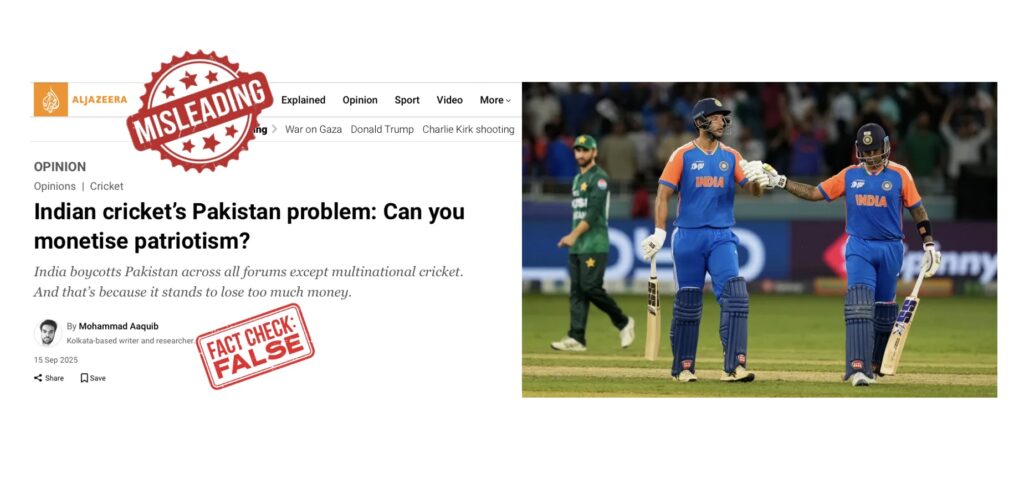
“…India refuses bilateral cricket with Pakistan yet plays them in ICC tournaments because the money is too big to lose, especially when most of it comes home through viewership endorsements and advertisements…” – Al Jazeera
Al Jazeera’s Flawed and Agenda-Driven Critique
Al Jazeera depicts India’s cricketing ties with Pakistan as a cynical commercial performance, dismissing patriotic dedications to the armed forces or terror victims as mere “tokenism” or marketing ploys. The article, authored by a writer with evident ideological biases, echoes the rhetoric of certain domestic political factions in India known for their opposition to the ruling government. This alignment with partisan narratives, combined with an international media agenda, frames India in a negative light under the guise of “critical analysis.”
Titled “Indian cricket’s Pakistan problem: Can you monetise patriotism?” the piece is riddled with factual inaccuracies and selective omissions. It falsely portrays India’s participation in international tournaments featuring Pakistan as financially motivated and hypocritical, ignoring national policy realities and genuine patriotic sentiment. Such claims collapse under financial scrutiny and disregard the nuanced political context guiding India’s sporting decisions.
India-Pakistan Match Revenues: Peanuts for BCCI
Let’s set the record straight with real, verifiable figures. The BCCI’s reported net worth stands at approximately INR 18,750 crore ($2.25 billion) in 2025, making it the wealthiest cricket body globally. In contrast, the net worth of the Pakistan Cricket Board (PCB) in 2025 is estimated to be approximately $55 million USD.
BCCI’s total income for the 2023-24 financial year was a massive INR 9,741.71 crore (about $1.17 billion). The IPL alone added INR 5,761 crore (around $693 million) to this total in just one season, making it cricket’s global financial juggernaut. Compare this to revenue from any single India-Pakistan encounter in the Asia Cup or other ICC tournaments, and you see how tiny the contribution truly is.
For instance, for Asia Cup 2025, Pakistan Cricket Board (PCB) is set to earn about INR 56 million (nearly $675,000) from its high-voltage clash with India, while its total share for the whole tournament is around INR 340 million (approx. $4 million). BCCI, earns even less, in fact nothing: this year, India has chosen to redirect all its Asia Cup earnings to support smaller Asian cricket boards as a developmental gesture—resulting in zero profit from the cricketing contest that Al Jazeera makes so much noise about.
IPL Dominates BCCI’s Revenue Landscape
Season after season, the IPL towers over every other cricket event in financial terms. The IPL’s domestic media rights deal for 2025 alone is projected to fetch over INR 10,000 crore (about $1.21 billion), and the league’s business value is roughly INR 18,750 crore ($2.25 billion). Compare that to the loose change that trickles in from even the most hyped India-Pakistan games.
So when Al Jazeera claims that Indo-Pak matches “monetise patriotism,” the data exposes the claim as both cynical and ill-informed. The numbers simply don’t support the conspiracy: the BCCI’s economic engine is the IPL and its massive sponsorship and broadcast ecosystem, not the occasional contest against Pakistan.
India vs Pakistan: Policy Over Profits
Why does India play Pakistan at all in ICC tournaments or the Asia Cup? Not for money, but because of international commitments. The Indian government has a clear and consistent policy of refusing bilateral cricket ties with Pakistan since 2008, honouring national interest and public sentiment. The only reason India appears alongside Pakistan is that multilateral tournaments like the World Cup or Asia Cup require all qualifying teams to participate, or else risk diplomatic fallout and sanctions.
This is why BCCI manages these occasional matches on government advice, not commercial calculation. The idea that Indian cricket policy is compromised for profits is not just misleading—it ignores reality.
Who Really Benefits? Not Pakistan
Claims that India-Pakistan cricket matches fund Pakistan-sponsored terrorism are grossly exaggerated by critics who oppose even these encounters on global stages, often overlooking the wider security and geopolitical context. The Pakistan Cricket Board’s (PCB) total earnings from Asia Cup 2025 amount to roughly INR 340 million (around $4 million)—a sum that, while beneficial for Pakistan cricket, is negligible in both sporting economics and geopolitical terms.
In contrast, the Board of Control for Cricket in India (BCCI) commands a commanding 38.5% share of the ICC’s global revenue, while Pakistan receives less than 6%. This difference reflects market size and audience reach, not covert or unethical arrangements. The narrative suggesting Pakistan gains a huge financial advantage from India-Pakistan matches is simply a myth.
Patriotism Isn’t for Sale
Al Jazeera’s writer also mocks dedications of wins to the armed forces or terror victims, suggesting these are just “marketing” devices. But for millions of Indians—across political lines—these gestures are expressions of genuine collective sentiment and national pride. The BCCI and Team India honor the spirit of the nation, especially in times of national trauma. That’s not a PR gimmick. It’s patriotism, and it resonates with the public.
Conclusion: Al Jazeera’s Argument Is Baseless
Al Jazeera’s narrative—aided by out-of-context numbers and emotional allegations—is not just anti-BCCI or anti-cricket. It echoes the tired rhetoric of those who habitually undermine the national interest for shallow headlines. The facts are crystal clear:
BCCI’s income from any single India-Pakistan match is minuscule when compared to its annual revenue, especially the IPL’s mountain of money.
India plays Pakistan in ICC events only to abide by international rules, not for revenue.
Dedicating sporting wins to the armed forces or terror victims is a national sentiment, not a profit ploy.
What is truly “monetised” in Al Jazeera’s report is not patriotism, but prejudice—a willingness to twist facts for ideological ends.