The Silent US Moves to Reclaim Bagram Air Base Revealed Months Before Trump’s Public Statement
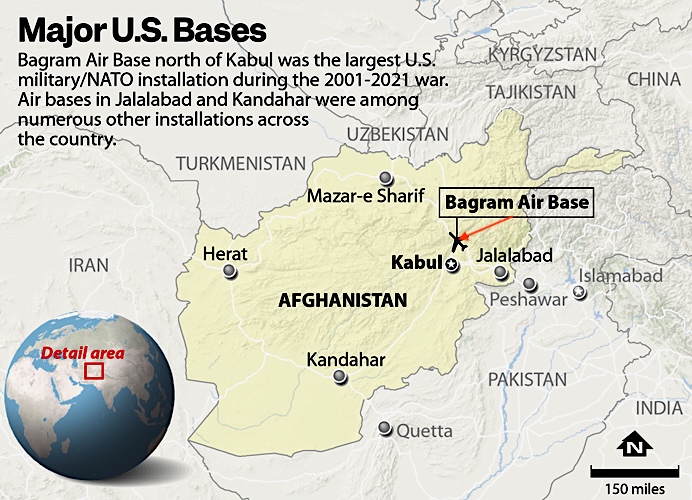
Bagram Air Base, a pivotal military asset in Afghanistan, has been at the centre of strategic manoeuvring long before President Donald Trump publicly declared efforts to regain it in September 2025. Revealing glimpses emerge from April and May 2025 reports that signal shifting control dynamics and intensifying geopolitical interests.
Taliban’s Reported Handover and US Military Activity in April 2025
On 8 April 2025, Bulgarian Military reported that the Taliban had handed Bagram Air Base back to the US for high-tech operations, signalling a discreet but significant shift in control dynamics. This was followed closely by an article published on 9 April 2025 by The Independent, highlighting that a US military plane had landed at Bagram, interpreted as a possible sign of resumed US activity or negotiations concerning the base.
These reports underscored rumours of renewed US presence and operations involving Bagram, despite the complex political and military landscape in Afghanistan. Though these developments were framed as strategic cooperation or negotiation handovers, they pointed towards a thaw or pragmatic engagement between the Taliban and US forces, likely linked to counterterrorism or intelligence activities.
Afghan Official Denials with Underlying Hints of Activity
Shortly after, on 13 April 2025, the Afghan news portal AVA Press published an article titled “US denies claims of control over Bagram Air Base.” While official US statements denied any current control over Bagram, the piece highlighted that talks and activities related to the base were ongoing and evolving, reflecting a complex situation behind public denials.
This contradiction between public denials and strategic ambiguity marked the US-Taliban relationship as delicate and in flux during this period. The base, having been a hub of US military operations under the post-9/11 framework, retains immense tactical and symbolic importance in the region.
Strategic Context from South Asia: India’s Defence Think Tank Analysis
Adding depth to these developments, on 2 May 2025, the Indian Centre for Joint Warfare Studies (CENJOWS) published a detailed analysis titled “Bagram, The US and the New Great Game: What It Means for India and South Asia.” The report traced the origins of Bagram Air Base and underscored its renewed strategic significance amid growing Sino-American rivalry and Afghanistan’s contested autonomy.
CENJOWS emphasized that Bagram’s location offers control over vital routes and resources and is an anchor for projecting power in Central and South Asia. The think tank concluded that US interest in the base reflects a broader geopolitical strategy to counterbalance China’s expanding influence while maintaining a foothold in a region critical to global trade and political stability.
Building Towards Public Disclosure in September 2025
The combined picture from April and May 2025 reports reveals a layered, behind-the-scenes struggle over Bagram that predated and set the stage for Trump’s public statements in September 2025. The early signs of US-Taliban dealings over the base and regional strategic assessment show that the battle for Bagram has long been quietly underway, shaping the security and diplomatic contours of Central Asia.
Broader Regional Dynamics: Speculations on Coordinated US Strategies
The recent surge in US political and military activities across South Asia—ranging from a regime change in Bangladesh, extensive military exercises around Dhaka and Chittagong near the India-Myanmar border, reported occupation of St Martin Island, shifting alliances involving Pakistan and Bangladesh following India’s Operation Sindoor, the accidental landing of an F35 reconnaissance aircraft in India, political changes in Nepal, to efforts focused on regaining Bagram Air Base in Afghanistan—could suggest preparations for a significant strategic posture in the region. While definitive conclusions remain premature, these coordinated developments may reflect an integrated effort to counter emerging regional challenges, particularly related to China’s growing influence and regional instability. Such multifaceted moves hint at a broader US strategy to enhance its military presence, strengthen alliances, secure critical land and maritime corridors, and position itself strategically for future geopolitical contests. Observers should view these activities as potential indicators of expansive long-term planning rather than isolated events.