Chief Justice Gavai’s Remark on Lord Vishnu Sparks Legal and Public Debate
Background
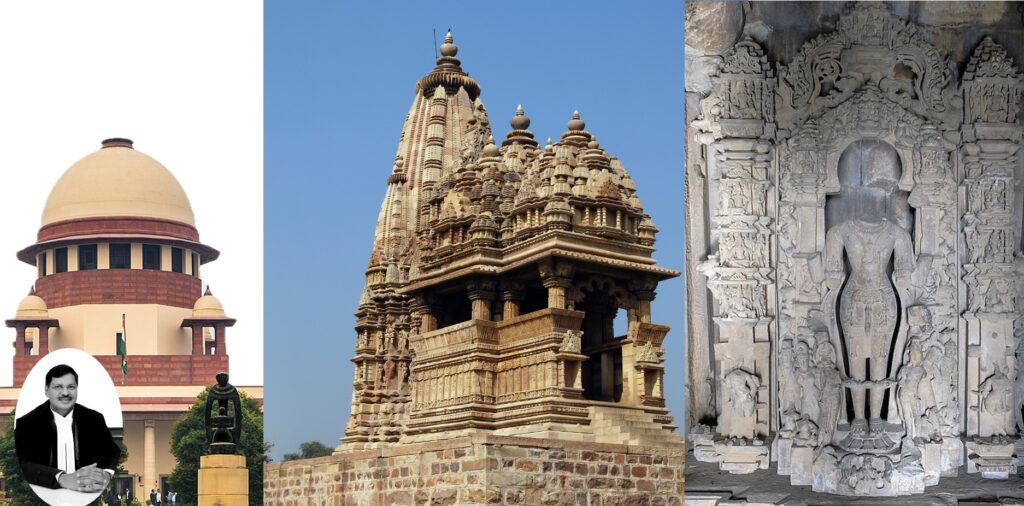
On September 16, 2025, a Public Interest Litigation (PIL) hearing at the Supreme Court regarding the reinstatement of Lord Vishnu’s mutilated idol at Khajuraho’s Javari Temple triggered intense public debate.
While dismissing the PIL, Chief Justice of India B.R. Gavai stated that the matter fell within the jurisdiction of the Archaeological Survey of India (ASI), not the Court. The petitioner had urged the Court to direct the central government and the ASI to allow corrections to the idol, claiming that several representations to the Home Ministry and the ASI had gone unanswered.
Court’s Dismissal and Remarks
During the proceedings, CJI Gavai remarked:
“This is purely publicity interest litigation. Go and ask the deity itself to do something now. You say you are a staunch devotee of Lord Vishnu, so go and pray. It’s an archaeological site, and ASI needs to give permission, etc. Sorry.”
He further added that devotees were not restricted from worship:
“In the meantime, if you are not averse to Shaivism, you can go and worship there… there is a very big linga of Shiva, one of the biggest in Khajuraho.”
Mocking Religion or Judicial Humour?
The remarks have been interpreted in contrasting ways. Some believe they were light-hearted comments not intended to offend, while others argue they appeared to mock a revered deity and failed to reflect the dignity expected of the highest judicial office.
Legal and Constitutional Framework
Judicial Responsibility: The Chief Justice, as head of the judiciary, is expected to uphold constitutional values, including religious neutrality.
Religious Protections: Sections 295A and 153A of the Indian Penal Code protect religious sentiments and prohibit deliberate acts intended to insult faith.
Judicial Accountability: While prosecution of a sitting Chief Justice is constitutionally complex, mechanisms such as judicial review and impeachment exist to safeguard accountability.
Why the Remark Matters
This controversy raises critical questions:
Does judicial humour risk being misunderstood as insensitivity?
Can remarks made in open court erode public trust in the judiciary?
How should courts balance free expression with religious respect?
Such remarks also risk setting a precedent that may encourage others to mock Hindu deities, thereby disturbing communal harmony and hurting religious sentiments. This raises a crucial question of how the legal system can ensure accountability and bring such conduct within the ambit of justice.
Public trust in the judiciary rests not only on impartial rulings but also on the perception of fairness, sensitivity, and respect for India’s pluralistic traditions.
Public Reaction and Debate
The incident has sparked nationwide debate across news media, legal forums, and social platforms. While some voices call for an apology or clarification, others emphasize the need for greater restraint in courtroom remarks. The episode has also reignited discussions on judicial accountability versus judicial independence.
Conclusion: Preserving Judicial Integrity and Religious Respect
Chief Justice Gavai’s remark has become a focal point for reflection on the balance between judicial authority and respect for religious sentiments. Regardless of intent, judicial leaders are expected to demonstrate sensitivity and maintain decorum. Upholding these values is essential to preserving confidence in India’s judiciary, as well as its secular and democratic framework.