Supreme Court Issues Notice to Nine BJP-Ruled States on Anti-Conversion Laws, Hearing in Six Weeks
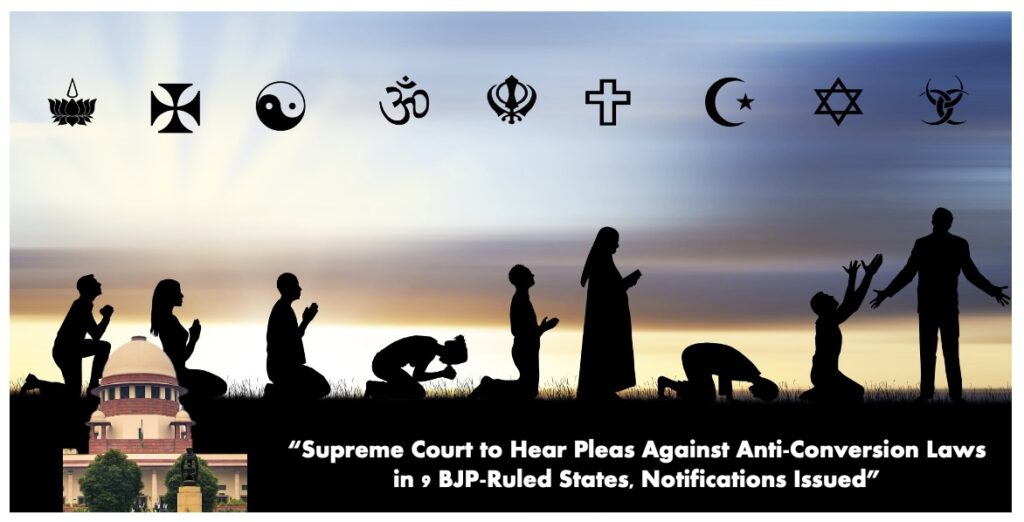
New Delhi, September 16, 2025: The Supreme Court on Tuesday agreed to hear a batch of petitions challenging the constitutional validity of anti-conversion laws enacted in several BJP-ruled states. The apex court also issued notices to nine state governments—Uttar Pradesh, Madhya Pradesh, Himachal Pradesh, Uttarakhand, Chhattisgarh, Gujarat, Haryana, Jharkhand, and Karnataka—seeking their response within four weeks.
A bench led by Chief Justice B.R. Gavai and Justice K. Vinod Chandran scheduled the matter for a detailed hearing in six weeks, keeping alive the possibility of granting an interim stay on the controversial legislations.
The Challenge to Anti-Conversion Laws
The petitions, filed by human rights groups such as Citizens for Justice and Peace (CJP), affected individuals, and interfaith couples, argue that these laws violate fundamental rights under Article 25 (freedom of religion) and Article 21 (right to life and personal liberty) of the Constitution. Petitioners contend that provisions requiring individuals to give prior notice to district authorities before religious conversion amount to “state intrusion into personal liberty,”and have been misused against minorities and interfaith couples under the so-called “love jihad” narrative.
These laws, enacted or amended since 2020, criminalize conversions by “force, fraud, or allurement,” often linking them to marriage. Offences carry stringent penalties, with some punishments ranging up to life imprisonment.
Previous Judicial Interventions
The Supreme Court’s action follows earlier interventions by state High Courts. In August 2021, the Gujarat High Court stayed provisions of the Gujarat Freedom of Religion Act (2003, amended 2021) that penalized conversions through marriage. Similarly, in November 2022, the Madhya Pradesh High Court restrained enforcement of sections of its new law.
Petitioners rely on past Supreme Court rulings, including the landmark Shafin Jahan v. Asokan K.M. (2018) case, which upheld the right to choose one’s religion and life partner, strengthening claims that anti-conversion laws infringe on constitutionally protected freedoms.
Political and Legal Context
Since 2020, at least eight BJP-ruled states have introduced or strengthened anti-conversion laws. Supporters of these laws argue they protect vulnerable communities from forced conversions, while critics view them as instruments of majoritarian overreach and a direct attack on India’s secular framework.
With more than 5 million pending cases in the Supreme Court, the final verdict could take time. However, by prioritizing these petitions, the court has signaled that the issue carries significant constitutional weight.
What’s Next
The state governments have four weeks to submit their responses. The Supreme Court is expected to take up the matter for detailed hearing in late October 2025, when it may also decide on granting an interim stay. Until then, the anti-conversion laws remain in force in the concerned states.