India’s Strategic Pivot: Balancing Israel-Gaza Conflict and West Asia Diplomacy
Introduction
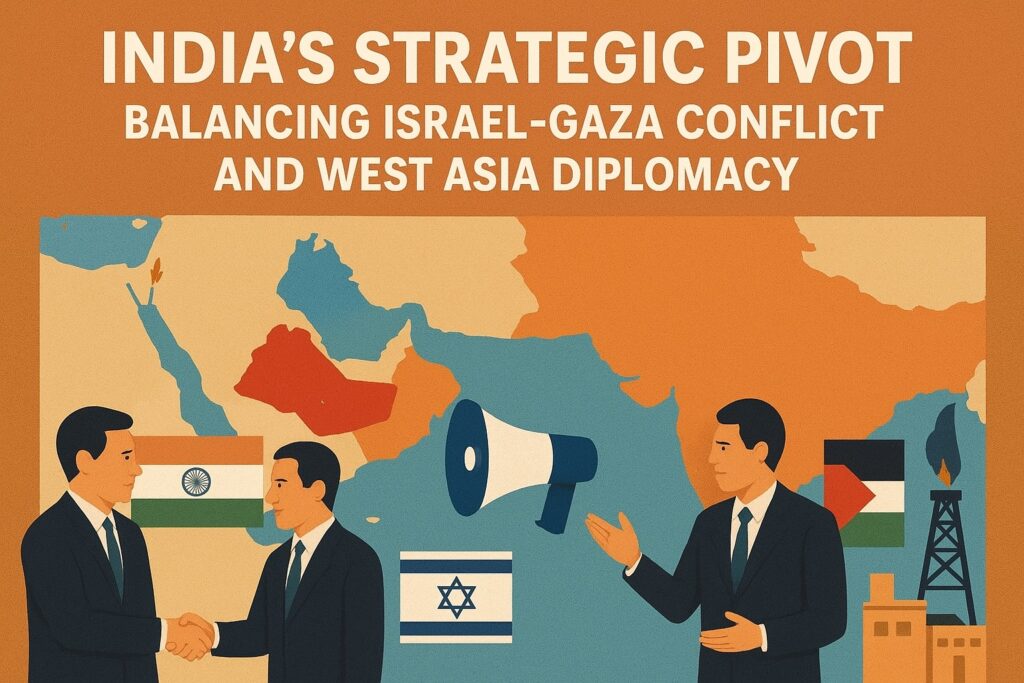
India’s geopolitical stance on West Asia, particularly the Israel-Gaza conflict, is undergoing a historic recalibration in 2025. Traditionally, New Delhi expressed solidarity with the Palestinian cause, rooted in anti-colonialism and non-alignment, while cautiously building ties with Israel. Today, however, India’s evolving foreign policy reflects strategic, economic, and diplomatic priorities, signaling a pragmatic and globally assertive shift that positions the country as a key player in regional and international diplomacy.
Historical Context and Evolution
India was among the earliest post-colonial states to recognize and support the Palestinian cause, rejecting the 1947 UN Partition Plan for Palestine. During the Cold War, its alignment with the Soviet bloc reinforced its pro-Palestinian policy, which also resonated with the broader Non-Aligned Movement (NAM).
Over the years, India was the first non-Arab state to recognize the Palestine Liberation Organization (PLO) in 1974 and the first country to recognize the State of Palestine in 1988.
Key milestones in India’s approach include:
1948–1980s: India consistently voted in support of Palestinian rights at the UN and opposed Israeli military actions.
1992: Formal diplomatic relations were finally established with Israel, opening a new chapter of bilateral engagement.
1990s–2000s: India pursued a “hawkish dove” strategy—publicly backing a two-state solution while quietly deepening cooperation with Israel in defense, technology, and agriculture.
2010s: Strategic ties expanded further, with India seeking Israeli expertise in counter-terrorism, irrigation, and cybersecurity.
This dual-track diplomacy reflected a blend of ideology and pragmatism, enabling India to remain aligned with Arab allies while securing critical cooperation with Israel.
Recent Shifts in 2025
India’s repositioning in 2025 illustrates a bolder and more confident foreign policy approach:
Multilateral Positions
India endorsed a UN General Assembly resolution calling for a Palestinian two-state solution.
It also joined the Shanghai Cooperation Organization (SCO) condemnation of Israeli and U.S. strikes on Iran, reflecting a willingness to critique Israel in multilateral forums.
Bilateral Ties with Israel
In parallel, India finalized a Bilateral Investment Agreement with Israel, strengthening economic cooperation and future-ready trade.
Defense partnerships continue to expand, particularly in areas like missile defense, drones, and joint research in artificial intelligence.
Diplomatic Balancing
New Delhi demonstrates a calibrated balance—condemning humanitarian excesses in Gaza while maintaining strategic, defense, and economic ties with Israel.
This approach preserves crucial relations with Iran, Gulf Arab states, and Western allies, preventing any rupture in its foreign policy matrix.
Reasons Behind the Shift
India’s evolving position is shaped by overlapping domestic and international factors:
Strategic and Economic Interests: Israeli defense and technology industries are essential for India’s modernization. Defense trade, worth billions annually, ensures long-term cooperation.
Geopolitical Realignment: As a member of the Quad with the U.S., Japan, and Australia, India views Israel as a strategic partner in countering China’s influence across West Asia and the Indo-Pacific.
Regional Balancing: India imports the majority of its energy from the Gulf and hosts an expatriate workforce of over 8 million citizens in West Asia. Managing these relationships is critical for economic and political stability.
Domestic Ideological Shifts: The rise of Hindutva narratives resonates with Israel’s nationalism, influencing how political leaders and policymakers articulate foreign policy.
Pragmatism Over Ideology: New Delhi’s global diplomacy is increasingly driven by economic growth, security needs, and great-power aspirations, rather than traditional ideological commitments.
Impact on India-Israel Relations
Despite global scrutiny, India-Israel relations remain stronger than ever:
Economic Cooperation: The recent bilateral investment treaty underlines New Delhi’s intent to strengthen financial and technological partnerships.
Defense and Counter-Terrorism: Israel remains one of India’s top defense suppliers, providing cutting-edge systems like drones, radar, and missile technology.
Political Engagement: High-level state visits and frequent ministerial dialogues continue, reinforcing strategic trust.
India tactfully manages disagreements by issuing measured critiques rather than confrontational statements, ensuring continuity of cooperation while safeguarding broader West Asia ties.
Geopolitical Implications and Future Outlook
India’s recalibration in West Asia is not a short-term adjustment but a strategic long-term shift. The implications are profound:
For Palestine: India maintains symbolic solidarity, supporting humanitarian relief and endorsing a two-state solution.
For Israel: The deepening of defense, technology, and investment ties ensures that Israel remains a reliable partner.
For Gulf States: India reassures Arab allies by voicing concern over excessive military actions, protecting its vital energy and expatriate interests.
For Global Standing: By balancing competing priorities, India positions itself as a responsible, adaptable global actor in a fractured international order.
This multi-vector foreign policy reflects realpolitik, economic pragmatism, and flexible diplomacy, showcasing India’s maturity in handling overlapping global challenges.
Conclusion
India’s evolving stance on the Israel-Gaza conflict represents a strategic pivot toward pragmatism. By carefully balancing historic solidarity with Palestine and robust strategic ties with Israel, New Delhi signals its intent to act as a responsible, influential global power.
As India deepens partnerships in West Asia while safeguarding broader international interests, its 2025 foreign policy demonstrates foresight, adaptability, and a clear vision of its future role in shaping global geopolitics.