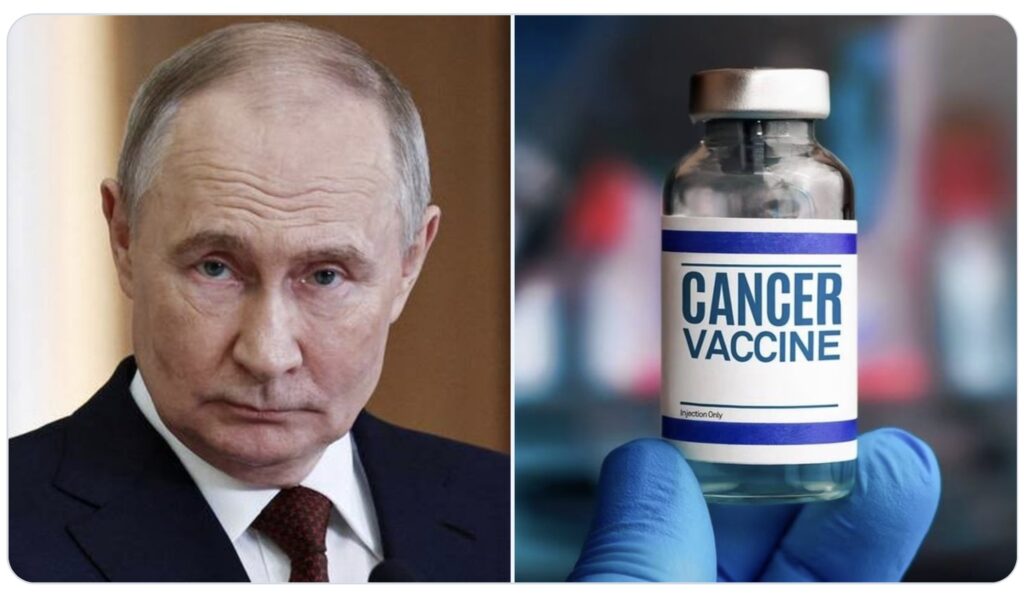
Russia announces cancer vaccine is ready for use, free for all patients:
Russia has officially announced that its groundbreaking personalized mRNA cancer vaccine is ready for clinical use, with treatments set to begin as early as September or October 2025. Developed by the Gamaleya National Research Center, renowned for creating the Sputnik V COVID-19 vaccine, this new therapy marks a pioneering step in oncology by using artificial intelligence to tailor each dose specifically to the genetic makeup of an individual patient’s tumor. The vaccine code instructs the patient’s immune system to recognize and attack cancer cells uniquely identified by their tumor markers, aiming to suppress tumor growth and reduce metastasis.
This vaccine is not a preventive measure but a treatment designed for patients already diagnosed with certain types of cancer, initially targeting melanoma. The manufacturing process is accelerated by AI, reducing the typical vaccine design period from weeks or months to just a few hours, allowing for rapid synthesis of personalised vaccine doses. Importantly, the Russian government will provide this vaccine free of charge to all eligible cancer patients, absorbing the estimated production cost of around 300,000 rubles (approximately $2,870) per dose to ensure accessibility.
The renewed media coverage today aligns with recent official statements from Russian health authorities confirming the transition from development and trials to real-world clinical application. Preclinical trials and early-stage human testing have shown promising results with significant tumor suppression and minimal metastasis. The vaccine’s launch represents a major milestone in personalized medicine and cancer immunotherapy, aiming to expand in the future to address other aggressive cancers such as pancreatic, kidney, and lung cancer.
This announcement also follows reports of a related Russian cancer vaccine candidate achieving 100% efficacy in clinical trials, which has heightened global and domestic attention on Russia’s advancing biotech capabilities in cancer treatment. With regulatory approvals expected imminently and the first patients soon to receive this innovative treatment within Russia’s healthcare system, the country positions itself at the forefront of a new era in personalized cancer care that could influence global oncology practices in the coming years. The world now watches closely as Russia embarks on this promising chapter in the fight against cancer, offering hope to millions of patients domestically and a model for future therapies worldwide.
Regarding international availability, as of now, the vaccine is primarily for Russian patients and is being distributed free within Russia under government funding. There are no confirmed plans for immediate availability in India or other countries. However, Russian research institutes have seen interest from foreign medical institutions, suggesting potential future international collaborations or licensing might make the vaccine accessible beyond Russia. For Indian patients and others outside Russia, access would depend on future regulatory approvals and partnership agreements. This evolving situation remains to be closely followed for any global rollout announcements. Thus, while a major breakthrough, the vaccine’s current availability is limited geographically, focused on benefiting the Russian population first.