Trump Defies Supreme Court Setback, Imposes 15% Global Tariff Surge
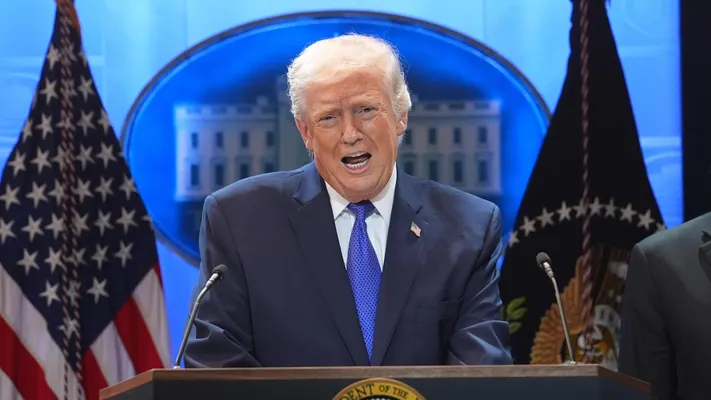
President Donald Trump has raised import
tariffs to 15% on goods from most countries, days after the Supreme Court of the United States struck down his earlier trade regime and sharply curtailed presidential authority over
emergency tariffs.
The latest increase follows a rapid sequence of events. On February 20, the Supreme
Court ruled that the International Emergency Economic Powers Act does not permit the president to impose sweeping
import duties. In a 6 – 3 judgment written by Chief Justice John Roberts, the court held that taxation powers rest with Congress, not the executive.
Within hours of the verdict, Trump imposed a 10% surcharge under Section
122 of the Trade Act of 1974. Next day, he raised it to the maximum permissible
level of 15%, citing trade imbalances and economic pressures. The tariff applies to most imports, with exemptions
for certain critical sectors and USMCA-compliant goods from Canada and Mexico.
The move effectively replaces a tariff regime that had generated nearly $130 billion
since 2025. It also signals Trump’s determination to maintain aggressive trade barriers despite judicial
resistance.
Economic and Legal Consequences of the 15% Tariff
The immediate consequence of the tariff hike is increased pressure on businesses and
consumers. Studies of previous rounds of tariffs suggest that nearly 90% of the cost was passed on through higher
prices. With the new 15% levy, manufacturers, retailers, and importers are again expected to absorb rising input
costs.
Several industry bodies have warned that prolonged uncertainty could disrupt supply
chains, delay investment, and weaken export competitiveness. Sectors dependent on imported components, including
automobiles, electronics, and machinery, are likely to be most affected.
Legally, the new tariff regime remains vulnerable. Section 122 allows emergency surcharges only for a maximum of 150 days unless Congress approves an extension. It was designed as a temporary stabilisation tool,
not a long-term trade weapon.
Importers are already preparing fresh legal challenges. Potential arguments include misuse of balance-of-payments provisions, lack of
transparent economic evidence, and violation of international trade commitments. At the same time, businesses are
seeking refunds for duties paid under the invalidated earlier regime,
with claims possibly exceeding $150 billion.
The absence of clear guidance from the Supreme Court on reimbursement has opened the
door to prolonged litigation, creating further uncertainty for markets and investors.
Internationally, trading partners are watching closely. Several European governments
have signalled that retaliatory measures remain on the table if the tariff policy becomes permanent. For
export-oriented economies, the instability itself is emerging as a major concern.
What Happens After 150 Days and How Trump Can Re-Impose Tariffs
The current 15% tariff announced by President Trump will automatically expire after 150
days unless Congress approves an extension. Given political divisions in Washington, legislative backing remains
uncertain.
The limit reflects the intent of lawmakers to keep Section 122 as a temporary stabilisation tool rather than a permanent trade instrument. If Congress
declines to intervene, the surcharge will lapse by law, regardless of the administration’s preferences.
This restriction follows closely on the earlier ruling of the Supreme Court of
the United States, which reaffirmed that long-term tariff authority rests
primarily with Congress.
Immediate Scenarios After the 150-Day Deadline
If Congress refuses to extend the current tariff, the administration will face three
immediate choices.
First, it may allow the surcharge to lapse and rely on negotiations with major trading
partners to extract concessions. However, this approach risks being seen as a political retreat.
Second, the White House may seek fresh economic justifications to trigger another
short-term emergency measure. This would invite immediate legal scrutiny and is likely to face resistance in
courts.
Third, Trump may push for legislative approval by framing the tariff as essential for
national security or industrial revival. Given the divided political climate, such approval cannot be taken for
granted.
In practical terms, the post-150-day phase is likely to be marked by policy uncertainty,
market volatility, and intensified lobbying by affected industries.
Legal Pathways to Re-Impose Tariffs Repeatedly
Even if the current tariff expires, Trump retains several statutory tools that can be
used to impose new duties under different legal frameworks.
One major option is Section 232 of the
Trade Expansion Act, which permits tariffs on national security grounds. This provision has no fixed duration and
was earlier used for steel and aluminium. New investigations into automobiles, energy, or technology imports could
revive sector-specific barriers.
Another powerful mechanism is Section 301
of the Trade Act. It targets unfair or discriminatory trade practices. By launching multiple country- or
sector-specific investigations, the administration can impose rolling tariffs that collectively resemble a broad
trade wall.
Safeguard measures under Section 201 offer
a further route. These allow temporary protection when import surges injure domestic industries. Although limited in
scope, they can supplement other tariff tools.
In addition, anti-dumping and countervailing duty laws provide a continuous channel for
raising tariffs through technical investigations into subsidies and pricing. Expanded enforcement can gradually
increase trade barriers without invoking emergency powers.
A more controversial option is Section 338
of the Tariff Act of 1930, which allows high duties against “discriminatory” countries. While rarely used, it
remains legally valid and could be revived, though it would almost certainly trigger court challenges.
By rotating these mechanisms, the administration can layer investigations, shift legal
justifications, and impose successive tariffs even after the current window closes. This approach increases
complexity and litigation but allows sustained trade pressure.
Implications for Trade Policy and Governance
The ability to cycle between different legal tools means that the end of the 150-day
period is unlikely to mark the end of tariff-driven trade policy.
Instead, it is likely to usher in a more fragmented and contested regime, shaped by
overlapping investigations, court battles, and political bargaining. While the Supreme Court has reaffirmed
constitutional boundaries, statutory delegations still provide substantial executive flexibility.
For businesses, the primary risk lies in prolonged instability rather than any single
tariff rate. Uncertain costs, shifting regulations, and delayed refunds may discourage long-term investment and
disrupt supply chains.
For trading partners, repeated tariff actions increase the likelihood of retaliation and
weaken confidence in negotiated agreements. For consumers, the burden is likely to appear gradually through higher
prices and reduced choice.
Overall, the present tariff hike represents only one phase in an ongoing struggle
between executive ambition, judicial oversight, and congressional authority. As legal challenges advance and
political negotiations continue, US trade policy is expected to remain volatile well beyond the current 150-day
limit.