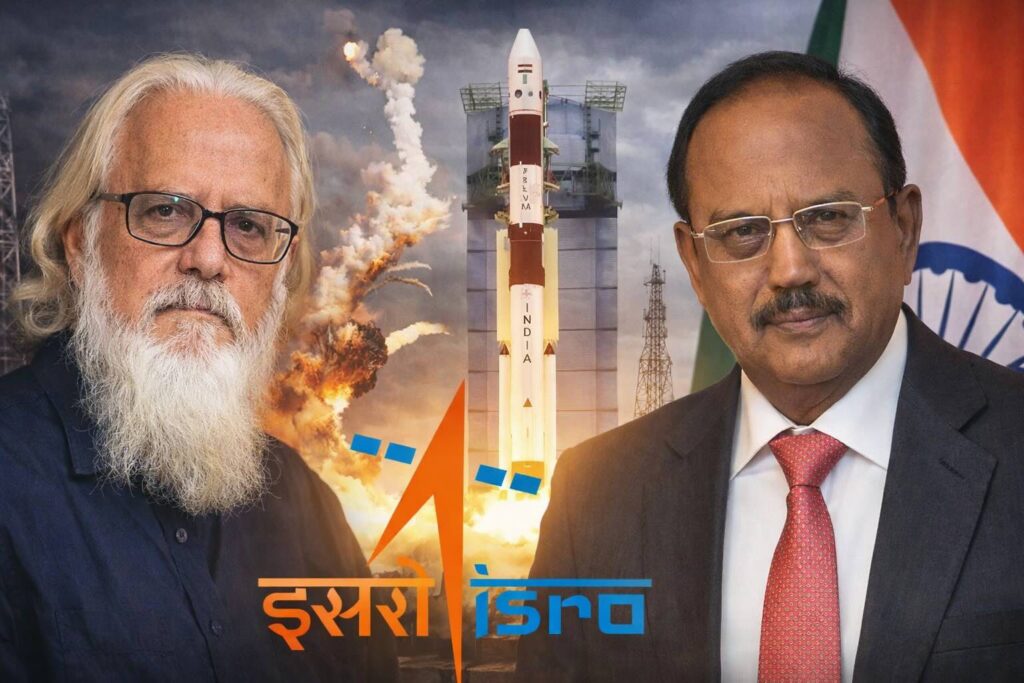
Legacy of the Espionage Case and Today’s PSLV Failures: A Critical Assessment
The revival of debate around the ISRO espionage scandal comes at a sensitive moment for India’s space programme. In May 2025 and January 2026, two consecutive Polar Satellite Launch Vehicle missions failed due to third-stage anomalies, resulting in the loss of critical satellites and triggering internal and governmental reviews.
These technical setbacks have coincided with renewed public discussion about the 1994 espionage case involving Nambi Narayanan, who was formally declared innocent by the Central Bureau of Investigation and unequivocally exonerated by the Supreme Court of India. His arrest was later recognised as unlawful, unjustified, and a grave miscarriage of justice.
It must be stated unambiguously that Narayanan bears no responsibility whatsoever for any past or present failures of ISRO’s launch systems. Courts, investigative agencies, and successive governments have confirmed that he was falsely implicated and subjected to institutional abuse.
However, the resurfacing of his case alongside recent PSLV anomalies has reopened a broader debate. Many observers now question whether the long-term damage caused by political interference, flawed investigations, and weakened institutional safeguards continues to affect India’s strategic programmes.
Therefore, the central issue today is not about individual guilt, which has been legally and morally settled, but about whether unresolved systemic vulnerabilities created decades ago still influence technological reliability.
Recent PSLV Failures and Institutional Alarm
The twin failures of PSLV-C61 and PSLV-C62 marked a rare setback in ISRO’s otherwise consistent launch record. Both missions reportedly suffered from third-stage ignition and propulsion irregularities. Consequently, critical Earth observation and communication satellites were lost.
These failures prompted internal reviews and external audits. Moreover, government agencies reportedly sought detailed security and systems assessments. According to defence and space policy observers, such scrutiny reflects apprehensions about both technical robustness and cyber-physical security.
In addition, strategic analysts noted that India’s expanding commercial launch market leaves little margin for repeated errors. Therefore, reliability remains essential for maintaining international credibility. These concerns have inevitably revived interest in how past institutional disruptions may still shape present performance.
The Spark: A Visa Case That Triggered a National Crisis
The ISRO espionage scandal originated in October 1994 in Thiruvananthapuram, Kerala. At that time, Maldivian national Mariam Rasheeda was detained for overstaying her visa. What began as a routine immigration issue soon escalated into allegations of spying.
Police claimed she possessed sensitive rocket engine drawings. Her associate, Fauziyya Hassan, was also arrested. Soon, sensational media reports alleged a “honey trap” operation involving foreign women and Indian scientists.
However, investigators later found that most documents cited as “classified” were publicly accessible. Nevertheless, the narrative had already damaged reputations and institutional morale.
The Arrests: A Proven Case of False Prosecution
On 30 November 1994, Nambi Narayanan, then leading India’s cryogenic engine programme, was arrested on charges that were later proven to be entirely fabricated. Along with several colleagues, he was accused of leaking classified data without any credible documentary, financial, or technical evidence.
Subsequent investigations confirmed that these allegations were built on coerced statements and speculative assumptions. The Central Bureau of Investigation concluded that no espionage had occurred and that the so-called “secrets” were either non-existent or publicly available.
The Supreme Court later observed that Narayanan had been “unnecessarily harassed” and subjected to mental cruelty. It held that the investigation reflected serious institutional failure rather than any wrongdoing by the scientist.
These judicial findings permanently closed the question of his innocence. Any attempt to associate him with operational setbacks, technological delays, or security lapses is therefore factually incorrect and legally untenable.
CBI Intervention and Judicial Exoneration
Due to mounting doubts, the investigation was transferred to the Central Bureau of Investigation in December 1994. After extensive inquiry, the CBI filed a closure report in 1996, declaring the case baseless.
The agency confirmed that confessions were extracted under duress. It also stated that no classified material had been compromised.
In 1998, the Supreme Court of India quashed the proceedings and reaffirmed Narayanan’s innocence. The judgment criticised investigative excesses and institutional failure.
From Past Injustice to Present Vulnerabilities
While Narayanan’s innocence is beyond dispute, the long-term consequences of the 1994 episode continue to merit scrutiny. The scandal disrupted research teams, delayed cryogenic development, weakened morale, and created a culture of institutional caution.
Several senior scientists later acknowledged that the programme lost critical momentum during this period. Years of technological isolation followed, forcing India to rebuild capabilities under constrained conditions.
The recent PSLV failures have therefore revived concerns about whether historical disruptions, combined with modern challenges such as supply-chain dependence, cybersecurity risks, and bureaucratic oversight, have created hidden fragilities within the system.
These questions are not about individual blame. Instead, they concern institutional resilience and strategic continuity.
Political Fallout and Compensation
The scandal had major political repercussions in Kerala. Then Chief Minister K. Karunakaran resigned in 1995 following allegations of interference.
After years of litigation, the Supreme Court awarded Narayanan ₹50 lakh in compensation in 2018. Subsequently, the Kerala government paid an additional ₹1.3 crore.
In 2021, the Court ordered a probe into police officers accused of misconduct. The CBI later described the episode as part of an “international conspiracy,” echoing Narayanan’s long-standing allegations.
He has repeatedly alleged the involvement of foreign intelligence agencies, including the Central Intelligence Agency, in obstructing India’s cryogenic ambitions. However, conclusive documentary proof remains contested.
NSA’s Visit, Government Concerns, and Security Reviews
Following the recent PSLV setbacks, senior national security officials reportedly visited ISRO centres. These visits aimed to assess systemic vulnerabilities, data security, and project oversight.
According to officials familiar with the matter, the government has sought tighter coordination between space, defence, and intelligence agencies. Cybersecurity, supply-chain integrity, and personnel vetting have received renewed attention.
This development reflects a broader recognition that space infrastructure is now critical to national security. Therefore, technical failures are no longer viewed as isolated engineering issues alone.
Sabotage, Incompetence, or Structural Weakness?
The central question remains unresolved. Were the 1994 events merely a case of investigative incompetence? Or did they represent deliberate interference?
Supporters of the sabotage theory cite the timing of the arrests, international competition, and long-term programme delays. They also point to patterns of institutional vulnerability.
On the other hand, critics argue that poor policing, media sensationalism, and political rivalry offer sufficient explanation. According to them, conspiracy narratives distract from governance reform.
Nevertheless, repeated institutional shocks indicate the need for sustained structural reform rather than episodic inquiries.
Enduring Lessons for India’s Space Future
India’s space programme has achieved remarkable milestones, including successful lunar and interplanetary missions. Yet, the ISRO espionage scandal remains a reminder of how fragile strategic ecosystems can be.
The combination of false prosecutions, delayed technologies, and recent launch failures underscores the importance of transparency, accountability, and professional autonomy.
As India expands its commercial and defence space footprint, safeguarding scientific institutions from political and external manipulation becomes essential.
The legacy of Nambi Narayanan’s ordeal therefore continues to shape debates on governance, justice, and national security across India’s strategic and high-technology sectors.