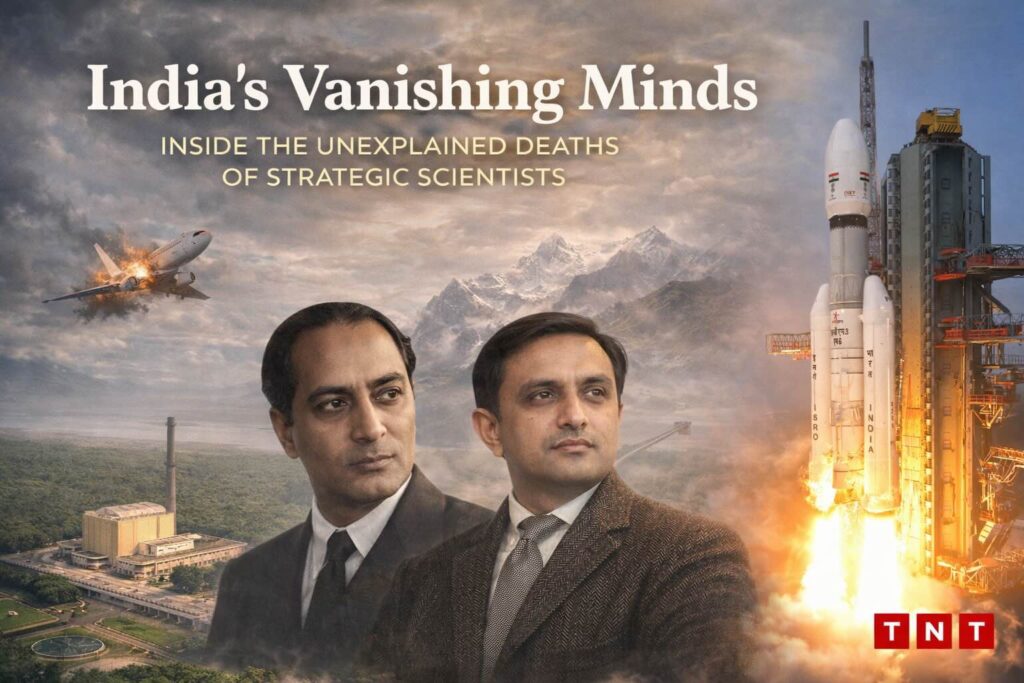
India’s Vanishing Minds: Inside the Unexplained Deaths of Nuclear, Space, and Defence Scientists
Prelude to a National Obsession — When India Lost Its Scientific Vanguard
India’s journey from a newly independent nation to a nuclear, space, and defence power has been built by exceptional scientific minds. From atomic energy to missile systems and satellite surveillance, these men and women laid the foundations of national self-reliance.
Yet, alongside these achievements runs a disturbing parallel.
Over the decades, several scientists working in sensitive institutions have died in circumstances that were sudden, unclear, or openly disputed. Official records have usually described these deaths as accidents, suicides, or natural causes. However, their frequency, timing, and occasional clustering have kept doubts alive in the public mind.
Families have asked questions. Colleagues have expressed unease. Citizens have wondered why so many files were closed so quickly.
In the absence of clear answers, speculation has filled the gaps. Much of this speculation thrives not on evidence, but on incomplete records and institutional silence.
This article traces the most prominent of these cases, examines official explanations, and reflects on why, even after so many years, they continue to trouble the national conscience.
When Two Deaths Changed History: January 1966
The story of India’s scientific mysteries effectively begins in January 1966.
On January 11, Prime Minister Lal Bahadur Shastri died suddenly in Tashkent, only hours after signing a peace agreement with Pakistan. The government said it was a heart attack. No post-mortem was conducted in India. His family later spoke of unusual marks and swelling on his body, raising questions that were never fully addressed.
Just thirteen days later, on January 24, Homi Jehangir Bhabha, the architect of India’s nuclear programme, was killed when Air India Flight 101 crashed into Mont Blanc while flying to Vienna.
Within two weeks, India lost its Prime Minister and its most important scientist.
At that time, the country stood on the threshold of becoming a serious nuclear power. Bhabha had created the scientific base. Shastri had supported strategic independence. Their sudden absence left a vacuum at the highest level of national decision-making.
For many Indians, this sequence could not be dismissed as mere coincidence.
It was the moment when quiet doubts first took root — doubts that would grow stronger with every unexplained death that followed.
Homi Jehangir Bhabha — Plane Crash or Silent Sabotage?
Date: January 24, 1966 | Official Cause: Air crash (Air India Flight 101)
Dr Homi Jehangir Bhabha, the architect of India’s nuclear programme, died when Air India Flight 101 crashed into the slopes of Mont Blanc while flying to Vienna for a scientific conference. All 117 people on board were killed.
International investigations at the time attributed the tragedy to pilot error and difficult weather conditions. The case was officially closed as an accident. However, over the years, reports emerged that large parts of the wreckage were never fully recovered and that key technical records remained inaccessible to the public. This lack of complete transparency kept doubts alive.
More than four decades later, the controversy deepened with the publication of Conversations with the Crow in 2013. The book, based on alleged conversations with former intelligence officer Robert Crowley, claimed that the Central Intelligence Agency had sabotaged the aircraft to prevent India from advancing its nuclear ambitions.
These allegations were never supported by official evidence. No government agency, Indian or foreign, has confirmed them. Yet, they received wide attention in Indian media and online discussions, largely because they appeared to fit the geopolitical realities of the Cold War era.
Among sceptics, three questions continue to recur: Why was the investigation never fully declassified? Why were crucial technical details withheld? And why did India’s nuclear programme lose its chief architect at such a decisive moment?
Bhabha’s death brought an abrupt end to a phase of bold, independent nuclear planning. His absence slowed decision-making and altered the programme’s direction for several years, according to senior policymakers and historians.
For many citizens, the case remains unresolved not because proof of sabotage exists, but because convincing closure never arrived. In the silence left behind by incomplete records and unanswered questions, suspicion found space to grow — and has never entirely faded.
Vikram Sarabhai — A Sudden Departure Amid Space Ascendancy
Date: December 30, 1971 | Official Cause: Cardiac arrest
Dr Vikram Ambalal Sarabhai, the founder of India’s space programme and the first chairman of the Indian Space Research Organisation, died suddenly at the age of 52 in a hotel room in Kovalam, Kerala. He had met colleagues earlier that evening and was reportedly in normal health. By morning, he was gone.
Authorities attributed his death to cardiac arrest. No post-mortem examination was conducted. This was consistent with administrative practice at the time, but unusual given his national importance. The case was closed quickly, and no formal inquest followed.
At the time, Sarabhai was at the peak of his influence. India’s space programme was expanding rapidly. Satellite applications, remote sensing, and defence-related capabilities were beginning to take shape. He was steering the country towards technological self-reliance in a field dominated by global powers.
His sudden death, therefore, came as a shock — not only because of his age, but because of its timing.
In later years, colleagues and associates, speaking in memoirs and interviews, recalled that Sarabhai had been under intense professional pressure and increasing international attention. Some questioned why a scientist of such national importance passed away without any independent medical or legal scrutiny.
There has never been concrete evidence of foul play. No official inquiry has suggested external involvement. Yet, the absence of a detailed investigation left a vacuum.
For many observers, Sarabhai’s case represents another moment when the nation accepted a convenient explanation without demanding deeper clarity. In a field where precision and verification are paramount, his unexplained departure continues to raise quiet, lingering questions about what was never examined — and why.
The 2009–2013 Cluster — A Wave of “Unnatural” Deaths
Between 2009 and 2013, a disturbing pattern surfaced within India’s nuclear establishment. Data obtained under the Right to Information Act showed that 11 personnel linked to the Department of Atomic Energy had died under “unnatural” circumstances. They included nine scientists and two research fellows. Most were in their 30s and 40s and were actively engaged in classified or high-value projects.
In a 2015 reply to Parliament, the government stated that police investigations had found nothing suspicious. The deaths were classified as seven suicides, two industrial accidents, one road accident, and one murder. Each case, it said, had been closed after due inquiry.
On paper, the matter stood resolved.
In public perception, it did not.
Many of those who died were connected with sensitive work, including thorium research and the nuclear submarine programme. The deaths occurred across different locations but within a short span of four years. To many observers, this concentration was difficult to dismiss as coincidence.
Later assessments by bodies such as the Stimson Center and reports in Asia Times warned that gaps in security and support systems made nuclear personnel vulnerable.
Cases That Raised Questions
Lokanathan Mahalingam (June 2009): a senior officer at Kaiga went missing during a morning walk. His body was found in the Kali River five days later. Police suggested suicide or accidental drowning. His family disagreed, saying he showed no signs of depression and was handling sensitive work. Media reports later questioned the speed of the investigation.
Umang Singh & Partha Pratim Bag (December 2009): Two young researchers at the Bhabha Atomic Research Centre died in a laboratory fire. Officials called it an accident. However, reports noted that the lab had no obvious flammable materials. The issue was never clearly explained.
MP Iyer (February 2010): Found hanging at his residence. The case was declared suicide. No detailed forensic findings were made public.
Ravi Mule (2009): An employee of the Nuclear Power Corporation was murdered weeks before Mahalingam’s disappearance. The case remained unsolved.
KK Joshi & Abhish Shivam (October 2010): Two engineers linked to the nuclear submarine project were found dead near railway tracks in Visakhapatnam. Authorities said it was an accident or suicide. Families questioned this, citing the absence of clear impact marks. The case was closed.
Uma Rao (April 2011): A former BARC scientist was found dead at home. Police ruled suicide. Her family disputed the conclusion.
Other Cases (2009–2013): Parliamentary records list more deaths involving drowning, hanging, and road accidents.
Collective Assessment
Each case, viewed alone, appeared explainable. Together, they formed a pattern that was never seriously examined.
No central agency reviewed the cluster as a whole. No independent forensic audit was conducted. No parliamentary committee investigated possible links related to work pressure, security lapses, or psychological stress.
Journalists later reported that hundreds of BARC employees had died over the years, many without detailed public explanation. This only deepened public unease.
Some observers attribute these deaths to extreme pressure and institutional neglect. Others suspect deeper interference. Neither view has been conclusively proven.
What remains undeniable is this: the country never made a serious effort to understand why so many scientists were lost in such a short time.
That failure continues to fuel doubt — even years later.
Space Scientist Poison Allegation — The Tapan Misra Case
Tapan Misra (2017 allegation, public in 2021), A senior scientist of the Indian Space Research Organisation alleged that he was poisoned with arsenic trioxide during a promotion interview in May 2017.
He claimed that his symptoms matched arsenic exposure and that security officials later confirmed poisoning. He described the incident as a targeted attempt to weaken India’s satellite surveillance programme.
No official agency has confirmed foul play.
He later sought official clarification, but no detailed findings were released publicly.
Though unproven, the allegation intensified concerns about internal security and vulnerability within scientific institutions.
Recent Defence Scientist Death — Akashdeep Gupta
Akashdeep Gupta (October 2025), a 30-year-old engineer with the Defence Research and Development Organisation, associated with the BrahMos Aerospace project, died suddenly at his residence in Lucknow.
Police suggested a possible heart attack. Detailed forensic findings were awaited at the time. His age and involvement in advanced defence technology led to online calls for deeper investigation. Authorities have so far urged restraint against speculation.
Related Claims
Social media platforms circulated claims of other similar deaths in late 2025. These remain unverified and unconfirmed by mainstream media.
Coincidence, Pattern, or Institutional Blind Spot?
No verified judicial or governmental inquiry has established systematic foul play against India’s nuclear, space, or defence scientists.
However, important concerns remain:
Repeated clusters suggest possible issues related to work pressure, security gaps, and mental health neglect.
Absence of a standard national review mechanism allows speculation to thrive.
Lack of transparency weakens public confidence.
Calls for stronger institutional safeguards — including central investigations, better counselling systems, and clearer disclosure norms — reflect growing concern over the protection of strategic talent.
India’s scientific community is a national asset.
Understanding not only how these individuals died, but whether systemic failures played a role, remains an unresolved responsibility — for policymakers, institutions, and society alike.
A nation that invests in missiles and satellites must invest equally in protecting the minds that build them.