Nepal T20 World Cup Analysis: Progress, Gaps, and the Road Ahead
Nepal’s campaign in the 2026 T20 World Cup, co-hosted by India and Sri Lanka, ended with a blend of disappointment and cautious optimism. This Nepal T20 World Cup Analysis reflects a side capable of challenging stronger teams but still struggling with consistency.
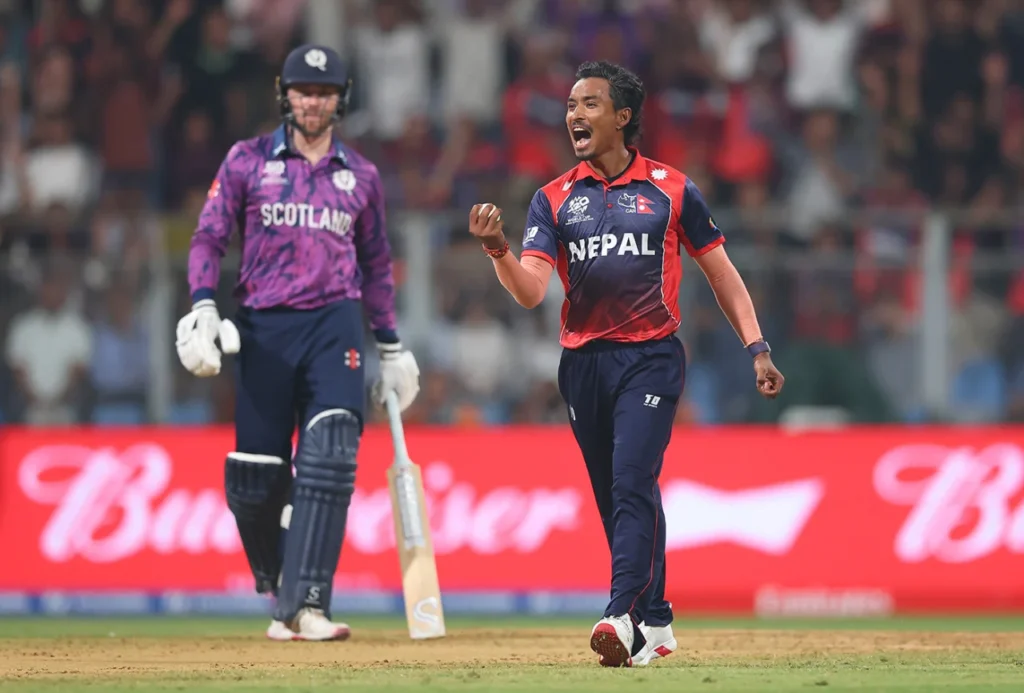
The Rhinos finished bottom of Group C with one win from four matches. Their lone victory came against Scotland on February 17 at the Wankhede Stadium, ending a 12-year wait for a World Cup win. However, defeats to the England, Italy, and West Indies prevented qualification for the Super 8s.
This report examines Nepal’s performance through a structured SWOT framework to assess their present standing and future direction in international T20 cricket.
Strengths: Batting Depth, Spin Resources, and Fan Support
Nepal’s primary strength lies in the steady improvement of their batting unit. The top order showed confidence and adaptability, especially in run chases.
Openers Kushal Bhurtel and Aasif Sheikh consistently provided solid starts. Their 56-run powerplay partnership against Scotland set the platform for Nepal’s most convincing win. In the middle order, Dipendra Singh Airee continued to deliver under pressure. His unbeaten 23-ball fifty against Scotland highlighted his value as a finisher.
Nepal’s batting resilience was also evident against England, where they fell just four runs short while chasing 184. Since 2024, Nepal have won 16 of their last 24 T20 internationals, reflecting growing reliability.
Spin bowling remains another major asset. Led by Sandeep Lamichhane, Nepal’s spinners controlled the middle overs effectively. Lamichhane’s economy and strike rate since 2024 have kept Nepal competitive, even in difficult matches.
Sompal Kami’s experience strengthened the bowling attack. His 3/25 against Scotland underlined the importance of senior players. All-rounders such as Airee and Gulshan Jha added balance, while strong crowd support, especially in Mumbai, boosted team morale and commercial appeal.
Weaknesses: Death Bowling, Inconsistency, and Limited Exposure
Despite visible progress, Nepal’s weaknesses became evident during crucial moments.
Death bowling remains the most pressing concern. Nepal conceded heavily in the final overs. Italy chased 124 without losing a wicket, while West Indies overhauled 134 in just over 15 overs. On flat pitches, Nepal’s pace bowlers struggled to maintain control.
Batting inconsistency against quality spin also affected results. Nepal have historically struggled against left-arm spin, and this weakness persisted in 2026. Over-dependence on key players often led to collapses, as seen in the Italy match, where Nepal managed only 123.
Limited exposure to Full Member teams continues to restrict development. Compared to established sides, Nepal lack regular high-intensity bilateral series. This experience gap was visible in pressure situations.
Strategic shortcomings further compounded problems. Field placements, bowling changes, and batting orders were not always optimal. Captain Rohit Paudel acknowledged that execution under pressure requires improvement.
Off-field governance issues within the Cricket Association of Nepal have also affected long-term preparation and planning.
Opportunities: Growth Through Exposure, Youth, and Investment
Nepal’s recent performances provide several opportunities for long-term advancement.
Close matches against England and the emphatic win over Scotland demonstrate that Nepal can compete at a higher level. With improved consistency, such performances could become regular.
Domestic platforms such as the Nepal Premier League have strengthened talent development. Continued ICC funding and structured grassroots programmes can expand this pipeline.
International exposure represents the biggest opportunity. Regular bilateral series against Full Members would accelerate learning. The West Indies tour in the UAE showed how sustained competition improves confidence and tactical awareness.
Coaching development also offers scope for improvement. Consultants like Nic Pothas have raised training standards. Expanding high-performance centres and specialist coaching could address technical weaknesses.
Nepal’s young squad, with an average age close to 25, allows for long-term planning and gradual consolidation.
Threats: Competitive Pressure, Infrastructure Gaps, and Administrative Risks
Several external factors could hinder Nepal’s progress if not addressed.
Tournament groups often include powerful teams. Against such opponents, experience gaps become evident. The defeat to debutants Italy also highlighted the rising competitiveness of Associate nations with better resources.
Infrastructure limitations remain a serious concern. Restricted facilities and high-altitude conditions increase injury risks and limit advanced preparation.
Administrative instability continues to threaten development. Prolonged governance issues could disrupt funding, domestic competitions, and player welfare programmes.
Rising public expectations also present challenges. Nepal’s passionate fan base increases pressure on players. Captain Paudel has spoken about the mental strain after close defeats. Without institutional and psychological support, performance anxiety may affect results.
Overall Assessment: Where Nepal Stands After 2026
Nepal’s 2026 T20 World Cup campaign represents a transitional phase rather than a final achievement. The Scotland victory showed the team’s potential. The defeats exposed structural and tactical shortcomings.
Progress in recent years is clear. Improved batting depth, dependable spin bowling, and growing international exposure have strengthened Nepal’s foundation.
However, weaknesses in death bowling, strategic execution, and governance continue to limit advancement. Addressing these areas remains essential.
With stable administration, sustained investment, elite coaching, and regular international fixtures, Nepal have the capacity to move beyond Associate limitations. If reforms are implemented effectively, the 2026 campaign may be remembered as the starting point of a more competitive era in Nepalese cricket rather than a missed opportunity.