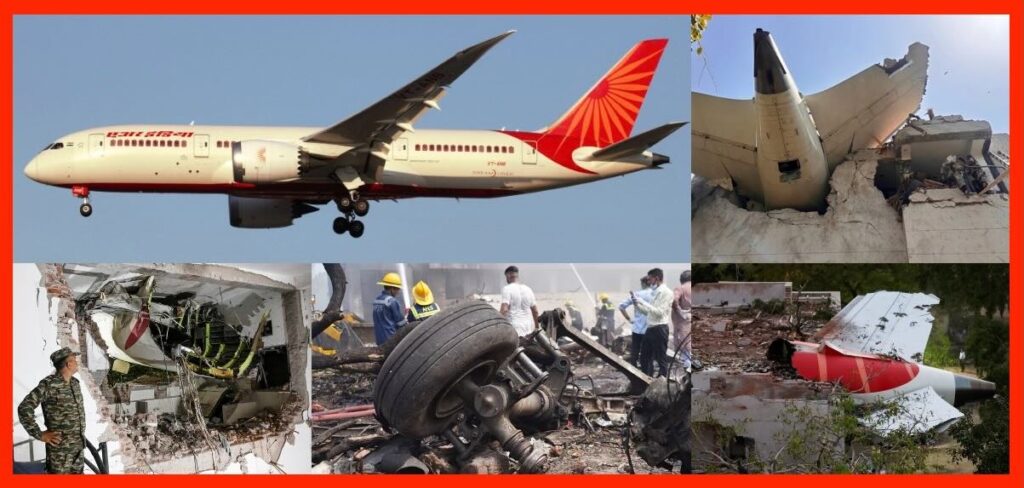
Air India Flight AI-171 Crash: Pilots Were Victims, Not Villains
Eight months after Air India Flight AI-171 — a Boeing 787-8 Dreamliner — crashed seconds after take-off from Ahmedabad on June 12, 2025, killing 241 passengers and crew and 19 people on the ground, a deeply disturbing narrative has once again begun to dominate public discourse.
That narrative is “pilot suicide”.
Through selective leaks, anonymous briefings, and speculative foreign media reports amplified by certain social media handles, one of the pilots—Captain Sumeet Sabharwal—has been subtly portrayed as a deliberate perpetrator of mass murder. This theory is now being circulated as if it were established fact.
It is not.
It is unsupported by evidence, inconsistent with human behaviour, and incompatible with technical realities. More importantly, it serves powerful institutional interests.
This is not emotional resistance. It is a demand for factual integrity in an investigation marked by secrecy, foreign influence, and premature blame.
No Motive, No Psychological Markers, No Evidence of Intent
History shows that pilot suicides, while rare, leave unmistakable trails. They are preceded by mental distress, documented instability, isolation, and warning signs that are visible to families, colleagues, and medical examiners.
The most cited example remains Germanwings Flight 9525, involving Andreas Lubitz, whose medical history and cockpit recordings clearly established intent.
No such indicators exist in the case of AI-171 crash.
Captain Sumeet Sabharwal, the pilot-in-command, aged 56, had accumulated approximately 15,638 total flying hours, including 8,596 hours on the Boeing 787, with nearly 8,260 hours as pilot-in-command on the type. He was approaching a major career milestone and had recently discussed a family holiday while actively planning the next phase of his professional life. His daughter had secured college admission. His financial records were clean, and his medical assessments revealed no psychological red flags.
First Officer Clive Kunder, the co-pilot and pilot flying at the time, aged 32, had accumulated approximately 3,403 total flying hours, including 1,128 hours on the Boeing 787. He had recently become engaged. His professional evaluations consistently described him as disciplined and reliable. His final message to his fiancée expressed affection and anticipation of reunion.
Neither man exhibited withdrawal, despair, or instability.
No suicide message was found.
No unusual behaviour was reported.
No therapy records existed.
No disciplinary proceedings were underway.
The July 2025 preliminary report by the Aircraft Accident Investigation Bureau explicitly stated that no psychological concerns were identified.
The notion that one of the two stable professionals would suddenly decide to kill 260 people defies both evidence and logic. Suicide patterns in aviation do not resemble this case in any way.
On the contrary, there is clear evidence that the pilots attempted to recover the aircraft.
Cockpit Recordings Reveal Shock and Struggle, Not Deliberate Action
The partially released cockpit voice recordings further undermine the suicide claim.
According to AAIB’s preliminary findings:
Within seconds of take-off, both engines lost power after fuel switches moved to “CUTOFF”. One pilot immediately questioned the action. The other denied responsibility. Both then attempted emergency recovery while issuing ‘May Day’ distress calls.
These exchanges show confusion, not conspiracy.
There was no locked cockpit door.
There was no prolonged silence.
There was no controlled descent/nose-down dive.
There was no argument or refusal to respond.
Instead, there was frantic troubleshooting at barely 300 feet above ground.
Aviation professionals reviewing the sequence described the dual switch movement as too synchronised for intentional individual action.
When Italian media suggested “deliberate conduct” in February 2026, AAIB publicly rejected the claim. Soon after, the Supreme Court of India demanded accelerated reporting, citing public anxiety caused by selective leaks.
If intent existed, the recordings would reflect it. They do not.
A Compromised Investigation and Foreign Institutional Pressure
From its earliest days, the investigation struggled with structural imbalance.
Although India’s Aircraft Accident Investigation Bureau (AAIB) led the inquiry, American agencies such as the National Transportation Safety Board and the Federal Aviation Administration became deeply involved due to the aircraft’s origin and are believed to have dominated the probe because of their expertise and technical superiority.
Technical cooperation is normal. Influence is not.
Internal disagreements soon emerged. In November 2025, The Wall Street Journal reported tensions over the direction of blame.
Black Box Complications
Two Enhanced Airborne Flight Recorders (Black Boxes) were recovered.
The forward unit provided partial data.
The aft unit, despite appearing intact, suffered severe internal damage.
Several crucial flight data logs were permanently lost in the crash, creating significant gaps in the investigation.
The Aircraft Accident Investigation Bureau’s July 2025 preliminary report relied solely on data from the forward EAFR. As a result, any “missing links”, such as extended FADEC diagnostics, remain speculative. However, these gaps have been repeatedly highlighted by critics, including petitioners in Indian courts and US whistleblower groups, as obstacles to verifying the absence of mechanical or electrical failure.
The anomaly has further deepened suspicion. While the tail section of the aircraft appeared relatively intact, the aft recorder installed in that area was found to be severely damaged. In contrast, the crushed and heavily burned nose section yielded usable data. This contradiction has fuelled widespread speculation in Indian media about possible pre-impact electrical or thermal events in the rear fuselage, such as a fire, short circuit, or damage to wiring, antennas, emergency locator transmitters, or the recorder itself.
Officially, AAIB has attributed the aft recorder’s condition to “impact and thermal effects” from the crash. However, critics question why the tail’s comparative structural integrity failed to provide better protection to a device specifically designed to withstand extreme conditions.
Flight data recorders are engineered and certified to survive forces far more severe than those typically affecting surrounding aircraft structures. Yet, in this case, the aft recorder suffered greater damage than the tail section housing it. This discrepancy has raised serious concerns about the robustness of the aircraft’s design and the real-world crash-worthiness of its recording systems.
Data extraction occurred in India with American technical assistance. Critics questioned why neutral third-country laboratories were not involved, especially given the scale of corporate exposure.
A Supreme Court petition demanding full disclosure remains unresolved.
Corporate Silence
Tata-owned Air India pursued settlements containing confidentiality clauses. Boeing restricted access to proprietary software systems. Independent engineers were denied full architecture visibility.
In January 2026, a US Senate submission by aviation safety advocates alleged that the aircraft had a history of electrical and power irregularities.
This echoes Boeing’s post-737 MAX crisis strategy emphasise pilot error to deflect systemic accountability.
Technical Evidence Points to Systemic Risk, Not Human Sabotage
The obsession with cockpit switches ignores Boeing’s long record of control-system vulnerabilities.
Heathrow Incident in February 2026
Air India Flight AI132, using the same aircraft model, experienced “uncommanded” fuel switch movement during engine start at Heathrow. It repeated twice and became normal only after third attempt. The crew reported abnormal looseness.
The aircraft was later grounded.
The resemblance to AI171 is striking.
Wider Pattern
In 2019, an ANA 787 experienced automatic engine shutdown due to software faults.
In 2018, the FAA issued advisories on disengaged locking mechanisms.
Whistleblowers have since alleged persistent avionics instability.
These are not isolated anomalies. They form a pattern of design vulnerability.
Yet investigators continue to centre blame on deceased pilots, who cannot defend themselves.
Indian Public Opinion Rejects the Suicide Narrative
Public scepticism in India is rooted in evidence rather than emotion. The widespread rejection of the suicide narrative stems from several concrete factors, including incomplete data caused by damaged flight recorders, recent incidents that appear to corroborate technical concerns, and Boeing’s long and controversial history with accountability. This distrust has been reinforced by selective leaks to foreign media and the premature destruction of professional reputations without substantiated proof. Even reports in January 2026 highlighted maintenance and fire-related issues within parts of Air India’s fleet. When viewed together, these elements form a consistent pattern, and that pattern points towards systemic failure rather than individual wrongdoing.
India’s Supreme Court in November 2025 ruled that the preliminary report did not blame the captain, with Justice Surya Kant stating, “There’s no insinuation against the pilot” and “No one in India believes it was the pilot’s fault.” The court emphasised a recorded exchange where one pilot asked the other if they had cut the fuel, and the response was a denial.
Blaming the Dead to Protect the Powerful
The suicide narrative performs a strategic function.
It shields Boeing from massive litigation.
It protects regulatory agencies from scrutiny.
It simplifies complex failure chains.
Dead pilots cannot contest findings.
Families cannot confront corporations.
Captain Sabharwal and First Officer Kunder are being posthumously convicted without trial, evidence, or defence.
That is not investigation.
That is institutional self-preservation.
India deserves a transparent inquiry.
Electrical logs must be released.
Software systems must be audited independently.
International experts must operate without corporate influence.
Until that happens, the truth remains buried.
These men were not villains.
They were victims of a system that failed.
And blaming them is the final injustice.
Legal Warning on “Full and Final” Settlements
In the meantime, Attorney Chuck N. Chionuma, representing over 105 families of victims of the Air India Flight AI-171 crash, has warned families against signing the airline’s proposed “full and final” settlement agreements. He has described the terms as unfair, as they require families to waive all present and future legal rights against Air India, manufacturers Boeing, and government agencies before the Aircraft Accident Investigation Bureau completes its investigation. Chionuma argues that accepting compensation without full disclosure of technical findings could prevent proper accountability. He has advised several families to wait for complete data. Air India has already paid interim compensation and is processing ex-gratia payments through a Tata Group trust, while urging families to seek independent legal advice.