India Solar Capacity Surges as 36.6 GW Added in 2025
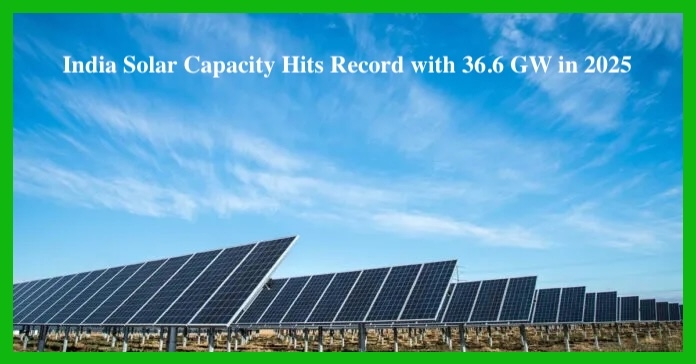
India recorded its highest-ever annual solar capacity addition in 2025, installing 36.6 gigawatts, according to Mercom India’s Q4 and Annual 2025 Solar Market Update Report. The achievement represents a 43% year-on-year increase over the 25.6 GW added in 2024.
As a result, India Solar Capacity reached nearly 136 GW by the end of December 2025. This milestone reflects accelerating deployment across utility-scale, open access, and rooftop segments.
The year also marked the first time annual installations crossed the 30 GW threshold, highlighting the sector’s growing maturity.
Utility-Scale Projects Drive Capacity Growth
Large-scale solar projects dominated new installations in 2025. Utility-scale and open access projects together accounted for nearly 85 per cent of total capacity additions.
Mercom reported that 29.5 GW of large-scale capacity was commissioned during the year. This figure represents a 31% increase from 22.5 GW in 2024.
Open access projects, which allow industrial and commercial consumers to procure power directly, contributed around 26% of large-scale installations. Rising electricity costs and sustainability targets have encouraged private companies to invest in clean power.
Therefore, corporate demand has emerged as a major growth driver.
Rooftop Solar Gains Momentum Nationwide
Rooftop solar also recorded strong growth in 2025. It accounted for nearly 15% of cumulative capacity and formed a significant share of annual additions.
Government initiatives played a critical role in this expansion. The PM Surya Ghar Muft Bijli Yojana encouraged residential adoption by offering financial incentives and simplified procedures.
Commercial buildings and industrial facilities also increased rooftop installations to reduce operating costs and improve energy security.
In some market segments, rooftop solar contributed close to 19% of total additions, reflecting growing decentralised generation.
Leading States Power India’s Solar Expansion
Several states continued to dominate India’s solar landscape. Rajasthan, Gujarat, and Maharashtra emerged as the top contributors to new capacity.
Rajasthan leads due to its high solar irradiation, large land availability, and strong transmission infrastructure. Gujarat has promoted rooftop and hybrid projects through proactive policies. Maharashtra benefits from strong industrial demand.
Other states are also expanding rapidly. However, land access and grid connectivity remain limiting factors in many regions.
As a result, regional policy support continues to influence project development.
Policy Support and Market Enablers
Mercom attributed record commissioning levels to faster project execution and supportive regulatory frameworks. Streamlined approvals and improved tender mechanisms have reduced delays.
In addition, central and state-level incentives have strengthened investor confidence. Long-term power purchase agreements and competitive bidding have improved revenue stability.
The expanding manufacturing base has also supported growth. India’s solar module and cell capacities increased significantly in 2025. This expansion has helped meet domestic content requirements under the Approved List of Models and Manufacturers scheme.
Consequently, import dependence has reduced gradually.
Grid Challenges and Operational Constraints
Despite rapid progress, the sector faces operational hurdles. Curtailment remains a concern in solar-rich states where transmission infrastructure lags behind capacity additions.
Grid congestion affects power evacuation during peak generation hours. Inadequate storage capacity also limits system flexibility.
Moreover, land acquisition delays and local opposition continue to slow projects in some areas.
Therefore, infrastructure upgrades must keep pace with generation growth.
Role of Solar in India’s Energy Transition
Solar energy has become the cornerstone of India’s clean energy strategy. It contributes significantly to power generation growth and reduces reliance on fossil fuels.
The sector supports India’s broader target of achieving 500 GW of non-fossil fuel capacity by 2030. Solar remains the largest contributor within this framework.
In addition, large-scale deployment strengthens energy security and improves air quality.
Thus, solar power is central to both economic and environmental objectives.
Outlook for 2026 and Beyond
Industry experts expect strong momentum to continue in the coming years. Pipeline projects, expanding manufacturing capacity, and rising corporate demand support this outlook.
However, sustaining growth will require parallel investment in storage, transmission, and distribution networks. Regulatory stability will also remain crucial.
The record performance in 2025 demonstrates India’s growing leadership in global renewable energy markets. It positions the country among the fastest-growing solar economies worldwide.
As capacity continues to scale, India Solar Capacity is likely to remain a key pillar of national development and climate policy.