Saudi-UAE Alliance Breakdown: How MBS and MBZ Drifted Apart
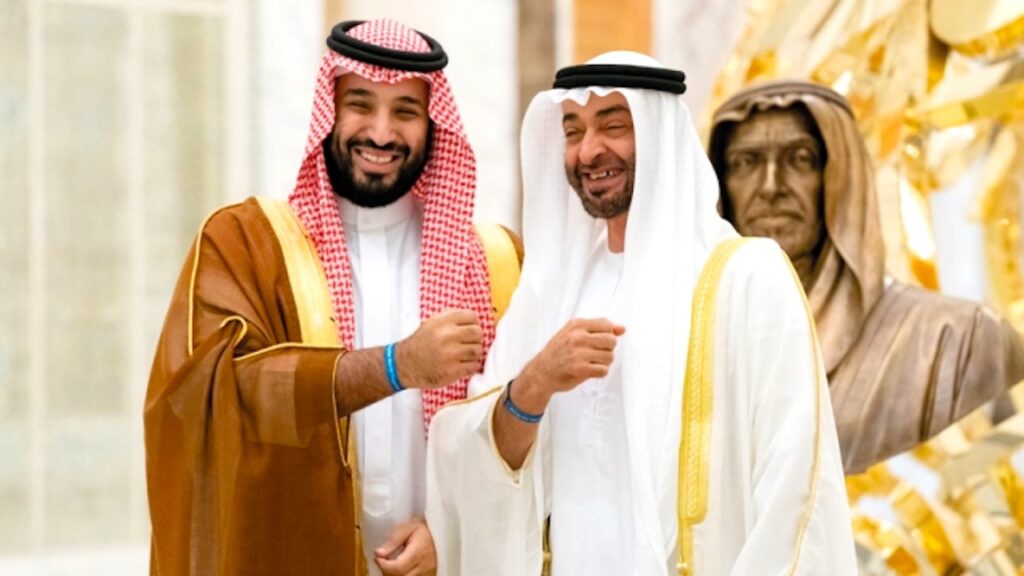
The Saudi-UAE alliance breakdown has emerged as one of the most significant geopolitical shifts in the Gulf in recent years. For much of the 2010s, Crown Prince Mohammed bin Salman (MBS) and President Mohamed bin Zayed (MBZ) projected an image of close personal and political partnership. Together, they shaped regional policy, coordinated security interventions, and promoted authoritarian stability.
However, by early 2026, that partnership has visibly fractured. Public disagreements, proxy confrontations, and diverging strategic visions have transformed former allies into cautious competitors. Although economic interdependence has prevented a complete rupture, the relationship now reflects deep structural tension.
From Strategic Brotherhood to Growing Estrangement
The alliance between Riyadh and Abu Dhabi took shape after the Arab Spring. Both leaders sought to counter political Islam, limit Iranian influence, and assert Gulf leadership. Their cooperation extended to the Yemen war, the Qatar blockade in 2017, and coordinated diplomatic campaigns.
For several years, this alignment delivered influence and regional leverage. Yet, as both states accumulated power and ambition, competition gradually replaced coordination. Saudi Arabia began asserting primacy within the Gulf. Meanwhile, the UAE pursued autonomous regional initiatives.
This shift laid the foundation for the Saudi-UAE alliance breakdown that became visible in 2025.
Yemen as the Central Flashpoint of Conflict
The most dramatic rupture occurred in Yemen in December 2025. Forces linked to the UAE-backed Southern Transitional Council advanced into oil-rich southern governorates, including Hadramawt and al-Mahrah. These areas lie close to Saudi Arabia’s border and hold strategic importance.
Riyadh viewed the expansion as a direct security threat. On December 30, Saudi-led coalition aircraft struck what officials described as a UAE-linked weapons shipment in Mukalla. Saudi statements accused Abu Dhabi of enabling separatism and crossing established red lines.
Subsequently, Saudi-backed Yemeni government forces pushed back the STC. By January 2026, the group faced major setbacks. The UAE withdrew remaining counterterrorism units soon afterwards. This episode exposed long-standing policy divergences.
Saudi Arabia prioritised Yemen’s territorial unity and border security. In contrast, the UAE favoured southern autonomy to secure ports and counter Islamist factions. These competing agendas transformed cooperation into confrontation.
PRAVEEN, here is a compressed and sharper version, retaining all key angles:
Expanding Rivalry Across Regional Arenas
The Yemen crisis reflects a wider pattern of strategic competition shaped by diverging regional alignments.
In Sudan, the UAE is accused of backing the Rapid Support Forces, while Saudi Arabia supports the Sudanese Armed Forces and mediation efforts, prolonging instability. In the Horn of Africa, Emirati engagement with Somaliland—through port investments and security ties—has alarmed Mogadishu and unsettled Riyadh. These interests are reinforced by Israel’s growing engagement with Somaliland, aligning with the UAE under the Abraham Accords and strengthening Abu Dhabi’s economic and strategic position in the Red Sea corridor.
This UAE–Israel alignment contrasts with Saudi Arabia’s improving ties with Turkey, which remains hostile to Israel and sceptical of Emirati regional activism. The resulting geopolitical divergence places Riyadh and Abu Dhabi on different strategic tracks.
In Libya and Syria, similar gaps persist. The UAE favours strongman-backed stabilisation and early engagement with Assad, while Saudi Arabia shows greater preference for political accommodation and regional consensus.
Together, these competing networks have replaced coordinated Gulf policy with fragmented influence zones, deepening mistrust and limiting strategic cooperation between the two former allies.
Economic Competition and Soft Power Struggles
Economic rivalry forms another pillar of the Saudi-UAE alliance breakdown. Saudi Vision 2030 aims to reposition Riyadh as a regional business hub. The strategy challenges Dubai’s traditional dominance in finance, logistics, and tourism.
Regulatory changes encouraging multinational firms to relocate headquarters to Saudi Arabia have intensified competition. Aviation, entertainment, and investment sectors have become battlegrounds for influence.
Disagreements within OPEC+ over production quotas have further strained ties. Although coordination continues, tensions remain visible. In February 2026, several UAE firms withdrew from Saudi defence exhibitions, signalling commercial spillovers.
Diverging Strategic Philosophies and Leadership Styles
Underlying these disputes are contrasting worldviews. Saudi Arabia has embraced a model of de-escalatory developmentalism. It prioritises regional stability to attract capital and support domestic reform.
The UAE follows a doctrine of pre-emptive activism. It relies on flexible alliances, proxy networks, and rapid interventions. It also maintains close ties with Israel under the Abraham Accords.
Leadership dynamics reinforce these differences. MBS, once seen as mentored by MBZ, has consolidated authority and seeks recognition as the Gulf’s primary power. Abu Dhabi, in turn, resists subordination and values strategic autonomy.
Global Context and Shifting External Alignments
The international environment has also reshaped the relationship. Reduced Western pressure on Riyadh after 2022, following Russia’s invasion of Ukraine, expanded Saudi diplomatic space. Dependence on the UAE as a Western intermediary declined.
Both countries now hedge between Washington, Beijing, and other partners. However, their approaches differ. Saudi Arabia emphasises traditional defence ties. The UAE cultivates diversified partnerships, including with India.
These contrasting alignments complicate joint diplomacy.
Consequences for the GCC and Regional Stability
The Saudi-UAE alliance breakdown weakens Gulf Cooperation Council cohesion. This fragmentation comes amid Red Sea insecurity, shipping disruptions, and humanitarian crises.
Smaller GCC states may gain mediation opportunities. However, they also face pressure to align. Proxy competitions risk prolonging conflicts in Yemen, Sudan, and the Horn of Africa.
For global actors, fragmented Gulf leadership complicates coordination on Iran, energy markets, and trade routes. European and American policymakers increasingly worry about inconsistent regional responses.
Prospects for Reconciliation or Managed Rivalry
By February 2026, both governments display cautious restraint. The UAE has de-escalated in Yemen. Joint statements on Gaza and Iran indicate selective cooperation. Trade and energy interdependence continue to act as stabilisers.
Nevertheless, trust remains fragile. Media campaigns and proxy manoeuvres persist. Without resolving fundamental disagreements over leadership and regional order, rivalry is likely to endure.
Analysts anticipate a prolonged phase of managed competition rather than full reconciliation.
A Pragmatic Partnership Under Strain
The Saudi-UAE relationship was never purely fraternal. It was built on shared interests and mutual advantage. As both states matured into ambitious regional powers, friction became inevitable.
The current Saudi-UAE alliance breakdown reflects this transition. It signals a shift from coordinated dominance to competitive coexistence. How Riyadh and Abu Dhabi manage this transformation will shape Middle Eastern stability in the coming decade.
For the region, the priority now is preventing rivalry from escalating into destabilising confrontation. Whether these two powers can balance ambition with restraint remains one of the defining strategic questions of the 2020s.