Space Events to Watch in 2026 — Missions, Launches and Exploration Highlights
The year 2026 is emerging as a defining chapter in modern space exploration. Major space agencies, private companies, and emerging space powers are preparing for historic missions that will reshape scientific research, commercial activity, and geopolitical influence beyond Earth. From humanity’s return to lunar orbit to India’s expanding human spaceflight ambitions, space events 2026 reflect a rapidly evolving global order in outer space.
Unlike previous decades, access to space is no longer restricted to a few superpowers. Instead, space missions 2026 will demonstrate how governments, private firms, and international partnerships are jointly shaping the next phase of exploration. As a result, the coming year is expected to generate unprecedented scientific data, commercial opportunities, and strategic competition.
Artemis II — Humanity’s Return to Deep Space
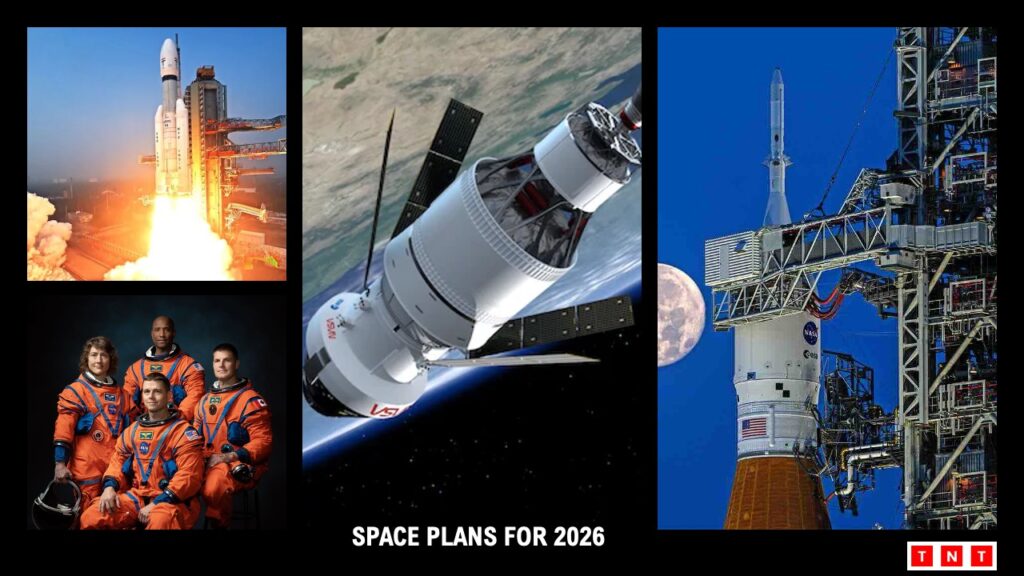
NASA’s Artemis II stands as the most anticipated mission among global space missions in 2026. The flight will send four astronauts on a ten-day journey around the Moon, marking humanity’s first venture beyond low Earth orbit since 1972.
The crew includes Reid Wiseman, Victor Glover, Christina Koch, and Canadian astronaut Jeremy Hansen. Notably, this mission represents the first time a woman and a person of colour will travel to lunar orbit. The spacecraft will launch aboard the Space Launch System from Kennedy Space Centre, with a target window in early February 2026.
The mission will test life-support systems, navigation, radiation shielding, and emergency procedures. Therefore, Artemis II will directly determine the readiness of future lunar landings under Artemis III and IV. In strategic terms, it also reinforces American leadership in deep-space exploration.
Also Read : NASA’s Artemis II Countdown Halted: What the Aborted Wet Dress Rehearsal Really Means
SpaceX and Commercial Launch Boom in 2026
Commercial space activity continues to dominate space events 2026. SpaceX remains the world’s most active launch provider, with Falcon 9 missions supporting satellite deployment, scientific payloads, and international customers.
Early 2026 witnessed the launch of Italy’s COSMO-SkyMed Second Generation satellite, enhancing Earth observation for disaster management and security. In addition, Starlink missions continue to expand broadband connectivity, especially in underserved regions.
Rocket Lab has also increased its launch frequency. The deployment of South Korea’s NEONSAT-1A satellite demonstrates how smaller nations now access space through private providers. As a result, orbital traffic is rising rapidly, transforming space into a commercially integrated ecosystem.
China’s Shenzhou 23 and Tiangong Operations
China remains a major player in 2026 space exploration through its independent human spaceflight programme. The planned Shenzhou 23 mission will transport three taikonauts to the Tiangong space station in April 2026.
This mission will support long-duration research in biology, materials science, and space medicine. In addition, China continues to refine its life-support systems and orbital maintenance capabilities. These developments indicate Beijing’s long-term objective of building permanent space infrastructure and conducting deep-space missions.
Consequently, space missions 2026 reflect an intensifying competition between major powers, particularly in human spaceflight and station operations.
ESA’s Hera Mission and Planetary Defence
The European Space Agency’s Hera mission is scheduled to reach the Didymos–Dimorphos asteroid system in late 2026. This probe will examine the aftermath of NASA’s Double Asteroid Redirection Test, which deliberately altered Dimorphos’s orbit in 2022.
Hera will deploy two CubeSats to study surface composition, internal structure, and gravitational dynamics. Therefore, this mission plays a crucial role in planetary defence strategies.
With near-Earth objects posing potential long-term risks, Hera demonstrates how international cooperation can address threats beyond national boundaries.
Next-Generation Space Telescopes in 2026
Astronomy will benefit significantly from new observational platforms in 2026. NASA’s Nancy Grace Roman Space Telescope is expected to launch in October, featuring a wide-field infrared camera nearly 100 times more powerful than Hubble’s survey capability.
Roman will investigate dark energy, map galaxy distribution, and detect thousands of exoplanets. Meanwhile, ESA’s PLATO mission will focus on identifying Earth-like planets around Sun-like stars.
Together, these observatories will redefine humanity’s understanding of cosmic evolution and habitability. Therefore, they represent a major scientific pillar of space events 2026.
Commercial Space Stations and Haven-1
Private space stations are becoming a practical reality. Vast Space’s Haven-1 module is scheduled for launch in mid-2026, marking the first operational privately developed orbital habitat.
Haven-1 will support short research missions, technology demonstrations, and commercial activities. Importantly, it aligns with NASA’s plan to transition from the ISS to commercially operated stations.
As government agencies reduce long-term station funding, private platforms are expected to dominate low Earth orbit infrastructure in the coming decade.
International Space Station and Expedition 74
Despite the rise of private stations, the International Space Station remains central to space research in 2026. Expedition 74 will conduct experiments in microgravity medicine, fluid physics, and materials engineering until July.
The ISS also continues to test technologies relevant to Mars missions and lunar habitats. Therefore, it remains a critical bridge between current operations and future deep-space exploration.
India’s Gaganyaan and Expanding Space Capabilities
India’s space programme occupies a strategically important position within space missions 2026. ISRO plans to conduct the Gaganyaan-1 uncrewed test flight in March 2026, focusing on life-support validation, crew module recovery, and atmospheric re-entry.
Gaganyaan represents India’s first human spaceflight initiative. It builds upon decades of experience gained through PSLV and Gaganyaan Launch Vehicle (LVM3) missions, as well as successful planetary projects such as Chandrayaan and Mangalyaan.
Beyond Gaganyaan, ISRO is advancing the NISAR Earth observation mission in partnership with NASA, expanding NavIC navigation services, and strengthening small-satellite launch capabilities. In addition, India is developing its Bharatiya Antariksh Station, planned for the early 2030s.
These efforts position India as a long-term spacefaring nation rather than a limited regional player. Therefore, space events 2026 may prove decisive for India’s human spaceflight credibility.
Space Safety and Debris Challenges
As launch activity intensifies, orbital debris management has become a global concern. The partial re-entry of China’s Zhuque-3 rocket in the Pacific highlighted the risks associated with uncontrolled debris.
Space agencies now invest heavily in tracking systems, collision avoidance software, and deorbiting technologies. However, regulatory coordination remains limited. Consequently, sustainable space operations represent one of the most urgent policy challenges of this decade.
A Transformational Year for Global Space Exploration
The collective impact of space events 2026 extends far beyond individual missions. Artemis II symbolises humanity’s return to deep space. Commercial stations demonstrate market-driven innovation. Advanced telescopes deepen scientific knowledge. Meanwhile, India and China consolidate their strategic positions.
Together, these developments indicate that space is becoming a permanent arena of economic activity, scientific discovery, and geopolitical influence. As access expands and competition intensifies, 2026 may be remembered as the year when exploration evolved into sustained presence.
For readers, investors, researchers, and policymakers alike, monitoring these missions is no longer optional. It is essential for understanding how humanity’s future is being shaped beyond Earth’s atmosphere.