Brazil’s Lula Signals Pragmatic Reset with Trump Amid Trade Tensions and Global Realignment
A 50-Minute Call That Signals More Than Courtesy
New Delhi, January 27, 2026 — Brazilian President Luiz Inácio Lula da Silva’s 50-minute phone conversation with U.S. President Donald Trump on January 26 marks a significant recalibration in bilateral relations that had appeared strained for much of 2025. According to an official Brazilian government statement, the two leaders discussed geopolitical flashpoints including Venezuela, the Middle East, and transnational crime, while agreeing that Lula would visit Washington in the coming months.
The call is notable not merely for its duration but for its timing. It comes after months of public disagreement, tariff disputes, and ideological distance, suggesting a conscious shift from rhetorical defiance to pragmatic engagement.
Venezuela and Gaza—Lines Drawn, Dialogue Maintained
One of the central issues discussed was the Venezuela crisis. Lula reiterated Brazil’s long-standing position that regional peace and stability must take precedence over unilateral actions. This followed his earlier criticism of the U.S. capture of Nicolás Maduro earlier in January, which Lula described as crossing an “unacceptable line” under international norms. Despite the sharp language, the discussion remained framed around humanitarian outcomes and regional equilibrium rather than escalation.
The leaders also addressed Trump’s recently announced “Board of Peace” proposal, unveiled on January 22. Lula urged that the initiative be limited strictly to the Gaza conflict and stressed the necessity of Palestinian representation, implicitly warning against any parallel structure that could undermine the United Nations or exclude affected stakeholders.
From Tariffs to Tentative Thaw
Relations between Washington and Brasília deteriorated sharply in mid-2025 after the Trump administration imposed tariffs of up to 50 percent on select Brazilian exports. Lula responded with unusually blunt rhetoric, calling the measures “uncivilized” and insisting Brazil would not be treated as a subordinate economy. At the time, he publicly ruled out direct talks with Trump, instead turning toward BRICS partners and the World Trade Organization to counter U.S. pressure.
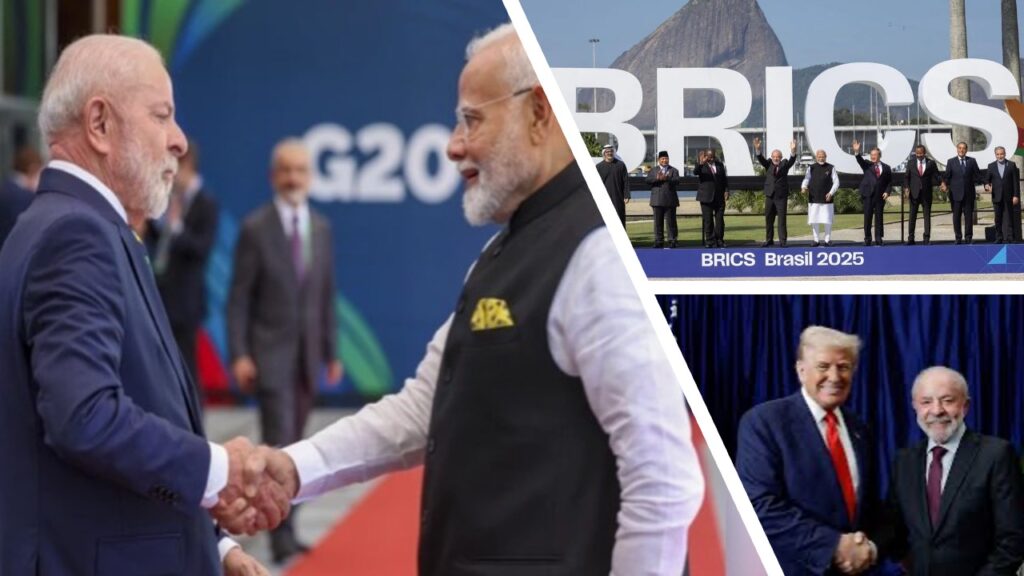
That posture began to soften in October 2025, when Lula and Trump met on the sidelines of the ASEAN Summit in Kuala Lumpur—their first in-person interaction. Since then, quiet diplomatic exchanges have resumed, culminating in the January 26 call that now formalises a pathway back to high-level engagement.
BRICS Remains Central to Lula’s Worldview
The renewed dialogue with Washington does not signal a retreat from Lula’s Global South strategy. As chair of BRICS in 2025, Brazil pushed aggressively for institutional reform, South-South trade expansion, and reduced reliance on the U.S. dollar. The BRICS+ Summit hosted by Brazil in July 2025 advanced discussions on a common settlement mechanism and expanded membership, reinforcing the bloc’s geopolitical weight.
Lula has consistently framed this approach as “active non-alignment,” rejecting binary choices between Washington and Beijing. His recent calls with Indian Prime Minister Narendra Modi on January 22 and Chinese President Xi Jinping on January 23 underscore this balance. With Modi, Lula confirmed a state visit to New Delhi from February 19–21 to deepen cooperation in trade, defence, and technology. With Xi, he reaffirmed Brazil’s commitment to safeguarding Global South interests amid renewed “America First” economic policies.
The Washington Visit and What Lies Ahead
Lula’s agreed visit to Washington is expected to take place after his February trips to India (19-21 February 2026) and South Korea, reflecting a carefully sequenced diplomatic calendar rather than a pivot toward any single power centre. Analysts view this as an effort to compartmentalize disagreements while preserving channels for cooperation, particularly on climate policy, organized crime, and regional stability.
Brazil’s hosting of COP30 in November 2025 further elevated Lula’s role as a bridge-builder between developed economies and emerging powers, reinforcing his claim that multilateralism, not confrontation, best serves national sovereignty.
A Calculated Pragmatism in a Fragmented World
Lula’s engagement with Trump illustrates how middle powers can assert autonomy without isolation. By reopening dialogue with Washington while deepening BRICS coordination, Brazil is attempting to extract strategic flexibility from a fractured global order. The approach carries risks—trade disputes remain unresolved, and domestic political pressures are mounting ahead of Brazil’s 2026 elections—but it also positions Brasília as a credible interlocutor across competing blocs.
In an era defined less by alliances and more by leverage, Lula’s diplomacy suggests that influence now lies in the ability to speak to all sides without belonging fully to any.