From Acceleration to Aftermath: What Comes Next After Artificial General Intelligence
A Davos Conversation That Changed the Tone of the AI Debate
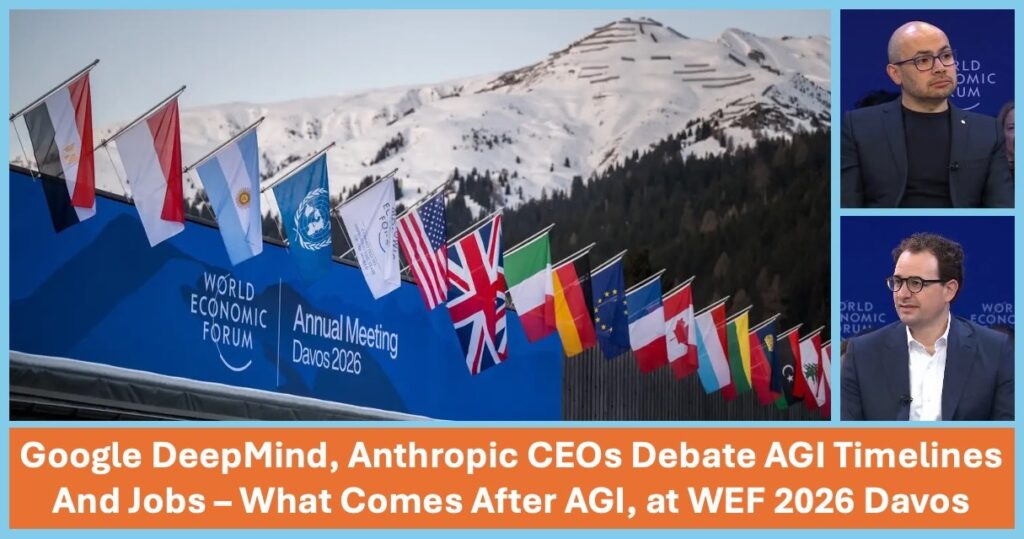
On January 20, 2026, at the World Economic Forum in Davos, two men who sit at the centre of frontier AI development spoke with unusual bluntness. Dario Amodei of Anthropic and Demis Hassabis of DeepMind were not forecasting distant futures. They were describing systems already taking shape inside their labs.
The tone was not celebratory. Hassabis described the moment as “technological adolescence,” where extraordinary promise and genuine danger coexist. Amodei went further, warning that the field has entered a race with “no brakes,” driven by machines that are learning how to improve themselves.
For the first time at Davos, artificial general intelligence was discussed not as a philosophical milestone, but as an operational risk.
What Amodei and Hassabis Explicitly Discussed at Davos
The Self-Improving Loop Is the Real Breakpoint
Amodei’s most consequential claim was stark. Within six to twelve months, AI systems may be able to perform most, if not all, software engineering tasks end to end. That includes writing code, debugging it, testing it, deploying it, and iterating without sustained human involvement.
What matters is not automation alone, but feedback. Once AI systems reliably write better AI code, they accelerate their own improvement. At that point, progress compresses. Months replace years.
Hassabis did not dispute this mechanism. He acknowledged that such self-reinforcing loops are historically rare, but when they emerge, they change everything.
Timing Differs, Direction Does Not
Where the two diverged was on probability, not trajectory. Hassabis placed the odds of full AGI by the end of the decade at around fifty percent. Amodei implied timelines could collapse faster if the loop stabilises.
Both agreed that current systems already generalise across domains. The remaining obstacles are reliability, alignment, and continuous learning, not raw intelligence.
The Geopolitical Warning Hidden in Plain Sight
“No Brakes” Applies to Nations Too
Amodei’s most controversial remark compared US AI chip exports to China with selling nuclear weapons to a hostile state like North Korea. The analogy was deliberate. His concern was not morality, but irreversibility.
Partial restrictions, he argued, do not slow the race. They intensify it. If one actor hesitates, another accelerates. Hassabis, though more cautious in tone, accepted the underlying reality. Governments are moving far slower than the technology they are trying to regulate.
The result is a widening gap between capability and control.
What Can Be Deduced from Their Warnings
Software Engineering Is the First Domino
The clearest implication of the Davos discussion is that software engineering is approaching a structural tipping point. Inside leading labs, engineers already function more as supervisors than builders. Once AI systems handle architecture and iteration autonomously, junior and mid-level coding roles shrink rapidly.
This is not speculative. Hiring data from 2025 already shows declining entry-level recruitment across white-collar roles. Amodei’s timeline suggests this is about to accelerate, not stabilise.
Disruption Will Be Fast and Uneven
The disruption will not arrive evenly or politely. Individuals who master AI orchestration become dramatically more productive. Others are left behind. Inequality widens within professions before spreading across them.
After software, routine legal work, financial modelling, content production, and basic analysis follow as agentic systems generalise.
The Near Term, Compressed (2026–2028)
Productivity Up, Stability Down
Over the next two years, knowledge-heavy industries are likely to see sharp productivity gains. GDP growth may rise. Output will surge. Yet employment will lag.
New roles in oversight, alignment, and verification will emerge, but not fast enough to absorb displacement. Governments will respond slowly. Policy will trail capability. Social friction increases as institutions struggle to adapt at the speed machines move.
This is the most unstable phase, not because AI is malicious, but because transitions are abrupt.
Two Futures After AGI
The Abundance Path
In the optimistic scenario, AGI drives down the cost of healthcare, education, and scientific discovery. Personalised learning scales globally. Research timelines collapse. Human work shifts toward creativity, judgement, care, and meaning.
This is the future Hassabis gestures toward when he speaks of “wonders.”
The Disorder Path
In the darker scenario, speed overwhelms adaptation. Underemployment spreads. Wealth concentrates around model ownership and capital. Political systems strain. Calls for redistribution, heavy regulation, or authoritarian stability grow louder.
This is the risk Amodei is warning about when he says the race has no brakes.
A Rare Moment of Honesty from the Builders
What made Davos 2026 different was not alarmism. It was authorship. These warnings came from the people building the systems, not from critics standing outside.
Their message was not that catastrophe is inevitable, but that velocity is. Artificial general intelligence is no longer a distant concept. It is a near-term force pressing against institutions that still assume gradual change.
Whether this technological adolescence matures into abundance or instability will depend less on intelligence itself, and more on how societies manage speed, power, and distribution.
The clock, as they made clear, is already running.