By ARAV KUMAR CHAND
Cricket’s Unequal Game: Why Associate Nations Keep Knocking but Never Enter
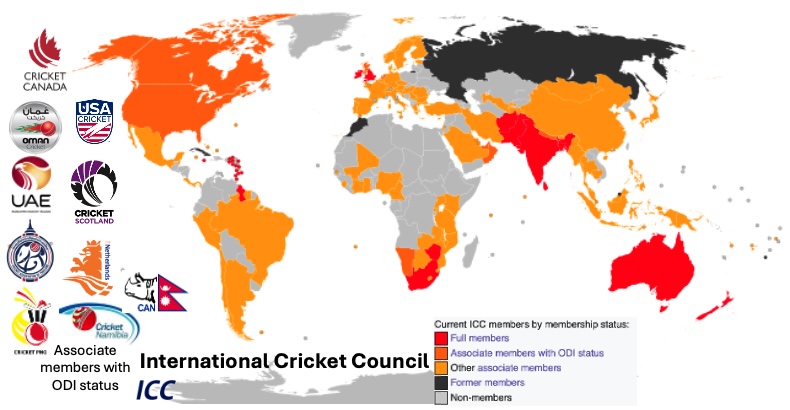
Cricket likes to present itself as a truly global sport, expanding across continents and cultures. Associate nations in cricket are often showcased as proof of that claim, especially when they spring headline-grabbing upsets at World Cups. However, beneath those moments of drama lies a far less inspiring reality. The gap between Associate nations and Full Members remains stubbornly wide, not because of talent deficits, but because the game’s structures actively prevent sustained progress.
Time and again, Associate sides demonstrate that they can compete on any given day. Yet year after year, those performances fail to translate into permanent elevation. This is not coincidence. It is the result of a system that rewards incumbency, concentrates power, and limits access to the very tools required to close the gap.
A Global Game That Plays by Selective Rules
The ICC’s public messaging emphasises growth, inclusivity, and development. In practice, however, cricket operates through a tightly controlled hierarchy. Associate nations in cricket exist on the outer edge of decision-making, funding allocation, and scheduling power. While they are invited to celebrate the game’s diversity, they are rarely allowed to influence its direction.
The contradiction becomes obvious during major tournaments. Associates are good enough to qualify, good enough to upset giants, and good enough to entertain global audiences. Yet once the tournament ends, the door closes again. There is no guaranteed follow-up in the form of regular elite opposition, expanded funding, or structural promotion. Exposure is temporary; inequality is permanent.
Money, Power and a System Designed to Favour the Few
The financial imbalance is the foundation of cricket’s inequality. Under the ICC’s current revenue distribution model for the 2024–27 cycle, nearly 89 per cent of total ICC income is allocated to the 12 Full Members. The remaining 11 per cent is shared among more than 90 Associate nations.
Within this structure, India alone is projected to receive roughly 38.5 per cent of ICC revenues, reinforcing the dominance of the so-called Big Three and their allies. For Associate boards, this leaves budgets that barely cover international travel, let alone long-term planning.
As a result, many Associate players operate on part-time contracts or match fees. Investment in sports science, analytics, specialist coaching, and nationwide academies becomes a luxury rather than a norm. Meanwhile, Full Member teams train year-round with deep support systems. The playing field is unequal before a ball is bowled.
Learning the Game Without Playing the Best
Cricketing excellence is built through repetition against high-quality opposition. This is precisely what Associate nations lack. While Full Members enjoy packed Future Tours Programme schedules, Associates largely survive on qualifiers, regional events, and brief bilateral T20I series.
Although T20I status has been extended to all ICC members, most Associate fixtures are against fellow Associates. Matches against top-tier teams remain rare and often confined to global tournaments. Consequently, batters seldom face sustained spells from elite pace attacks or world-class spin. Bowlers rarely test themselves against the best line-ups over multiple matches. Captains are denied the chance to learn pressure management across long series.
World Cup upsets are celebrated, but they cannot replace the educational grind of regular elite exposure. One-off victories inspire fans; consistent competition builds teams.
Domestic Cricket on Life Support
At home, the situation is no better. Underfunded boards struggle to sustain robust domestic structures. Many Associate nations rely on short-format tournaments played over compressed windows, often with semi-professional players juggling employment and cricket.
Long-format cricket has nearly disappeared at this level. The ICC Intercontinental Cup, once a crucial stepping stone for Ireland and Afghanistan, has been mothballed. With it went a vital development pathway for red-ball skills, tactical patience, and endurance.
This environment accelerates talent drain. Promising players retire early for financial stability, migrate to other countries through residency rules, or burn out under heavy workloads without medical or sports science support. Even when talent exists, the system fails to protect it.
Test Cricket: The Locked Door to True Legitimacy
Test cricket remains the ultimate classroom. It sharpens technique, temperament, and strategic depth like no other format. Yet access to this classroom is tightly restricted. Only 12 nations currently enjoy Full Member status and the right to play Tests.
Afghanistan and Ireland, granted Full Membership in 2017, illustrate both the potential and the fragility of progress. Afghanistan’s rapid rise showed what sustained funding and fixtures can achieve. Ireland’s uneven journey since promotion highlights how quickly gains can stall when financial and scheduling support remains inconsistent.
For other Associate nations, the pathway to Test cricket is unclear. There is no active global multi-day competition that mimics Test pressures. Ability alone is not enough; permission is required.
Upsets Make Headlines, Structures Decide Futures
Administrators often point to development programmes and increased participation as evidence that Associates are catching up. Yet power within the ICC remains concentrated. Full Members dominate committees, broadcast negotiations, and bilateral scheduling.
This control determines who hosts marquee events, who receives lucrative tours, and whose calendars remain full. Associate nations may produce moments of brilliance, but without guaranteed fixtures, multi-year funding security, and transparent promotion mechanisms, those moments fade quickly.
The hierarchy renews itself by design, not by accident.
If the ICC Truly Wanted Competition, This Would Change First
The solutions are neither radical nor unknown. A more balanced revenue model, with ring-fenced development funds and transparent criteria, would allow Associate boards to plan beyond a single season. Guaranteed home-and-away series against selected Full Members each cycle would provide real learning opportunities.
Reviving a meaningful long-format pathway, whether through a revamped Intercontinental Cup or regional four-day competitions, would restore credibility to the promotion ladder. Minimum player retainers, medical cover, and sports science support would help retain talent and extend careers.
Until such reforms move from discussion to obligation, cricket’s claims of globalisation will remain hollow. Associate nations in cricket will keep knocking on the door, occasionally forcing it open for a moment, only to find the room inside permanently reserved for the same few.
Cricket may call itself a global game. Its structures, however, still tell a far more exclusive story.