From Warning to Reality: How U.S. Forecasts on India–Pakistan Conflict Unfolded in 2025 and Shape 2026
South Asia ended 2025 with an uneasy calm that few policymakers mistake for stability. The brief but intense India–Pakistan military confrontation in May, followed by fresh warnings from leading U.S. strategic institutions in December, has reinforced an uncomfortable truth: India–Pakistan tensions are no longer episodic crises but part of a recurring structural pattern.
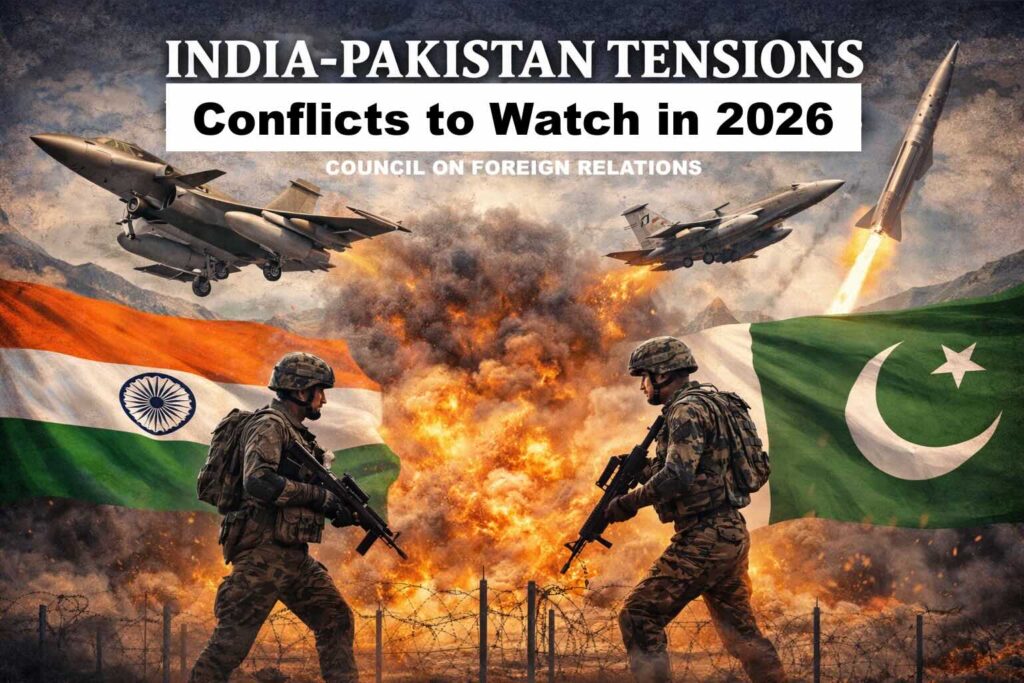
On 18 December 2025, the Council on Foreign Relations (CFR) classified the India–Pakistan conflict as a Tier II global risk in its Preventive Priorities Survey for 2026, citing a “moderate likelihood” of renewed armed conflict. The warning arrived barely seven months after both nuclear-armed neighbours engaged in their most serious military exchange since 2002—an escalation that eerily mirrored predictions made by U.S. intelligence four years earlier.
The convergence of 2021 foresight, 2025 reality, and 2026 risk assessment offers a rare opportunity to examine how long-range warnings are now colliding with near-term events in one of the world’s most dangerous flashpoints.
The 2026 Warning: CFR Flags Renewed India–Pakistan Conflict Risk
The CFR’s Preventive Priorities Survey 2026, based on inputs from more than 600 U.S. foreign policy experts, ranks global contingencies by likelihood and impact on U.S. interests. India–Pakistan tensions were placed in Tier II, reflecting a credible chance of escalation with significant regional consequences.
The survey identifies terrorist activity and repression in Kashmir as the primary triggers. It explicitly links the assessment to the May 2025 crisis, noting that structural drivers of instability remain unresolved. While the second Trump administration’s role in brokering de-escalation was acknowledged, the report cautions that diplomacy has not altered the underlying trajectory.
Notably, the survey situates South Asia within a broader global context of record-high armed conflicts, increasing the risk that future crises may escalate faster and de-escalate more slowly.
2025: When Prediction Became Reality
The CFR warning gained credibility because 2025 had already delivered what U.S. intelligence once forecast.
The immediate trigger was the Pahalgam terrorist attack on 22 April 2025 in Indian-administered Jammu and Kashmir. Militants affiliated with The Resistance Front, widely assessed as a proxy of Pakistan-based Lashkar-e-Taiba (LeT), massacred 26 civilians, selectively targeting Hindu tourists. The brutality of the attack and its communal targeting marked a sharp escalation.
Pakistan denied involvement, with LeT briefly claiming responsibility before retracting the statement. India dismissed Pakistan’s denials, framing the attack as part of a sustained cross-border terror campaign.
Operation Sindoor and the Four-Day Crisis
India’s response departed decisively from past restraint. On 7 May 2025, New Delhi launched Operation Sindoor, conducting precision missile strikes against nine terror-linked targets across Pakistan and Pakistan-administered Kashmir. According to Indian authorities, the strikes eliminated more than 100 militants associated with LeT, Jaish-e-Mohammed, and Hizbul Mujahideen.
What followed was a four-day multi-domain confrontation:
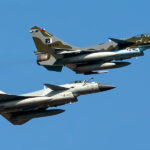
Large-scale aerial engagements involving over 100 aircraft
Drone-on-drone combat between nuclear-armed states
Cyber operations targeting infrastructure
Heavy artillery exchanges along the Line of Control
Pakistan retaliated with Operation Bunyan-un-Marsoos, claimed striking Indian military installations, including airbases. Missile interceptions using India’s S-400 systems raised alarms about escalation thresholds, particularly as strikes neared Pakistan’s strategic command infrastructure.
Casualty figures were contested, but civilian deaths occurred on both sides. Markets fluctuated sharply, airspaces were closed, and disinformation proliferated online through deepfakes and coordinated influence campaigns.
U.S. Mediation and a Fragile Ceasefire
On 10 May 2025, a ceasefire was announced following intense diplomatic engagement. U.S. President Donald Trump publicly claimed credit for averting a wider war, underscoring Washington’s continued crisis-management role in South Asia.
While both India and Pakistan declared strategic success—India citing deterrence against terrorism, Pakistan highlighting military resilience—the episode confirmed how quickly India–Pakistan tensions can escalate into near-war scenarios despite nuclear deterrence.
The 2021 Foresight: Global Trends 2040 Revisited
The May 2025 crisis closely followed warnings issued in April 2021 by the U.S. National Intelligence Council (NIC) in Global Trends 2040: A More Contested World. Though the report looked ahead to 2040, it explicitly flagged near-term risks within a five-year window.
India and Pakistan were identified as states that could “stumble into a large-scale war”, driven by terrorism, miscalculation, and hardened military doctrines. The NIC highlighted:
Ungoverned militant spaces
India’s declining tolerance for terror attacks
Pakistan’s defensive and escalation-prone posture
Environmental stress and resource competition
Water insecurity, particularly in Pakistan, was noted as an emerging destabiliser, while nuclear escalation risks were framed as consequences of eroding arms-control norms.
The report’s language was cautious, but its logic was unmistakable. Structural pressures were outpacing governance capacity—a condition ripe for crisis.
Why 2026 Remains Dangerous
Despite the 2025 ceasefire, the drivers of instability persist.
Terrorism remains the most immediate trigger. Any major attack in Kashmir could provoke rapid Indian retaliation, compressing decision-making timelines.
Domestic pressures matter equally. Nationalist sentiment in India and economic stress in Pakistan reduce political space for compromise.
Geopolitical overlays add risk. China’s strategic support to Pakistan and India’s growing alignment with the Quad complicate crisis management.
Nuclear thresholds remain opaque. With both sides possessing sizable arsenals, misinterpretation or technical failure could have catastrophic consequences.
Water stress in the Indus basin, while not central in 2025, could become politically charged if climate volatility intensifies.
Escalation or Restraint: The Narrow Path Ahead
There are still pathways to stabilisation. Restoring confidence-building measures along the Line of Control, sustained third-party crisis mediation, and limited humanitarian engagement in Kashmir could reduce immediate risks.
However, none of these address the core paradox: deterrence has prevented total war but not repeated crises. As long as terrorism, unresolved territorial disputes, and asymmetric strategies persist, warnings like those issued by the NIC and CFR will continue to materialise.
A Pattern, Not an Anomaly
The arc from the 2021 intelligence warning to the 2025 confrontation and the 2026 CFR alert underscores a sobering reality. India–Pakistan tensions are no longer anomalies triggered by exceptional events. They are the predictable outcome of structural imbalance, unresolved grievances, and shrinking diplomatic buffers.
With over two billion people living under the shadow of escalation, preventing the next crisis will require more than emergency diplomacy. It demands confronting the causes that allow prophecy to keep turning into reality.