M777 Howitzer and India’s Search for More Ultra-Light Firepower
The M777 Howitzer has quietly moved from being a niche acquisition to a reference point in India’s evolving artillery doctrine. Its operational performance, particularly during Operation Sindoor, has triggered renewed internal discussions within the Indian Army on whether the existing fleet of 145 guns is sufficient for India’s expanding high-altitude and rapid-response requirements.
This reassessment has gained added relevance following the Defence Acquisition Council’s approval on 29 December 2025 of a massive defence procurement package worth approximately ₹79,000 crore. While the clearance does not explicitly list fresh M777 purchases, it underscores a broader institutional push towards long-range precision, mobility, and network-centric warfare — all areas where the M777 Howitzer has demonstrated tangible value.
Why the M777 Howitzer Matters More Today
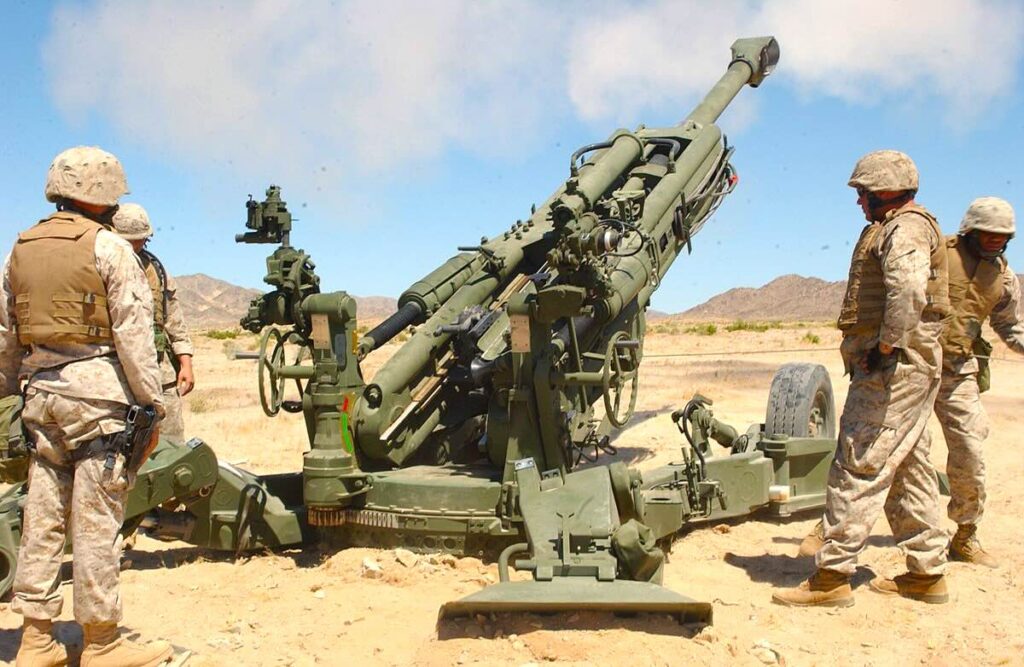
The M777 Howitzer is a 155mm, 39-calibre ultra-light towed artillery gun developed by BAE Systems. Its defining feature remains its extensive use of titanium, which reduces its weight to around 4,200 kilograms. This enables helicopter transport and rapid redeployment in terrain where conventional artillery struggles to operate.
For India, this capability is not theoretical. The country’s northern and eastern borders impose altitude, weather, and infrastructure constraints that penalise heavy systems. In this environment, artillery that can be flown in, repositioned quickly, and brought into action within minutes offers a distinct operational edge.
The gun’s compatibility with precision-guided munitions such as the M982 Excalibur further elevates its relevance. Precision fire allows the Army to achieve decisive effects without resorting to prolonged or indiscriminate bombardment, a factor increasingly important in politically sensitive theatres.
From Procurement to Operational Validation
India’s acquisition of 145 M777 Howitzers under a 2016 Foreign Military Sales agreement with the United States is well documented. The contract, valued at around $737 million, included 25 guns delivered in fully built condition and 120 assembled in India through a partnership between Mahindra Defence Systems and BAE Systems.
The induction process concluded by 2021. Since then, the guns have been deployed primarily along the Line of Actual Control with China, particularly in Ladakh and Arunachal Pradesh. Their ability to be airlifted by CH-47 Chinook helicopters has allowed the Army to position artillery in areas previously considered inaccessible for sustained fire support.
Operation Sindoor: A Turning Point
The decisive moment for the M777 Howitzer came during Operation Sindoor in May 2025. The operation involved precision strikes against terrorist infrastructure across Pakistan-occupied Kashmir and adjoining areas. It combined air power, drones, and ground-based artillery into a tightly coordinated campaign.
During the Operation Sindoor, a full regiment of M777 Howitzers was airlifted from the northeastern sector to Jammu and Kashmir at short notice. This redeployment highlighted the system’s strategic mobility. Once deployed, the guns fired Excalibur precision-guided rounds to neutralise hardened targets, ammunition depots, and logistical hubs.
Military assessments following the operation noted that the M777’s combination of accuracy, speed, and ease of integration with drone-based targeting significantly reduced engagement time and collateral damage. This performance has since become a reference point in internal artillery evaluations.
Post-Sindoor Reassessment Inside the Army
In the months following Operation Sindoor, defence-focused reports indicated that the Indian Army has begun examining the requirement for additional ultra-light howitzers. These discussions are driven by three converging factors.
First, the Army’s operational footprint along the China border remains expanded since 2020. Second, the western front continues to demand rapid response capabilities. Third, experience from Sindoor reinforced the value of precision artillery that can be repositioned quickly without large logistical tails.
Importantly, these deliberations do not amount to an approved purchase. They represent a capability review phase, where the Army is weighing options that could include additional M777s, an upgraded variant if available, or indigenous ultra-light alternatives that have cleared trials.
The ₹79,000 Crore DAC Clearance and Its Significance
On 29 December 2025, the Defence Acquisition Council approved a broad procurement package worth approximately ₹79,000 crore. The clearance covers missiles, radars, long-range ammunition, loitering munitions, and airborne platforms.
While no line item explicitly names the M777 Howitzer, the approval is significant in context. It signals the government’s willingness to fund high-impact, technology-driven capabilities that enhance precision, reach, and responsiveness. The inclusion of long-range ammunition and advanced munitions aligns directly with the operational model demonstrated by the M777 during Sindoor.
Within this framework, additional ultra-light howitzers would logically fall under follow-on procurement cycles rather than immediate approvals. Defence acquisitions of this scale typically progress through phased approvals, beginning with capability validation, followed by Acceptance of Necessity, and finally contract negotiations.
Clarifying the “M777M” Narrative
Some defence discussions and online commentary have referred to a possible “M777M” or upgraded M777 variant. At present, there is no official confirmation from the Ministry of Defence or the US Defence Security Cooperation Agency of a sanctioned Indian purchase under that designation.
What can be stated with confidence is that any future acquisition, if pursued, would likely incorporate lessons from Indian operational use. These could include improved range, enhanced digital fire-control integration, or compatibility with newer precision-guided ammunition. Whether this results in an upgraded M777 or a different platform altogether remains an open question.
Ammunition, Interoperability, and Logistics
One of the strongest arguments in favour of additional M777 Howitzers lies in ammunition commonality. The M777 shares its 155mm/39-calibre specification with the Bofors FH-77B, Dhanush, and K9 Vajra. This allows the Indian Army to standardise ammunition stocks, including precision rounds such as Excalibur.
Following Sindoor, India moved swiftly to replenish depleted Excalibur stocks through a fast-tracked US approval in November 2025. This decision reinforces the Army’s commitment to precision artillery across platforms rather than reliance on a single gun system.
Cost, Choices, and the Road Ahead
Each M777 Howitzer costs roughly $5 million, reflecting advanced materials and systems. While the price is significant, the operational payoff in terrain like Ladakh or Arunachal Pradesh is difficult to ignore.
The Indian Army is therefore at a decision point. It must balance the cost of additional imports against the promise of indigenous ultra-light guns, while ensuring that capability gaps do not emerge during prolonged deployments.
What is clear is that the M777 Howitzer has reshaped expectations. It has demonstrated that in modern Indian warfare, mobility and precision can outweigh sheer mass. Whether India buys more M777s or fields an alternative, the template established by this gun is unlikely to be abandoned.