Bangladesh Internal Politics Shaken by Youth Leader Assassinations Ahead of 2026 Election
A Political Landscape Without Its Old Centre
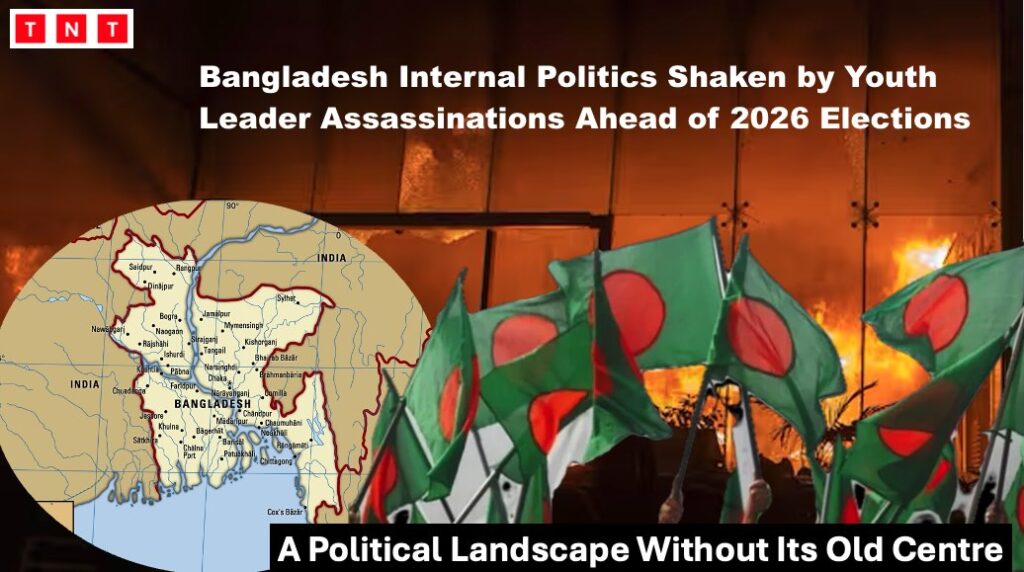
Bangladesh internal politics has entered a period of acute uncertainty as the country prepares for its February 12, 2026, general election under conditions unseen in recent decades. The suspension of the Awami League after the 2024–25 student-led uprising dismantled the traditional two-party framework that had long dominated national politics. In its place has emerged a fragmented and volatile political order marked by an explosion of parties, rising ideological competition, and an alarming return of political violence.
As of December 23, 2025, the Bangladesh Election Commission confirms that 57 political parties are formally registered and eligible to contest elections. This figure has steadily increased throughout the year, reflecting both the political vacuum left by the Awami League and the scramble among new and existing actors to secure relevance. However, despite this numerical expansion, effective political power remains concentrated among a few dominant forces, while many newly registered parties lack organisational depth, resources, or nationwide reach.
Context: The Exiled Leadership and a Ban That Reshaped Politics
A defining backdrop to Bangladesh internal politics is the continued ban on the Awami League, which has removed the country’s longest-ruling party from the electoral arena altogether. With its registration suspended, the party’s extensive organisational network has effectively collapsed, leaving millions of traditional supporters politically unanchored. Former prime minister Sheikh Hasina remains outside Bangladesh amid ongoing legal proceedings that have closed the door on her return to active politics. Her son, Sajeeb Wazed, has continued to defend her legacy from abroad, but without party recognition or ground-level machinery, his role remains symbolic rather than operational.
On the opposite side, the Bangladesh Nationalist Party (BNP) has moved to consolidate rather than retreat. The expected return of acting chairman Tarique Rahman after years in exile marks a decisive moment, particularly as Khaleda Zia’s direct political role has diminished due to health concerns. Together, the Awami League’s exclusion and the BNP’s leadership reassembly have redrawn the political map, creating both opportunity and instability in equal measure.
Fragmentation Without Balance
The surge in registered parties has not translated into political equilibrium. Instead, Bangladesh internal politics now reflects a crowded and competitive arena where legitimacy is contested but authority is thin. Many newly registered parties lack nationwide structures, credible leadership, or a defined ideological base. Informal movements and protest platforms continue to influence street mobilisation, yet they remain largely detached from the formal electoral process, widening the gap between revolutionary sentiment and institutional politics.
This fragmentation has placed the interim administration under sustained pressure. Muhammad Yunus, serving as Chief Adviser, operates without a political party of his own, positioning him simultaneously as a neutral caretaker and a convenient target for competing accusations. As election preparations intensify, the absence of a stabilising centre has amplified mistrust among political actors and deepened public scepticism.
The Reconfigured Contest for Power
Despite the crowded field, three forces dominate the electoral conversation. The Bangladesh Nationalist Party has emerged as the frontrunner largely by default, benefiting from organisational continuity and voter expectations shaped by the Awami League’s absence. Opinion surveys throughout 2025 suggest a broad assumption that the BNP will secure the largest share of seats. The party has announced candidates across most constituencies and is actively engaging smaller parties to consolidate its position. Yet internal leadership dynamics and the challenge of governing a fractured polity remain unresolved questions.
Jamaat-e-Islami has simultaneously re-entered the political mainstream with renewed confidence. After regaining full registration, the party has rebuilt its grassroots networks and expanded its reach among conservative and protest-oriented voters. While its historical baggage continues to limit wider appeal, Jamaat is increasingly viewed as a potential power broker capable of influencing coalition outcomes in the next parliament.
The National Citizen Party (NCP) represents the most visible attempt to translate the July Revolution into formal politics. Formed in February 2025 and led by former student leader Nahid Islam, the NCP campaigns on constitutional reform and systemic change. Despite its moral visibility and youth appeal, the party faces organisational constraints, limited resources, and internal divisions. Its role in the 2026 election is expected to be disruptive rather than decisive.
Youth Politics Turns Deadly
The trajectory of Bangladesh internal politics took a darker turn in December 2025 with the targeted killing of two prominent youth figures. The assassination of Sharif Osman Hadi, a leading activist of the post-uprising Inqilab Mancha platform, sent shockwaves through the political establishment. Hadi, a former university lecturer, had emerged as a powerful independent voice and was preparing to contest the Dhaka-8 seat without party backing. He was shot by masked assailants in Dhaka and later died after being flown to Singapore for treatment.
Hadi’s death triggered widespread protests, riots, and arson attacks across major cities. Media offices and diplomatic properties were targeted, exposing how quickly political violence could spill into broader instability. Court proceedings and police investigations have since revealed troubling links involving previously arrested individuals and legal figures associated with mainstream parties, though no convictions have been secured. The case has become a lightning rod for accusations of political elimination.
Only days later, Muhammad Motaleb Sikdar, a senior leader of the National Citizen Party and its Khulna divisional chief, was shot in a separate incident while organising a labour rally. Although reports differ on his condition, the attack reinforced fears that youth-led political mobilisation is increasingly being met with lethal force. Together, the two incidents have reintroduced fear into the political process and reshaped campaign dynamics nationwide.
Who Gains from the Chaos?
The killings have intensified speculation over who benefits from rising instability. Supporters of the interim government argue that entrenched parties seek to neutralise independent youth figures who threaten established hierarchies. Critics of Muhammad Yunus claim the violence exposes the state’s inability to maintain order under his stewardship. Others point to external actors, invoking regional intelligence agencies to explain the surge in unrest, while rival factions accuse each other of engineering chaos to delay elections or consolidate leverage.
What remains clear is that political violence has once again become a strategic variable. The timing of the attacks, so close to the election calendar, has deepened public cynicism and undermined confidence in a peaceful transition.
An Election Under a Shadow
As Bangladesh moves closer to the 2026 polls, the political landscape reflects a nation suspended between transformation and instability. The exclusion of the Awami League, the reorganisation of the BNP, the rise of Islamist influence, and the vulnerability of youth movements have combined to create a highly combustible environment. Whether the coming election restores democratic balance or deepens uncertainty will depend not only on who wins, but on whether the political system can absorb change without further bloodshed.