South Asia Air Power Balance: Turkey’s TF Kaan, Pakistan’s Stealth Gamble, and How India Is Managing the Edge
Turkey’s TF Kaan and the New Geometry of Regional Air Power
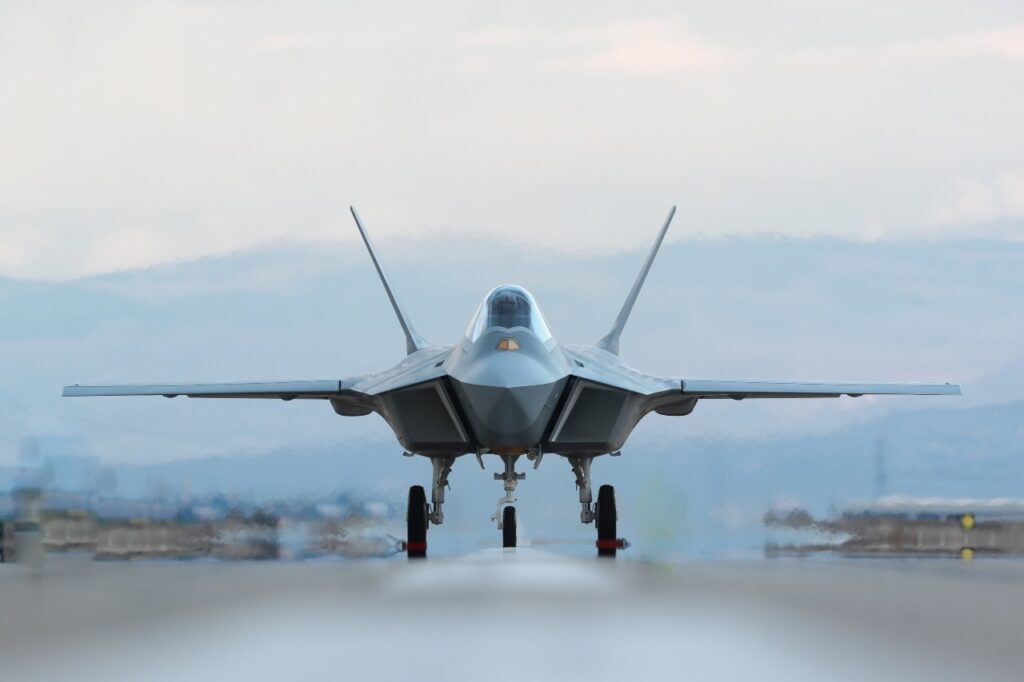
Turkey’s TF Kaan programme has been moving decisively from ambition to reality, and in doing so has begun to influence air power calculations well beyond West Asia. Conceived in 2010 as an indigenous fifth-generation fighter, the aircraft was initially meant to replace Turkey’s ageing F-16 fleet. However, Ankara’s expulsion from the F-35 programme in 2019 following the purchase of the Russian S-400 system transformed TF Kaan from a long-term industrial project into a strategic necessity.
The first prototype of TF Kaan flew in February 2024, completing a 15 minutes, short but symbolically critical maiden sortie that validated the aircraft’s fly-by-wire system, aerodynamic configuration, and baseline stealth shaping. Since then, the programme has progressed steadily, though not without delays. The second prototype, which will incorporate the majority of mission avionics and sensor fusion systems absent from the first airframe, is now expected to fly in the first half of 2026. Turkish Aerospace Industries plans to build up to six prototypes for intensive flight testing before committing to serial production toward the end of the decade, i.e., 2030.
Technically, TF Kaan is designed as a full-spectrum fifth-generation fighter rather than a transitional stealth platform. Its design incorporates internal weapons bays, low observable shaping, a domestically developed AESA radar by ASELSAN, advanced electronic warfare systems, and an architecture built around network-centric operations and artificial intelligence-assisted pilot support. Initial aircraft will rely on American GE F110 engines, a dependency Ankara is keenly aware of. The indigenous TEI TF35000 turbofan, unveiled publicly in 2025, is not expected to be ready for integration before 2032 (likely on later blocks), which means Turkey’s first operational squadrons will still depend on foreign propulsion.
Despite these constraints, TF Kaan has achieved something unusual for a fifth-generation fighter: export momentum before operational induction. Indonesia has signed a reported ten-billion-dollar agreement for forty-eight aircraft, while Egypt and Azerbaijan have entered co-production or industrial partnership arrangements. Saudi Arabia has expressed interest in a large future order. This export push has helped Turkey offset development costs and position TF Kaan as an alternative to the increasingly politically constrained F-35 ecosystem.
Pakistan’s Entry into the TF Kaan Programme and What It Actually Means
Pakistan’s association with the TF Kaan programme has attracted significant attention, often accompanied by exaggerated claims about timelines and capability leaps. In reality, Islamabad’s involvement is substantial but bounded. Pakistan is not a co-designer of the aircraft. Instead, it is a manufacturing and industrial partner, with a joint production facility planned on Pakistani soil and several hundred engineers already embedded within Turkish Aerospace Industries.
For Pakistan, the attraction is obvious. The Pakistan Air Force faces an ageing fleet and limited access to Western platforms. Participation in TF Kaan offers a credible pathway to fifth-generation capability without the political strings attached to American systems or the complete dependence associated with Chinese platforms. However, this pathway is neither immediate nor cheap.
Even under optimistic assumptions, Pakistan is unlikely to receive its first TF Kaan aircraft before 2030 or 2032. Turkey will prioritise its own air force during initial production, and early export slots will depend on engine availability, production ramp-up, and avionics maturity. Moreover, Pakistan’s defence budget places natural limits on fleet size. While figures ranging from forty to one hundred aircraft are often cited, the lower end of that spectrum appears more realistic in the medium term.
This timeline matters. Pakistan’s TF Kaan participation does not create a sudden stealth advantage over India. Instead, it represents a long-term bet that begins to materialise only in the early 2030s, by which point India’s own fifth-generation plans will also be approaching fruition.
The Chinese J-35 Question and Pakistan’s Short-Term Stealth Gap
Alongside TF Kaan, persistent speculation has surrounded Pakistan’s potential acquisition of China’s J-35 stealth fighter. Reports in mid-2025 suggested that Islamabad had secured approval for a limited number of aircraft, possibly making Pakistan the first export customer for the type. These claims were later publicly denied by Pakistan’s defence leadership, and subsequent reporting indicated that financial constraints and shifting priorities had stalled the effort.
The uncertainty surrounding J-35 highlights a deeper issue. China itself is still inducting the aircraft primarily for naval aviation, and export variants are not yet mature. Even if Pakistan were to revive negotiations, the most optimistic delivery timeline would place the first aircraft in the mid 2026 or later, and likely in small numbers. Such a limited induction would not fundamentally alter the regional air balance.
As a result, Pakistan’s short-term reality remains unchanged. Its frontline capability continues to rely on olde F-16 (reason for recent news on American DSCA approval for USD 686 million upgrades)l, J-10C and JF-17 variants armed with Chinese PL-series missiles, while its fifth-generation ambitions remain aspirational rather than operational.
India’s Fighter Fleet: Managing Capability Before Stealth Numbers
India’s approach to the fifth-generation transition differs markedly from Pakistan’s. Rather than seeking an immediate stealth platform at any cost, the Indian Air Force has prioritised layered capability through a combination of advanced fourth-generation fighters, indigenous production, and long-range weapons.
The Rafale fleets remain central to this strategy. Equipped with Meteor beyond-visual-range missiles, SCALP cruise missiles, and the Spectra electronic warfare suite, Rafale provides India with a qualitative edge in both air-to-air and deep strike roles. Operational experience has reinforced these assessments, with aircraft demonstrating high availability rates and effective integration with Indian command-and-control networks.
Alongside Rafale, India continues to modernise its Su-30MKI fleet, integrating indigenous avionics, upgraded radars, and advanced missiles. Also, India is getting world’s deadliest Russian AAM R-37M for Su-30MKI beyond-visual-range integration. The aircraft’s ability to carry supersonic BrahMos cruise missiles gives India a standoff strike capability that Pakistan cannot currently match. Tejas Mk1A, entering service from 2027 onward, will bolster squadron strength and replace legacy platforms, while Tejas Mk2 is expected to emerge as a heavier, more capable 4.5-generation fighter toward the end of the decade.
This combination ensures that India does not face a capability vacuum while waiting for its own fifth-generation platform.
Missiles as the Silent Equaliser in South Asia Air Power
Any assessment of South Asia air power that focuses solely on airframes misses the decisive factor shaping modern aerial combat: missiles. In this domain, India enjoys a clear and growing advantage.
Meteor and AAM R-37M provide the Indian Air Force with one of the largest no-escape zones in operational service today, giving Indian pilots a first-shot advantage against adversaries relying on dual-pulse solid-fuel missiles. Indigenous Astra variants further deepen this edge, with the second generation approaching ranges comparable to export versions of China’s PL-15 while offering better integration with Indian sensors and electronic warfare systems.
On the strike side, the BrahMos family fundamentally alters engagement geometry. Supersonic cruise capability, combined with long range and high accuracy, allows Indian aircraft to neutralise high-value targets without entering contested airspace. The forthcoming BrahMos-NG and hypersonic BrahMos-2 will further compress reaction times for adversary air defences.
When layered with S-400, Akash-NG, and indigenous radar networks, India’s missile ecosystem functions as a force multiplier that offsets any numerical disadvantage and complicates adversary planning well before stealth aircraft enter the picture.
AMCA and the Question of the Fifth-Generation Gap
India’s Advanced Medium Combat Aircraft (AMCA) programme is often criticised for its long timelines. Yet those timelines must be viewed in context. The programme cleared critical design review in 2025, secured prototype funding, and finalised an engine development partnership with France. Prototype rollout is expected in the latter half of the decade, with induction planned for the mid-2030s.
Crucially, AMCA is not conceived as a minimal stealth platform. It is designed as a 5.5-generation aircraft incorporating artificial intelligence, manned-unmanned teaming, internal weapons carriage, and sustained supercruise. By the time it enters service, it will face not early fifth-generation fighters, but more mature stealth ecosystems.
In parallel, India retains the option of inducting an interim fifth-generation platform should the strategic environment demand it. Discussions around the Su-57 reflect this hedging approach. While no decision has been finalised, the very existence of this option reduces strategic risk.
So Does India Need to Worry?
The answer, based on current trajectories, is no—at least not in the way alarmist narratives suggest. Pakistan’s fifth-generation capability remains a decade away from meaningful operational strength. Turkey’s TF Kaan, while impressive, will first serve Turkish requirements and only later flow to partners. China’s J-35 export pathway is uncertain and constrained.
India, meanwhile, is not standing still. It is consolidating advantage through missiles, electronic warfare, networked sensors, and high-end fourth-generation platforms, while methodically building its own fifth-generation capability. In modern air warfare, dominance is rarely decided by a single aircraft type. It is decided by systems, timelines, and the ability to integrate technology at scale.
On those measures, India retains the upper hand well into the 2030s.