H1 (Header): Trump C5 Proposal and the Battle to Redraw Global Power
Trump C5 Proposal and the Battle to Redraw Global Power
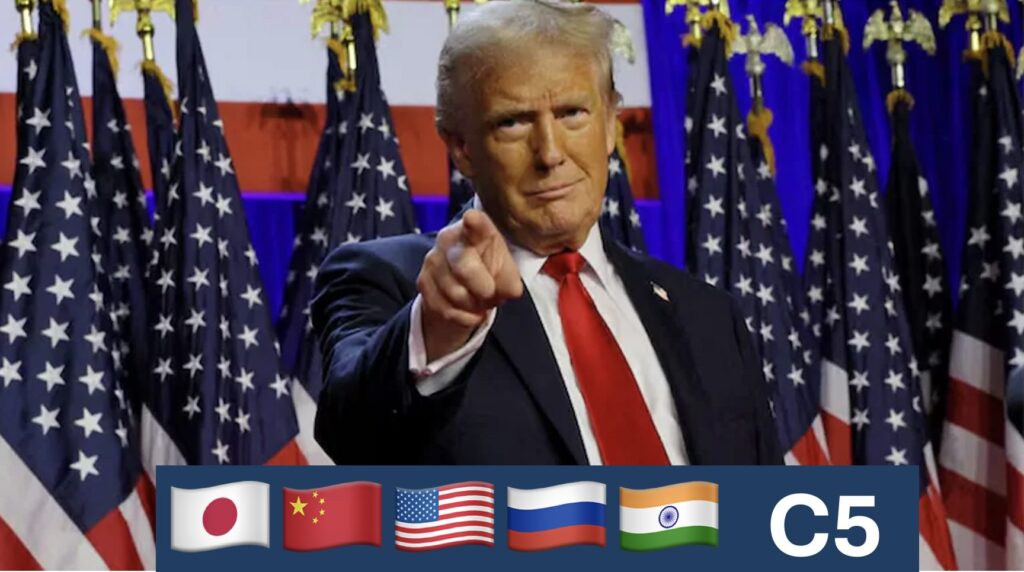
A leaked draft of the Trump administration’s 2025 National Security Strategy (NSS) has pushed a dramatic idea into the global spotlight: the Trump C5 proposal, a new “Core Five” grouping of the United States, China, Russia, India and Japan. The draft describes this bloc as a forum for direct engagement among the world’s most powerful states, designed for managing crises and shaping global order without the constraints of older structures like the G7 or the UN Security Council.
Some media Indian outlets framed this as a “shocking offer” to India. Others speculated that the plan would replace the G7 entirely. The leaked document, however, paints a more calculated picture. It proposes a forum based on power realities, not ideology, and positions India as a pivotal member of a new global core. Yet it remains an internal proposal, not a formal diplomatic invitation.
What the Trump C5 Proposal Really Contains
The draft NSS outlines the C5 as an informal platform for candid dialogue among equals. It identifies areas that cannot be resolved through existing multilateral bodies, including nuclear risk, technology competition, supply-chain fragmentation and great-power rivalry. Analysts highlight that the move accepts a new truth: unilateral American dominance is over, and the US must deal with rivals and partners alike through balance-of-power diplomacy.
A Break from Alliance-Centric Approaches
Unlike the Biden-era push for democratic coalitions such as the G7, NATO, the Quad or IPEF, the NSS adopts a pragmatic lens. It signals a shift from “values first” to “power first”. The C5, in Trump’s framing, bypasses ideological groupings and focuses on capability and population scale.
No Offers—Yet India Is Central
The leaked draft makes no reference to an invitation to any country, including India. It is a structural idea within a strategy document. Yet India features prominently because of its fast-rising economic and military profile and its role as a swing power between the West and Asia.
No Direct Connection to Ending the G7
Some headlines linked C5 with the end of the G7 or the rebirth of the G8. The document never claims this. Trump has previously said Russia should return to the G7, but the C5 is a separate concept. It does not mention removing or replacing the G7.
Why the C5 Signals a Multipolar Wake-Up Call
The Trump C5 proposal suggests that institutions born in the 1970s no longer reflect 21st-century realities. The G7 excludes the world’s largest population centres and several of its most assertive powers. Therefore, Trump calls the G7 “outdated”, arguing that it encourages “ineffective posturing”.
The Rise of Competing Power Centres
The NSS acknowledges that China and Russia cannot be ignored or contained through moral pressure. It frames them as unavoidable players whose participation is necessary for resolving major global issues.
India and Japan as Strategic Anchors
In the C5, India and Japan serve as balancing forces. Their presence prevents the grouping from becoming a US–China condominium or a Russia–China axis. This configuration recalibrate global power arithmetic and elevates Asia’s centrality in geopolitics.
Can the C5 Actually Take Shape?
The feasibility of the C5 depends on political timing, great-power willingness and absence of major crises. The NSS is now official policy, which increases the odds. Trump’s known preference for personal diplomacy could help accelerate early meetings. Think tanks estimate a 60–70% chance that the first C5 summit could occur by 2026 if geopolitical shocks do not intervene.
Japan Shows Early Quiet Interest
Japan sees the C5 as leverage against China’s growing clout. It maintains trust with Washington and has reasons to welcome a forum where it is recognised as a major power, not merely a Western ally.
India’s Calculated Advantage
For India, the C5 is a diplomatic elevation. It enters the highest table of global power without Western conditionalities on domestic issues. New Delhi gains more room to manoeuvre among competing powers while retaining its policy of strategic autonomy.
China and Russia Are the Wild Cards
China may agree if the C5 strengthens its stature. However, it may seek US concessions on Taiwan or trade. Russia may use C5 participation to erode sanctions and rebuild global influence. Trump’s existing rapport with Putin may help secure Russian buy-in.
Who Wins and Who Loses in the C5 Equation
Winners — United States, India, Japan
The US gains direct negotiation channels with Beijing and Moscow without the friction of the UN or G7. It also positions itself as the architect of a major-power order. India and Japan gain prestige, strategic leverage and economic opportunities. India could benefit in areas such as defence co-production, technology transfer and semiconductor collaboration. Japan may use the forum to secure supply chains and stabilise regional dynamics.
China and Russia — Conditional Gains
Both countries gain legitimacy and space to discuss grievances, from sanctions to NATO expansion. The C5 could offer them a structured path to influence decisions that affect their interests.
Europe’s Anxiety and the Democratic World’s Concerns
Europe is the largest loser in this equation. The C5 sidelines traditional Western heavyweights like France and Germany. Many European diplomats interpret this as a deliberate snub, even a “MAGA betrayal”.
Erosion of Western Moral Leverage
By engaging Russia and China as equals, the C5 weakens the West’s ability to frame global politics through democratic values or human-rights concerns.
Marginalisation of Middle Powers
Countries like Australia and South Korea fear losing their influence. Structures such as the Quad or AUKUS could weaken if overtaken by C5-led strategic dialogues. Human-rights groups warn that this normalisation of authoritarian states may embolden illiberal trends globally.
Europe’s Search for Relevance
Leaders like Macron have long advocated “strategic autonomy”. The C5 accelerates that pressure. The EU may pursue an “E5” bloc, but internal challenges like migration, inflation and energy crises limit its bandwidth. Analysts warn that unless Europe innovates, the G7 could drift into irrelevance.
The Road Ahead — A New Bargaining Table or New Fault Line?
As 2025 closes, the Trump C5 proposal stands as a bold attempt to rewrite the global conversation. It could stabilise great-power competition through structured dialogue, or it could institutionalise rivalry by placing adversaries across the same table without shared values. Much now depends on how each participant interprets its leverage, and whether the US can manage competing ambitions without triggering new confrontations.
The world watches a geopolitical experiment take shape. If the C5 materialises, it will not just add another forum—it will redefine the hierarchy of global power for years to come.