Australia’s Nationwide Ban on Social Media for Under-16s Takes Effect
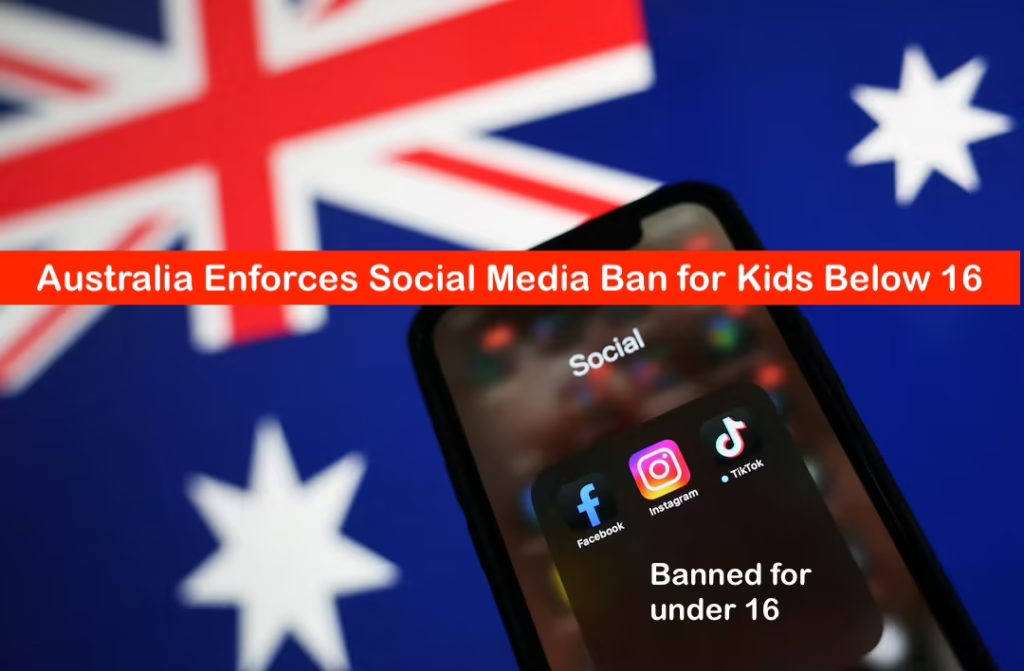
Australia on Wednesday activated a sweeping Australia social media ban for users below 16 years of age, becoming the first nation to impose such a restriction across its entire territory. The policy, which came into force at midnight local time, obligates major digital platforms to deny access to under-age users or risk penalties that could reach tens of millions of Australian dollars. The move marks a profound shift in how governments confront online harms, and regulators across Europe and North America are monitoring the rollout closely.
A New Era of Mandatory Age-Gating
The newly enforced law applies to ten of the largest and most influential social media platforms operating in the country. Under the legislation, platforms must take reasonable and verifiable steps to prevent Australians younger than 16 from creating accounts. They must also identify and remove existing under-age accounts. The penalties for non-compliance are severe, with fines rising to nearly 50 million Australian dollars (approximately 33 million US dollars).
Authorities have described the framework as one of the most stringent enforcement systems ever implemented in a democratic nation. It reshapes the accountability of platforms that dominate global communication and entertainment.
Platforms Covered and Enforcement Mechanisms
Scope of Regulated Platforms
The mandate covers a broad spectrum of services used by millions of Australians. These include TikTok, YouTube, Instagram, Facebook, Snapchat, Threads, X, Reddit, Twitch and Kick. By extending the law to both established giants and smaller but fast-growing platforms, the government aims to close loopholes that previously allowed under-age users to migrate from one service to another.
Tools to Enforce the Age Cut-Off
To meet the legal threshold, companies have informed the government that they will deploy a combination of enforcement tools. These include:
Age-inference algorithms that analyse behavioural patterns.
Selfie-based verification, which uses facial analysis to estimate a user’s age.
Optional ID-linked or payment-linked verification for more stringent checks.
In addition, platforms must issue periodic reports outlining the number of under-16 accounts they remove, the enforcement measures they apply, and the technological adjustments they plan. As a result, regulators will gain visibility that was previously absent in voluntary compliance regimes.
Government Explains Its Push for Regulation
Prime Minister Anthony Albanese has highlighted the legislation as a significant social intervention aimed at shielding young people from the escalating risks of digital environments. According to the government, heavy social media exposure among children and adolescents correlates strongly with increased rates of anxiety, self-harm content consumption, compulsive use, and cyberbullying.
Officials argue that voluntary commitments from tech companies have failed to tackle the depth of the problem. They therefore insisted on a legally binding age limit that cannot be bypassed through simple self-declarations.
In addition, the law responds to growing community concern about the addictive design of social platforms. As a result, policymakers view this intervention as essential to restoring control to parents and educators who often struggle to manage children’s screen time.
Support and Pushback as the Law Rolls Out
Support from Parents and Child-Safety Advocates
Many parent organisations and child-protection experts have welcomed the legislation. They contend that it gives families a powerful tool to curb the influence of platforms that saturate teenagers’ daily lives. Several advocacy groups assert that children face risks ranging from body-image pressures to exposure to harmful challenges, and therefore applaud the government for taking decisive action.
Concerns from Tech Firms and Rights Groups
However, the policy has provoked strong criticism from technology companies, digital-rights organisations and free-speech advocates. They argue that the ban is overly broad, technically difficult to implement and may generate new privacy vulnerabilities. Several organisations fear that age-verification tools could expose minors to the risk of data breaches or misuse of biometric information.
Furthermore, critics warn that the prohibition may prompt teenagers to shift to less regulated or offshore platforms where surveillance and safety controls are weaker. As a result, some experts caution that the law may inadvertently drive risky behaviour underground rather than eliminating it.
Global Significance of Australia’s Approach
International Scrutiny of the Enforcement Model
The Australia social media ban is attracting intense attention around the world. Regulators in the United States, United Kingdom and the European Union are tracking its impact to assess whether an age threshold can reduce online harm without causing disproportionate collateral effects. Because social media companies operate globally, the outcome in Australia may influence regulatory debates elsewhere.
Long-Term Regulatory Framework
The Albanese government has signalled that the list of covered platforms may expand as new services emerge. Officials describe the legislation as a long-term regulatory structure designed to evolve with technological change rather than a one-time intervention.
Because the law places responsibility directly on platforms rather than parents or schools, international observers view it as a key test of whether democracies can impose firm digital boundaries without stifling innovation or infringing on fundamental rights.
Final Note
Australia’s decision to restrict social media access for under-16s marks a turning point in global technology governance. As the world watches, the policy’s success or shortcomings may reshape future debates about children’s safety, corporate accountability and the balance between digital freedom and regulation.