The Slow Erosion of American Global Influence in a Changing World
A Sanctions Earthquake That Never Shook Russia
When Russia invaded Ukraine in February 2022, Washington assembled what it called the most powerful sanctions coalition in modern history. Over forty countries, representing half of global GDP, aligned behind the United States. They froze USD 300 billion in Russian reserves, removed major banks from SWIFT, and blocked the export of oil, gas, metals, and critical goods. Western leaders predicted an economic implosion so severe that the Kremlin would face open revolt.
However, reality unfolded differently. Russia suffered only a mild recession in 2022, with GDP contracting 2.1% rather than the forecast 15–20% while applying sanctions. By 2023, growth rebounded to 3.6%, and in 2024 it reached 3.9%, surpassing Germany, Britain, and France. Instead of collapsing, the rouble stabilised. Approval ratings for the Russian leadership rose. Moscow adapted, redirected trade, and discovered new partners.
Why Sanctions Failed to Demonstrate American Global Influence
The weaponisation of the dollar once appeared absolute. Yet the sanctions designed to showcase American dominance exposed its limitations instead. Russia did not break. It improvised. Therefore, many governments observing the crisis reconsidered the assumption that economic pressure from Washington is always decisive.
The sanctions war became the first major signal that American Global Influence had begun to weaken—not in dramatic fashion, but through the failure of its most trusted instrument.
Oil Markets Rewired – The India Corridor and the Limits of Pressure
The West assumed Russia could not redirect millions of barrels of crude oil after Europe banned imports. Analysts claimed there were no alternative markets large enough to absorb this volume. Nevertheless, the global oil trade rapidly reorganised itself.
How India Became the Unexpected Pivot
India, which had almost no Russian crude in its energy mix before 2022, suddenly received offers at USD 30 per-barrel discounts. For a country importing 5 million barrels per day, the savings were enormous—around USD 150 million per day. Consequently, Indian refiners enthusiastically entered the market.
Imports of Russian crude surged from nearly zero to 2 million barrels per day. Russia became India’s largest supplier. Indian refiners processed this crude into petrol, diesel, and aviation fuel, and these refined products flowed to Europe—ironically, to countries that had banned Russian oil.
Some reports even suggest that Ukraine purchased fuel from India that had been refined from Russian crude. Ironically it raises a question — who has been fuelling whose war: Russian energy powering Ukrainian battle tanks, or Ukrainian money funding the pay cheques of Russian soldiers?
A Sanctions Bypass Hidden in Plain Sight
Europe did not purchase Russian oil directly but continued consuming it indirectly at higher prices. India earned margins. Russia secured revenue. Europe absorbed the costs of its own restrictions. Washington, meanwhile, watched its sanctions strategy lose coherence.
This episode demonstrated that American Global Influence cannot easily override the profit logic of global markets. Nations act in their economic self-interest, even during geopolitical crises.
The China-Russia Realignment and the Rise of a Parallel Economic Infrastructure
Russia’s eastward pivot proved even more consequential. Before sanctions, Russia–China trade stood at USD 147 billion. After sanctions, Beijing filled the vacuum left by Western firms within months. By 2023, bilateral trade exceeded USD 240 billion.
Beyond Trade – The Currency Revolution That Challenges Dollar Dominance
The most significant shift was not volume, but method. Russia and China began settling transactions in roubles and yuan rather than US dollars. This development mattered because, for eight decades, the dollar acted as the indispensable intermediary for global commerce. Removing it from a major bilateral relationship signalled the emergence of a new financial architecture beyond American reach.
Construction of a System Outside US Control
Russia provides energy, metals, and grain. China supplies semiconductors, machinery, cars, and consumer electronics. Payments flow through local systems, not Western banks. Therefore, a blueprint for a non-Western trade network emerged—an ecosystem where sanctions hold less weight and Washington’s oversight is limited.
The shift did not instantly shatter dollar hegemony. Yet it demonstrated that the world can build alternative pathways. As a result, American Global Influence began eroding, transaction by transaction.
Europe’s Industrial Crisis – The Unexpected Self-Inflicted Blow
While Russia’s economy re-routed itself, Europe struggled to cope with the rupture of its energy model. For decades, German industry thrived on cheap Russian gas delivered through pipelines. Consequently, European manufacturing enjoyed low production costs and a competitive edge.
When Energy Costs Quadrupled
After sanctions halted pipeline flows, Europe replaced them with LNG from the United States and Qatar. However, LNG cost almost four times more. German factories, particularly in chemicals, steel, and automotive components, faced severe cost pressures.
Factories cut output. Some shut down. Others moved operations to the United States or China where energy was cheaper or supply chains were more resilient.
Sanctions That Hurt Europe More Than Russia
European leaders expected sanctions to cripple Russia. Yet the continent absorbed more economic damage. Energy prices surged. Inflation rose. Industrial production declined. Meanwhile, Russia adjusted by selling discounted oil to Asia.
This mismatch further weakened confidence in Washington’s strategic judgment. Allies who suffered more than the intended target began questioning whether American Global Influence aligned with their own economic survival.
The Dollar Freeze – The Sanction That Shattered Trust
The most dramatic sanction was the freezing of USD 300 billion in Russian central bank reserves. Western governments believed this move would cripple Russia’s financial stability.
The Global Shockwave – Reserves Are Not Safe
The freeze delivered an unexpected message to the world: sovereign assets held in Western banks can be seized at any time for political reasons. This revelation alarmed countries far beyond Russia.
China, with more than USD 3 trillion in foreign reserves, saw the danger immediately. If Washington froze Russian reserves over Ukraine, it could freeze Chinese reserves over Taiwan or South China Sea disputes. Consequently, China accelerated diversification away from dollar-denominated assets.
A Quiet but Steady Retreat from the Dollar
Saudi Arabia began accepting yuan for oil contracts. The UAE increased local-currency trade. Several African and Asian economies shifted parts of their reserves into gold or non-Western financial systems.
Each of these decisions, although modest in isolation, signalled declining trust in the dollar. And trust—not merely economic weight—is what sustains global reserve currency status. Therefore, American Global Influence weakened at the core of its power structure: the financial system.
BRICS and the Emergence of a Multipolar Economic Bloc
BRICS long appeared symbolic—an acronym that sounded impressive but lacked institutional strength. Sanctions changed that perception.
BRICS Expansion That Altered the Global Balance
In 2024, BRICS added several key countries: Saudi Arabia, UAE, Egypt, Iran, and Ethiopia. Together, the enlarged bloc represents:
- 45% of the global population
- 35% of global GDP (PPP)
- The world’s largest oil exporters
- The world’s largest oil importer
- Two nuclear powers
- Three major manufacturing economies
Building the World’s First Non-Western Financial Ecosystem
The expanded BRICS began developing:
- a BRICS payment system to rival SWIFT
- a BRICS currency settlement mechanism
- a BRICS Development Bank
- cross-border trading options without using dollars
These structures remain in their early stages. Nevertheless, the existence of a viable alternative reduces dependency on Western systems. And whenever dependency falls, so does American Global Influence.
Africa’s Strategic Turn – Choosing Partners Without Lectures
Africa provides a striking case of shifting loyalties. Russia, despite limited economic resources, has expanded its footprint rapidly. The key to its success lies in its approach.
Russia’s Model – Security Without Moral Conditions
African governments often view Western partnerships as patronising due to their emphasis on political reforms and human-rights standards. By contrast, Russia offers:
- weapons
- security assistance
- mining deals
- zero commentary on domestic politics
Therefore, nations such as Mali and Burkina Faso expelled French forces and invited Russian security contractors. They were not choosing Russia for ideological reasons but because Moscow offered sovereignty without oversight.
A Symbol of Declining American Global Influence
This trend does not indicate Russian supremacy. Instead, it signals dissatisfaction with Western conditionality. African leaders increasingly seek partners who treat them as equals rather than pupils. As a result, Washington’s position in Africa—historically strong—is slipping.
The Middle East Hedging Strategy – No More Exclusive Allies
The Middle East reflects the new multipolar dynamic more clearly than any region. Historically, countries aligned firmly either with Washington or against it. Today, alliances are fluid.
Why Gulf States Are Balancing Between Great Powers
Saudi Arabia and the UAE maintain deep military cooperation with the United States. Yet they also cultivate economic ties with China and energy coordination with Russia.
Saudi Arabia joined BRICS, purchases American weapons, and strengthens its relationship with Beijing—all simultaneously. Turkey, a NATO member, buys Russian S-400 missile systems while participating in Western defence projects.
The End of Single-Pole Influence
This level of strategic flexibility would have been impossible fifteen years ago. Nations followed a binary logic because opposing Washington once carried high costs. Now, because Russia survived Western sanctions, countries believe resistance is survivable. Consequently, American Global Influence no longer demands exclusive loyalty.
The Credibility Problem – When Predictions Fail Publicly
Great powers lose influence not only through defeat but also through repeated misjudgements. One of the most damaging outcomes of the Ukraine sanctions was the erosion of Western credibility.
Failed Predictions That Reshaped Global Perceptions
Several confident forecasts from Western capitals failed dramatically:
- Russia’s economy would collapse.
- The rouble would become worthless.
- Oil revenues would evaporate.
- Political turmoil would destabilise Moscow.
None of this occurred. Meanwhile, nations in Asia, Africa, the Middle East, and Latin America monitored the situation closely. They realised that American threats, while serious, were not infallible. Therefore, they began recalibrating their risk assessments.
When Non-Compliance Carries No Consequences
India ignored Washington’s pressure to stop buying Russian oil. Nothing happened.
Saudi Arabia dismissed American requests to increase oil production. No penalties followed.
Turkey bought Russian missile systems despite American objections. Relations frayed, but strategic cooperation continued.
Each instance weakened the perception of American Global Influence as an unquestionable force. Power relies as much on belief as on capability. When belief fades, influence follows.
The Multipolar Reality – When “No” Becomes Possible
The greatest geopolitical shift is philosophical. For decades, many countries believed that challenging Washington’s wishes would result in unbearable costs. Russia’s survival proved otherwise.
Surviving the West – A New Playbook for Sovereignty
Russia endured isolation, asset freezes, technology bans, export controls, and financial restrictions. Yet it adapted through three strategies:
- shifting trade eastward
- integrating into new financial networks
- exploiting global energy demand
As a result, the Kremlin demonstrated that resisting Western pressure does not guarantee collapse.
The New Global Psychology
Countries across the Global South watched closely. They concluded that alternatives exist, and that resisting American demands no longer ensures ruin. Therefore, saying “no” to Washington has become thinkable.
This is the true erosion of American Global Influence—a subtle mental shift that makes defiance appear survivable.
The Quiet Transformation of Power – Why Survival Is Enough
Russia has not emerged as a global hegemon. Its economy remains overly dependent on energy. Its demographics are declining. Its technology base is limited. Yet none of these issues negate the geopolitical impact of its survival.
Why Russia’s Survival Changes Everything
The sanctions campaign was not merely punitive; it was symbolic. It represented America’s attempt to assert its authority over the global system. Russia’s endurance damaged that symbolism. Surviving the full force of Western pressure proved that American dominance is not absolute.
The Future of Global Power
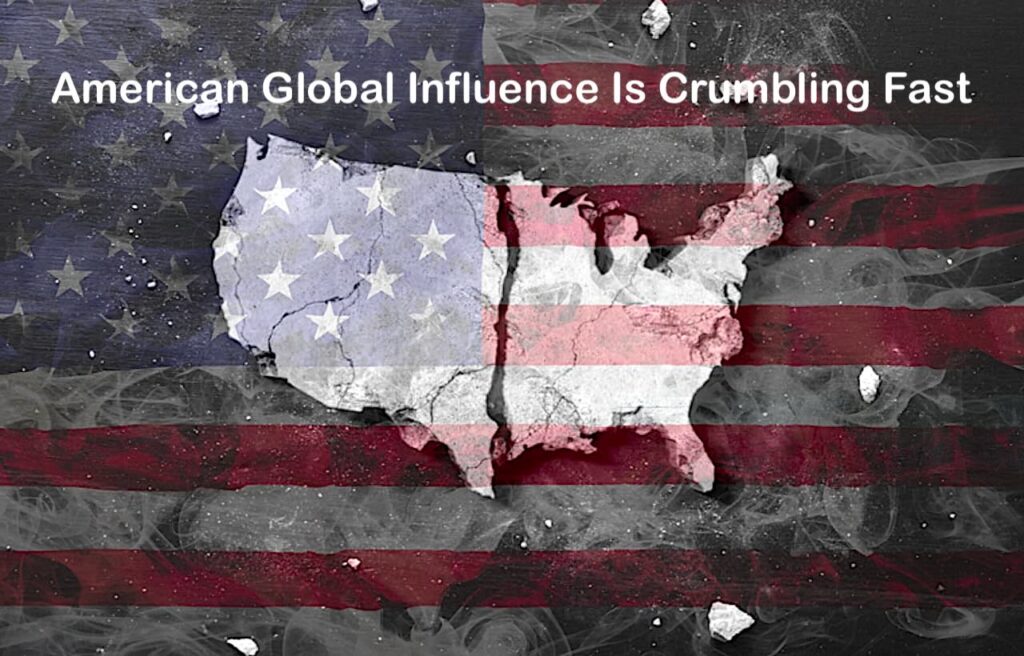
American Global Influence is not collapsing; rather, it is dissolving slowly into a multipolar landscape. The United States remains powerful—militarily, economically, technologically. However, its ability to compel obedience has weakened.
For Washington, this is the strategic challenge of the century.
For the world, it is a rebalancing long in the making.