The IndiGo Meltdown: A Monopoly’s Reckoning and the Skies That Grounded India
The Unprecedented Chaos: IndiGo’s Operational Collapse and Government Crackdown
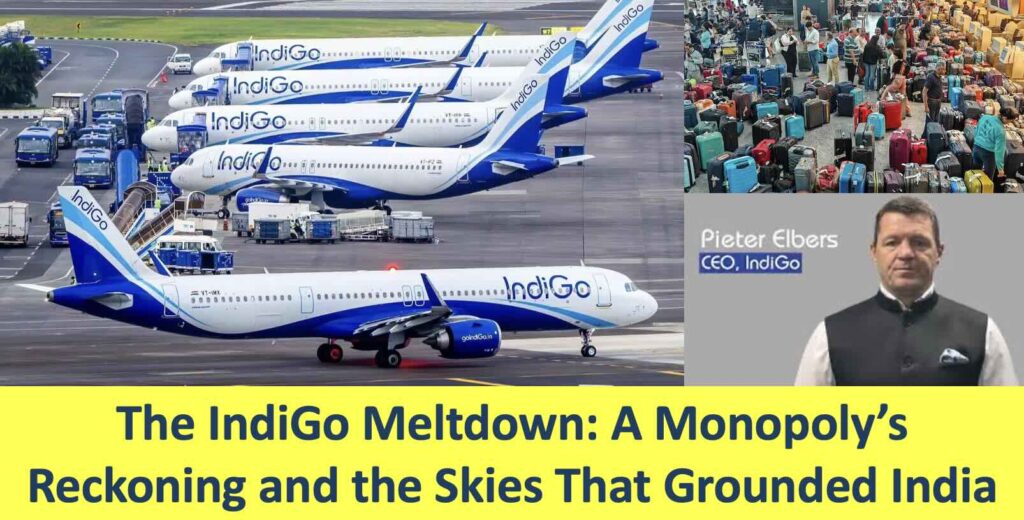
The IndiGo meltdown in early December 2025 paralysed India’s aviation sector on a scale unseen in recent years. What began as routine winter delays escalated into a national crisis when the airline cancelled more than 2,100 flights between 3 and 8 December. On 5 December alone, the carrier scrapped over 1,000 flights, leaving nearly 200,000 passengers stranded at airports during peak travel season. The disruptions created a chain reaction across India’s busiest hubs, with Delhi airport halting all domestic departures until midnight as terminals overflowed with passengers desperate for alternatives.
Grounded Skies and Collapsing Metrics
Mumbai, Bengaluru and Hyderabad witnessed similar distress, with hundreds of flights grounded for two consecutive days. On 6 December, cancellations continued with 124 flights in Bengaluru, 109 in Mumbai, 86 in Delhi, and 66 in Hyderabad, pushing delays beyond 12 hours for many passengers. IndiGo’s on-time performance crashed to 3.7%, a steep fall from its typical 80–90%. Fog, crew unavailability, schedule congestion and technical snags compounded the chaos, exposing structural weaknesses in the airline’s operational backbone.
Government Intervention and Emergency Orders
The Government of India responded with urgency. The Ministry of Civil Aviation and the DGCA issued a series of mandatory relief measures. Airlines had to process full refunds within 72 hours, with a hard deadline of 8 p.m. on 7 December for all pending claims. To protect vulnerable travellers, airlines had to offer meals, accommodations and lounge access for delays exceeding two hours.
To prevent fare gouging by other carriers, the government imposed temporary fare caps:
₹7,500 for routes up to 500 km
₹10,000 for 500–1,000 km
₹15,000 for 1,000–1,500 km
₹18,000 for over 1,500 km
The PMO supervised real-time coordination, even approving a temporary relaxation in Flight Duty Time Limitations (FDTL). Night landing limits were doubled from two to four per pilot until 10 February 2026 to stabilise the system.
A four-member DGCA committee began investigating root-cause lapses. Aviation Minister Ram Mohan Naidu stressed accountability, while CEO Pieter Elbers received a show-cause notice on 6 December demanding explanations for “failure to ensure reliable operations”.
Elbers Under Fire
Elbers, an aviation veteran from the Netherlands, previously led KLM through pre-pandemic expansion and COVID recovery. His time at IndiGo saw rapid scaling and a market share peak of 65%, but critics blame his lean-manpower model for the meltdown. His compensation for FY25 rose to ₹43.2 crore, fuelling public anger during the crisis. He apologised publicly and promised a system “reboot” with normalisation by mid-December.
IndiGo’s Rise: From Startup to Aviation Behemoth
Founded in 2005 by Rahul Bhatia and Rakesh Gangwal, IndiGo redefined low-cost travel in India. It launched operations in August 2006 with a single leased Airbus A320 and soon established a reputation for punctuality and efficiency. By 2025, it commanded 65% market share, unprecedented in Indian aviation.
Ownership, Leadership and Fleet Strength
As of Q2 FY26, promoters held 41.58% of the company, with institutional investors controlling more than half the remainder. The Board, led by Chairman Vikram Singh Mehta, included prominent figures such as Amitabh Kant, Michael G. Whitaker and Air Chief Marshal (Retd.) B.S. Dhanoa.
IndiGo operated a fleet of 418 aircraft, the world’s largest A320 family operator, serving over 137 destinations with 2,300+ daily flights. Financially, it remained strong before the crisis, though Q2 FY26 posted a net loss of ₹2,582 crore due to rupee depreciation.
Unpacking the Root Cause: Monopoly Overreach or Engineered Sabotage?
The meltdown’s core trigger was the enforcement of Phase II FDTL rules on 1 November 2025. These rules mandated longer rest periods and stricter night flying limits to combat pilot fatigue. The DGCA had provided a 20-month window for compliance, yet IndiGo maintained a stagnant pilot workforce. The shortfall became acute when the new rules took effect.
Single Point of Failure
IndiGo’s dominance meant that any internal failure had national consequences. With over 62–65% domestic share and near-monopolistic control of short-haul routes, the airline became a structural bottleneck in India’s aviation ecosystem.
Pilot unions alleged “engineered chaos”, claiming that the airline allowed the situation to worsen to secure regulatory relaxations. A viral internal letter echoed these allegations. Rahul Gandhi accused the government of fostering a “monopoly model”, intensifying the political storm. Public anger spilled online, with demands ranging from CEO dismissal to antitrust action and higher compensation slabs.
Why Criminal Charges Elude Elbers and the Board: Mismanagement vs Malice
Despite the magnitude of the IndiGo meltdown, Indian law limits criminal prosecution unless malice or deliberate endangerment is proven. Existing aviation rules prioritise administrative penalties. DGCA’s investigation focuses on “planning lapses”, not sabotage.
Under the Companies Act, board liability requires proof of collusion or deliberate wrongdoing. Without documentary evidence, criminal prosecution remains unlikely. Historical precedents, including Jet Airways’ collapse, suggest regulatory stress on recovery rather than criminal trials.
Charting Safer Skies: Government’s Roadmap to Avert Future Fiascos
Post-crisis, the government signalled structural reforms. The DGCA review panel will examine FDTL implementation and propose Phase III improvements with AI-enabled rostering. The government may require airlines to maintain 20% crew reserves to prevent future shortages.
Reforms and Structural Checks
The CCI is expected to investigate IndiGo’s dominant position. Measures such as slot-sharing and market-share caps may be considered to prevent monopolistic risks. Other planned interventions include:
- a National Aviation Safety Board for independent investigations
- AirSewa 2.0 for digitised compliance
- a ₹1,000-crore pilot training fund
- potential Joint Parliamentary Committee oversight
- fare stabilisation mechanisms for volatile seasons
If implemented by mid-2026, these steps could strengthen aviation resilience and ensure no airline becomes a national single point of failure again. IndiGo aims for 95% operational restoration by 15 December, a milestone that will test both its recovery strategy and the nation’s confidence in its skies.