Chennai–Vladivostok Corridor Reimagines Indo-Russian Ocean Connectivity
Few expected a shipping route deep in the Indian Ocean to become one of the most talked-about strategic links after President Vladimir Putin’s December 2025 visit to India. Yet the Chennai–Vladivostok Corridor, also known as the Eastern Maritime Corridor (EMC), has re-emerged with a mix of curiosity, strategic intrigue, and economic ambition. The route, stretching across the Indo-Pacific, has suddenly become a central pillar in India and Russia’s race to reach $100 billion bilateral trade by 2030.
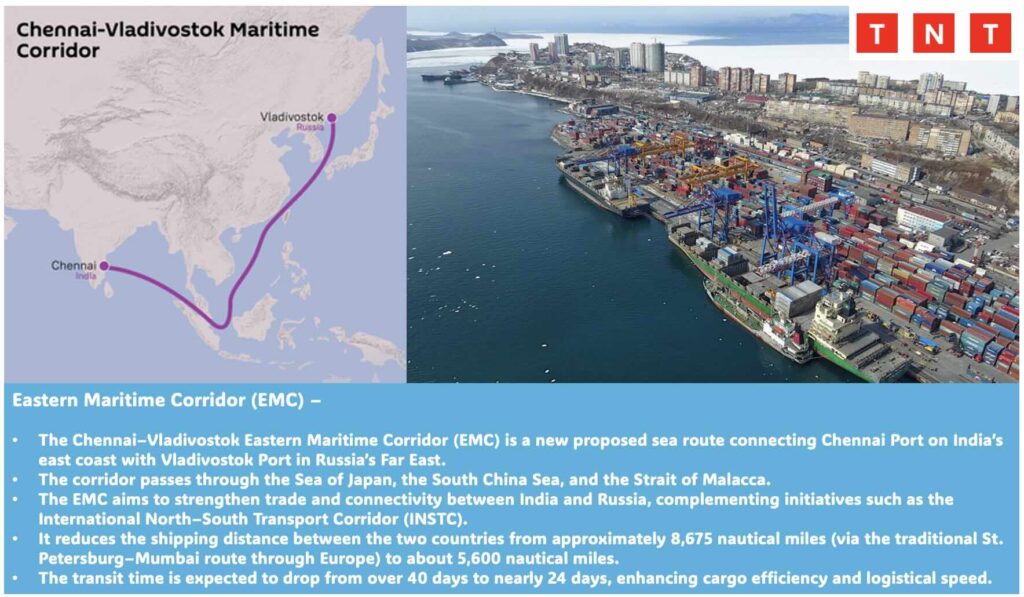
At the heart of the renewed attention lies the simple fact that the EMC transforms a once-tedious forty-day journey through the Suez into a swift 24-day passage. This efficiency shifts freight dynamics across the Indian Ocean, enabling both nations to bypass congestion hotspots and geopolitical choke points.
The Ocean Route That Cut Transit Time Nearly in Half
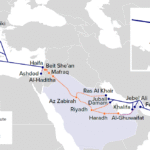
Operational since November 2024, the Chennai–Vladivostok Corridor spans about 5,600 nautical miles (10,300 km). It connects Chennai Port on India’s eastern coast with Vladivostok in Russia’s Far East through the Sea of Japan, East China Sea, South China Sea, Malacca Strait, and Bay of Bengal.
This corridor supports the movement of coal, crude oil, fertilisers, machinery, metals, textiles, and food products. The reduction of transit time from more than 40 days to nearly 24 days lowers shipping costs and improves supply-chain reliability.
Indian and Russian officials have underscored its value, especially as global shipping lines continue to face turbulence caused by Red Sea attacks, Suez delays, and rising insurance costs.
Trade Ambitions and the Push Toward $100 Billion
In the last fiscal year, India–Russia trade touched nearly $70 billion, though heavily tilted by India’s discounted oil imports. During the 23rd Annual Summit in New Delhi on 4–5 December 2025, leaders agreed that connectivity projects must be accelerated to meet the $100 billion trade target before 2030.
The Chennai–Vladivostok Corridor, along with the International North-South Transport Corridor (INSTC), the Chabahar port, and emerging Arctic routes, forms the logistical backbone of this effort. Prime Minister Narendra Modi also highlighted a forthcoming “virtual trade corridor” that uses digital customs tools to fast-track documentation and reduce delays.
Russia echoed this priority. Kremlin spokesman Dmitry Peskov called the EMC a “key project”, while Russian ministries suggested faster integration of Pacific ports with India’s east coast hubs.
Operational Momentum: Cargo Surge and Possible Expansion
FY25 recorded a notable surge on the EMC route. Coal shipments rose by 87%, and crude oil increased by 48%, reflecting the shift away from longer routes.
India and Russia are already considering expanding the corridor to include Visakhapatnam and Kolkata on the Indian side, as well as Vostochny and Olga in Russia. Additionally, there is interest in introducing commercial stops in Vietnam, Thailand, and Indonesia.
However, Vladivostok’s severe winter icing remains a seasonal challenge. Container imbalance, especially during peak months, requires joint fleet planning and possible Indian investments in the Russian Far East’s maritime terminals.
Strategic Significance: From Energy Security to Far East Diplomacy
Beyond trade, the EMC strengthens India’s Act Far East Policy and enhances New Delhi’s long-term energy security. At the same time, it supports Russia’s vision to integrate the sparsely populated but resource-rich Far East with major Asian economies.
India and Russia signed complementary agreements covering polar seafarer training, shipbuilding cooperation, and nuclear technologies. These align with the corridor’s wider strategic ecosystem, which connects commercial and defence logistics.
Consul General Siddarth Gowrav’s Timely Intervention
India’s Consul General in Vladivostok, Siddarth Gowrav, spoke to TASS on 06 December 2025 where he emphasised that the EMC is essential to reaching the $100 billion trade mark on schedule. His comments gained traction across Indian and Russian media, especially as they followed the high-profile Modi–Putin summit.
Gowrav, an IFS officer fluent in Russian and trained in engineering and management, has played a pivotal role since assuming charge in February 2024. He argued that the corridor brings measurable savings for exporters and enhances predictability for import-dependent sectors.
RELOS Ratification Adds a Strategic Layer to the Maritime Corridor
Just two days before Putin’s arrival in Delhi, Russia’s State Duma ratified the Reciprocal Exchange of Logistics Support Agreement (RELOS). The timing amplified the corridor’s strategic relevance.
RELOS allows reciprocal access to over 40 Russian naval and air bases, including Vladivostok, for Indian forces during humanitarian missions, training, and repairs. In return, Russian forces gain logistics support at Indian facilities, although this does not include permanent bases.
For Russia, this provides a rare opportunity for a warmer-water presence in the Indian Ocean—an area through which nearly 70% of India’s trade passes. For India, it enables extended reach into the Russian Far East and the Arctic. The EMC complements this by offering the commercial backbone to these emerging defence linkages.
Why the Corridor Now Stands at the Centre of India–Russia Relations
The Chennai–Vladivostok Corridor symbolises a new phase in India–Russia relations, where connectivity, logistics, and ocean routes matter as much as defence and energy. The Modi–Putin summit, the RELOS ratification, and Gowrav’s interview collectively placed the corridor at the heart of both economic ambition and maritime strategy.
As global routes remain volatile, this Indo-Pacific link offers stability, speed, and strategic depth—reshaping India’s Indian Ocean footprint and giving Russia a more reliable Asian gateway.