FIFA Peace Prize to Trump Sparks Neutrality Backlash
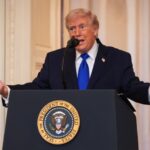
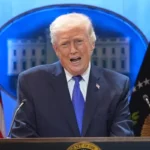
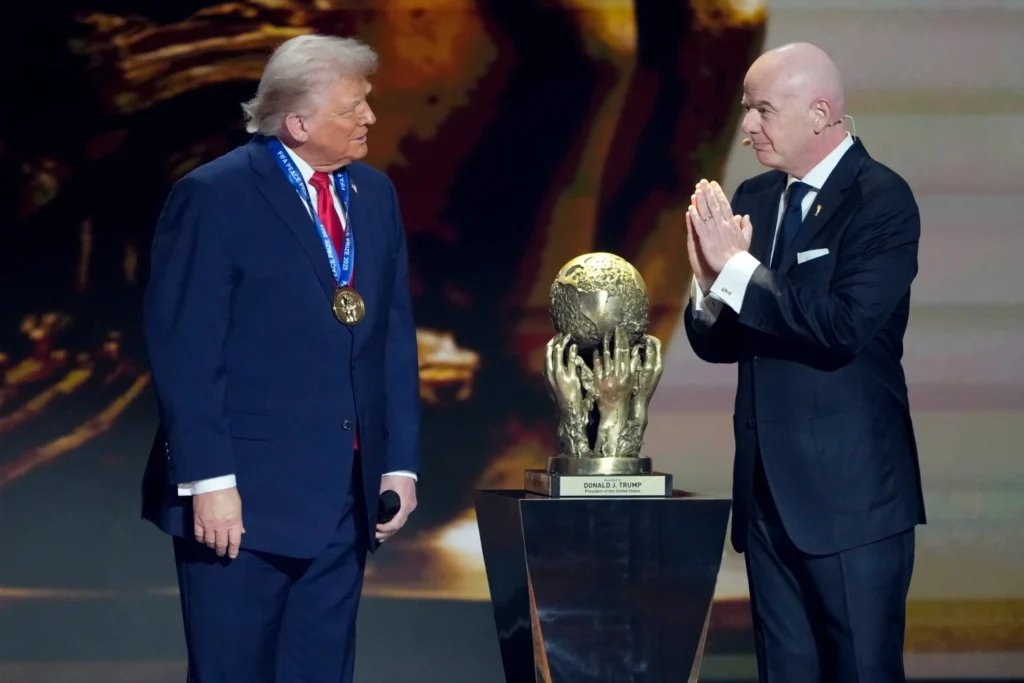
FIFA President Gianni Infantino’s decision to present the inaugural FIFA Peace Prize to U.S. President Donald Trump has sparked a wave of global criticism, reviving long-standing concerns about FIFA’s claims of political neutrality. The award was presented during the 2026 World Cup draw in Washington, D.C., where Trump received a gold-plated trophy featuring two hands lifting a globe, a medal, and a certificate praising his supposed contributions to global de-escalation. The gesture aligned with Infantino’s praise of Trump as a “close friend” and a leader committed to peace and unity.
Global Concerns Over FIFA’s Political Neutrality
The announcement immediately triggered reactions from human rights advocates, football analysts, and former FIFA officials. They argued that the decision contradicted FIFA’s long-established neutrality rules, which restrict political expression unless directly tied to football activities. Critics stated that awarding the FIFA Peace Prize to a sitting U.S. President with a divisive global image demonstrated a selective interpretation of neutrality principles.
Human Rights Watch remarked that Trump’s record on civil liberties and human rights did not align with the ideals of peace or humanitarian leadership. According to the organisation, this award undermined FIFA’s credibility by appearing to legitimise contentious foreign policies. Meanwhile, longtime UN human rights investigator Craig Mokhiber described the move as “vulgar”, adding that presenting a peace award to a leader criticised for his stance on Gaza risked trivialising human rights concerns.
Football journalist Zach Lowy also questioned the decision. Through a widely shared online commentary, he compared it to honouring a player known for violent conduct with a prize for good behaviour, using satire to underline perceived absurdities in the decision.
Questions Over Governance and Process Transparency
Internal concerns within FIFA added to the external criticism. Several FIFA Council members expressed surprise, as many had reportedly learnt of the peace prize through the organisation’s press release rather than through internal consultation. This fuelled criticism that Infantino acted unilaterally, bypassing governance norms and eroding accountability.
Observers also noted that FIFA had offered no detailed explanation of the selection criteria or the committee responsible for choosing Trump. The lack of transparency in the process raised further doubts about whether the prize was conceived independently or shaped by political interests.
Strategic Timing Amid the 2026 World Cup Preparations
The timing of the award is particularly significant. The United States, along with Mexico and Canada, will co-host the 2026 World Cup, the largest edition in the tournament’s history. Infantino has made multiple visits to the White House in recent months, citing logistical planning, security arrangements, and infrastructure coordination.
Analysts argue that awarding the FIFA Peace Prize at this juncture strengthens FIFA’s relationship with the host country’s leadership. However, they caution that the move risks creating the perception that major political figures may receive favourable treatment in exchange for supporting FIFA’s operational interests. Critics claim that such actions blur the line between necessary diplomatic engagement and political endorsement.
Trump, while accepting the prize, called it one of the “greatest honours” of his life. He claimed that his administration had prevented possible conflicts in regions such as Congo, Ukraine, and South Asia. However, international commentators pointed out that several of these claims lacked verifiable evidence, further intensifying debate around the award’s validity.
Broader Implications for Football’s Global Image
The backlash highlights a wider set of concerns regarding football governance. FIFA, historically associated with corruption scandals, has attempted to rebuild its reputation under Infantino. Yet critics argue that decisions such as the FIFA Peace Prize undermine these efforts and deepen scepticism about the politicisation of football governance.
Experts warn that such awards risk alienating global fanbases, especially in regions affected by conflict or human rights violations linked to the policies of the award recipients. Observers also note that FIFA’s increasing entanglement with political figures may complicate its standing as a neutral global sporting body.
Football regulators, advocates, and fans continue to question why a sport that claims political neutrality repeatedly finds itself embroiled in politically sensitive controversies. The latest episode, they argue, reinforces perceptions that FIFA’s leadership selectively interprets neutrality when it serves institutional or strategic objectives.
The global conversation around the FIFA Peace Prize is expected to intensify as the 2026 World Cup approaches, particularly if more details emerge regarding the decision-making process behind the award. For now, the controversy has once again positioned FIFA at the centre of a debate about integrity, transparency, and political influence.